Seoul's latest robot fashion show looked like spectacle, but it was really a live test of whether embodied AI can feel normal, stylish, and commercially useful.
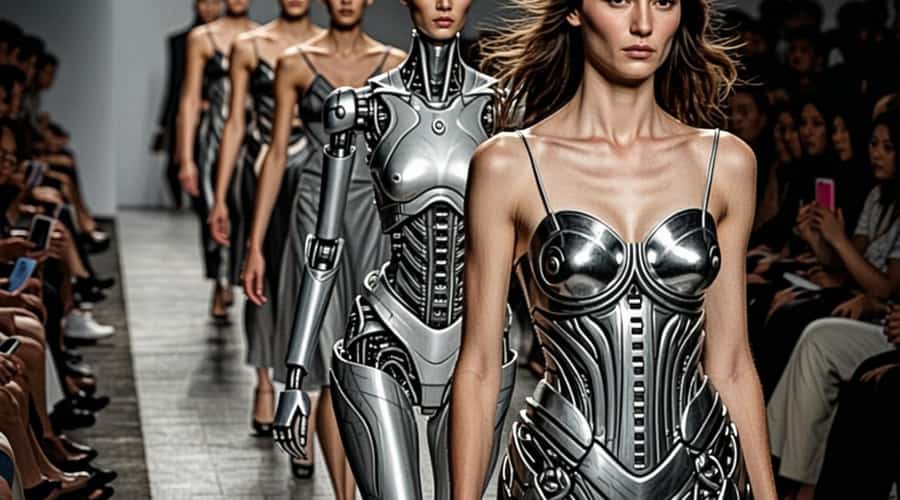
That is why the images from Galaxy Corporation's runway traveled so quickly. According to Reuters, robots and human models walked in matching outfits in Seoul on May 28 as part of a "physical AI" fashion show built around the idea of human and robot coexistence. The event was hosted by South Korean entertainment technology company Galaxy Corporation, and the company framed it as a glimpse of a future in which robots are companions rather than replacements. On the surface, it was easy to read the show as novelty. Look a little closer, though, and it becomes clear that Galaxy was trying to do something more ambitious, which is to make robotics feel less like industrial hardware and more like a cultural product people may eventually pay to watch, wear, and live alongside.
That distinction matters. Software has already slipped into daily life so completely that most people barely notice it. Physical AI is different because it asks the public to share space with machines that move, gesture, and perform. Fashion is a smart place to test that discomfort because runway culture has always rewarded exaggeration, theater, and future-facing ideas. If a humanoid robot can look natural under stage lights next to a human model, the sales pitch for robots in entertainment venues, retail spaces, and public attractions becomes a little easier to make.
The show itself was built to push that message hard. South Korean reports identified the event as the "MACH33 : Physical AI Fashion Show," held on May 28 at Galaxy Robot Park in Seoul's Gangdong district. AFP's coverage added useful detail: the lineup included pairs of humans and humanoids in coordinated looks, from a blue Western-style outfit with a cowboy hat to a silver puffer and other deliberately futuristic pieces. According to AFP, Galaxy said the clothes were designed in-house and could be launched under the MACH 33 brand later this year, which turns the runway from a one-off media moment into an early product signal.
That commercial angle is the real story. A robot walking a runway is interesting for a day. A company trying to build a fashion label, an entertainment format, and a public venue around robots is a much bigger bet. Some of the robot models appeared to be humanoids from Chinese startup Unitree, AFP reported, which also shows how quickly this space is becoming international, modular, and media-driven rather than confined to pure research labs. In other words, the hardware may come from one part of the market, the choreography from another, and the brand value from whoever best understands attention.
The performance format reinforced that point. Video coverage of the show described synchronized movement between the human and robot pairs, with Galaxy positioning the event as a vision of emotional and creative coexistence rather than a demonstration of technical superiority. That is a subtle but important shift. For years, robotics demos have asked viewers to admire what machines can do. This show asked viewers to imagine what machines might mean, which is a very different question and a much harder one to answer.
Why Seoul fits
Seoul is not a random backdrop for that experiment. Euronews and Yonhap reported earlier this month that Galaxy Robot Park opened in eastern Seoul as a robot-themed entertainment venue, spanning about 16,500 square metres and featuring humanoid performances, family attractions, and a central robot arena. The company said the park officially opens in August 2026 and plans to host more than 1,000 robot performances a year, which makes the fashion show look less like an isolated stunt and more like a launch strategy for a larger consumer business. Galaxy's connection to K-pop also matters here, because the company is closely associated with artist G-Dragon and is clearly trying to fuse robotics with the performance logic that already drives Korean entertainment exports.
There is also a broader national backdrop. One report on the fashion show noted that South Korea is accelerating investment in robotics and AI, and that gives companies a reason to move beyond engineering circles and prove there is public appetite for robot-centered experiences. That is the missing bridge in much of the AI conversation right now. We talk a lot about model capability, compute, and infrastructure. But mass adoption also depends on taste, trust, and social comfort. A runway cannot solve that on its own, yet it can make the unfamiliar feel a little less alien.
That is why this show deserves more attention than a viral clip usually gets. Galaxy is effectively betting that the next phase of AI will not live only on screens. It will appear in parks, concerts, stores, and branded experiences where people decide very quickly whether a machine feels useful, entertaining, awkward, or unsettling. If the company follows through on a MACH 33 launch later this year and turns Galaxy Robot Park into the high-frequency venue it is promising, Seoul's robot catwalk may end up looking like an early prototype for a new kind of consumer business, one where culture does the work that engineering alone cannot.
Also read: The CFTC just admitted it made a mistake on Gemini • Claude Opus 4.8 just made honesty a market advantage • Anthropic Closes $65B Round at $965B Valuation as Claude Opus 4.8 Launches