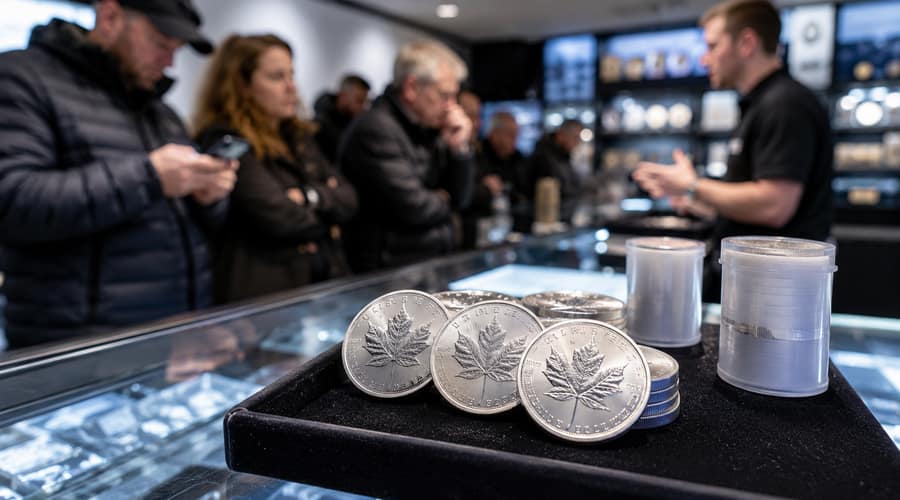
A 100-ounce Maple Leaf purchase is a small story, but it captures a much bigger one: physical silver buyers are still paying up for trusted coins while spot prices remain elevated.
A silver stacker walking out of Bullion Exchanges in Manhattan with 100 ounces of Canadian Maple Leafs on Friday is not the kind of trade that moves futures markets. But it does show what retail demand looks like when silver is no longer cheap, premiums still matter, and buyers are becoming more selective about what they carry home.
The post, shared on Reddit's Silverbugs forum on Saturday, described a purchase of 100 ounces of Maple Leaf silver on May 29, with the buyer saying he was now up to roughly 160 ounces accumulated in 2026 alone. That is an individual anecdote, not a demand report. Still, it lands because the math has changed. At current prices, 100 one-ounce coins are no casual impulse buy. They are a several-thousand-dollar allocation into a metal that many investors still view as both a store of value and a leveraged bet on industrial demand.
Silver was trading around $75 an ounce late on May 29, with GoldPrice.org showing a May 29 spot silver price of $75.09 an ounce near the New York close. That puts the melt value of 100 ounces at roughly $7,500 before dealer premiums, shipping, tax, or payment method differences. For a sovereign coin such as the Royal Canadian Mint's Silver Maple Leaf, the final ticket is usually higher because buyers are not only paying for silver content. They are paying for recognition, liquidity, anti-counterfeiting features, and the comfort of owning a government-issued coin that dealers know instantly.
The clearest way to understand the retail market is not only to watch spot. It is to watch the spread between spot and finished products. FindBullionPrices showed 500-ounce Silver Maple Leaf monster box listings in late May ranging from just above $39,000 to more than $40,000 depending on dealer, date, and payment method. That works out to roughly the high-$70s to low-$80s per coin, or a premium of several dollars an ounce over melt value on the listings shown.
That premium is the market's quiet language. When it widens, buyers are competing for finished product, dealers are protecting inventory, or mints and wholesalers are not feeding enough supply into the channel. When it narrows, demand is softer or product is easier to source. Silver investors often talk about spot as if it is the whole story, but anyone buying physical coins learns quickly that the usable price is what a dealer will actually sell for and later buy back.
Canadian dealer quotes show the same pattern from another angle. Recent Gold Stock Canada listings put one-ounce Silver Maple Leafs above C$100, while U.S. retail listings from major online dealers have also shown Maple Leafs trading well above melt value. Those are not identical markets, and they are not directly comparable to a New York purchase because currency, local supply, and dealer model all matter. But together they show a physical silver market where Maple Leafs are trading as a branded product, not just a metal disk.
That distinction matters for ordinary investors. A 100-ounce bar will usually offer a lower premium per ounce than 100 individual coins. The tradeoff is flexibility. Coins are easier to sell in smaller lots, easier to verify for many buyers, and often more attractive in peer-to-peer markets. Bars are efficient. Coins are liquid in a different way.
The retail crowd is still buying dips
What makes the May 29 purchase interesting is timing. Silver has already had a volatile 2026, including a sharp spike earlier in the year and a retreat back toward the mid-$70s. A buyer adding 100 ounces here is not buying forgotten metal at bargain-bin prices. He is buying after a major repricing, which suggests the retail thesis has shifted from cheap accumulation to long-term scarcity, monetary hedge, and industrial demand.
That psychology is visible across the retail silver community. Recent BullionStats tracking shared on Reddit showed one-ounce Canadian Silver Maple Leaf products among the APMEX items with measurable movement during late May, alongside generic rounds, 10-ounce bars, 100-ounce bars, Silver Eagles, and kilo bars. The exact figures are narrow and platform-specific, but the mix is useful. Buyers are not only chasing the lowest possible premium. They are spreading money across recognizable sovereign coins and efficient bullion formats.
For dealers, that creates a good but demanding market. High prices can slow casual buying, yet they also pull in customers who want products with strong resale value. Maple Leafs benefit from that environment because they sit in the middle of the retail bullion stack: cheaper than many collectible issues, often lower premium than American Silver Eagles, and far more trusted than unknown private rounds.
For investors, the lesson is simpler. A 100-ounce Maple Leaf purchase is not just about conviction on silver. It is about execution. The buyer has to compare the premium, think about storage, understand the local tax treatment, and know the likely buyback spread before assuming a spot-price move will translate into profit.
The next thing to watch is whether premiums hold if silver stays near current levels. If spot rises and Maple Leaf premiums remain firm, that would suggest physical demand is absorbing higher prices. If premiums compress, the market may be telling buyers that enthusiasm is still there, but not at any price. In silver, that small difference can decide whether a stack feels like protection or an expensive habit.
Also read: Singapore's new silver futures contract challenges COMEX's grip on global price discovery • Samsung ships HBM4E samples ahead of SK Hynix • Meta's subscription push shows the next phase of social monetization