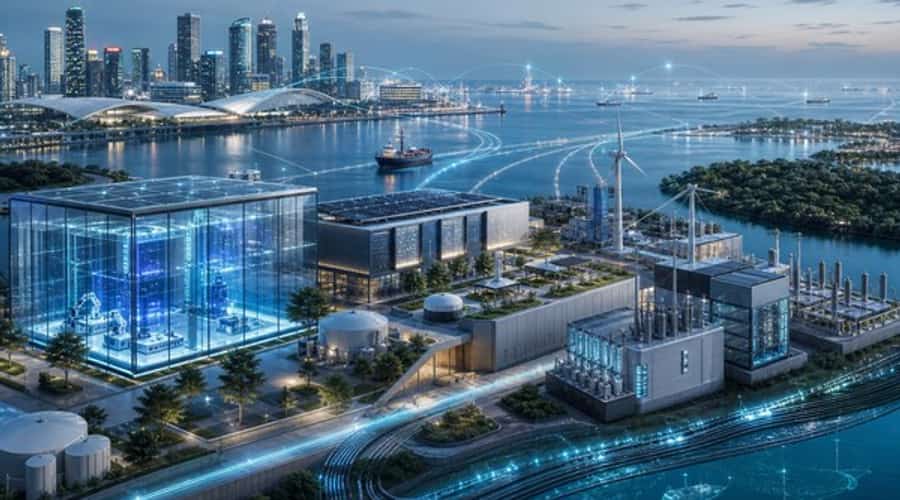
Singapore is trying to turn AI into a practical economic advantage, not a slogan. The harder part is making sure the energy, talent and trust infrastructure can keep up.
Singapore's latest growth plan is a clear signal to the world's biggest AI companies: the city-state wants them to do more than open regional offices. It wants them to anchor serious activity there, bring talent with them, and help turn the country into a trusted place where artificial intelligence is developed, tested and deployed.
That is the strongest message from the Economic Strategy Review committees, which released 32 recommendations on May 13 after about nine months of work. According to Reuters, the committees told the government that Singapore must attract leading AI firms while also building on its position as a major energy hub, a pairing that says a lot about where the next phase of competition is heading.
AI is not just a software story anymore. It is a capital, power, talent and regulation story. Countries that want to win the next round need data infrastructure, reliable electricity, credible governance and a workforce that can actually use the tools being introduced. Singapore understands this better than most because it has never had the luxury of competing on size.
Deputy Prime Minister and Minister for Trade and Industry Gan Kim Yong framed the review as a longer-term exercise, not a response to one bad quarter or one geopolitical shock. CNA reported that five ESR committees submitted their recommendations after engaging more than 7,700 stakeholders, including businesses, unions and workers. That matters because the AI transition will fail quickly if it is designed only for investors and not for the people expected to work inside it.
The recommendation to become a trusted AI hub is carefully chosen. Singapore is not pretending it can outspend the United States or China on the largest frontier models, nor can it host the world's biggest data centres without hard physical limits. Land is scarce. Power is constrained. The domestic market is small. So the better strategy is to become the place where companies can test, govern and scale AI systems with confidence.
That means attracting AI companies and talent, but also shaping rules around data governance, safety, cross-border use and enterprise adoption. For a bank, logistics firm or healthcare group, trust is not a nice extra. It determines whether AI can move from pilot projects into core operations.
The committees also pointed to the need for leading firms to become champions of AI and for adoption to spread across the economy. A country does not become more productive because a few multinational companies build impressive labs. It becomes more productive when small clinics, manufacturers, finance teams and logistics operators use the tools well enough to change how work gets done.
CNA highlighted one example from Yong Kang TCM Clinic, which used a generative AI chatbot for customer engagement. The company said response times improved from around 30 minutes to under five minutes, while bookings rose 20 percent. That is not the flashiest AI use case, but it is exactly the type of improvement that matters. It saves time, raises service quality and lets staff move toward higher-value work.
The Energy Question Comes Next
Singapore's AI plan cannot be separated from its energy strategy. More advanced computing needs more reliable power, and the global race for AI infrastructure is already forcing governments to think harder about grids, gas, renewables and future fuels. The committees recommended that Singapore build on its energy hub status by developing capabilities in liquefied natural gas trading, hydrogen, ammonia and sustainable aviation fuels.
This is not just about keeping the lights on for data centres. It is about keeping Singapore relevant in the flows that matter to business. For decades, the country turned its port, airport and financial system into strategic advantages. Now it has to do the same with energy transition markets and digital infrastructure.
The timing is awkward, but that is the point. Geopolitical tension, including the Iran war referenced in the Reuters report, threatens growth and raises inflation risks. Energy markets, shipping routes and supply chains can no longer be treated as background conditions. For a hub economy, disruption elsewhere becomes a domestic business problem very quickly.
Singapore's answer is to sharpen its value proposition. The committees urged the country to persuade leading industries to anchor there, building on existing strengths in semiconductors, advanced manufacturing, aerospace and satellite systems. They also identified quantum and space technologies as promising sectors. These are not random bets. They sit close to capabilities Singapore already has, which gives the country a better chance of turning policy ambition into commercial activity.
The harder task will be execution. Attracting AI giants is one thing. Making sure local firms benefit from their presence is another. Singapore will need enough skilled workers, enough growth capital for startups, enough room for companies to restructure, and enough trust in the system for businesses to deploy AI without creating new risks they cannot manage.
There is a useful lesson here for every small, open economy. AI policy cannot live in a technology ministry alone. It touches industrial strategy, energy security, workforce training, investment promotion and trade. Singapore's latest recommendations recognize that reality, which is why they deserve attention beyond the city-state itself.
What comes next is the government's translation of the review into action. If Singapore can connect AI adoption with credible governance and energy resilience, it will not need to be the biggest player in the AI race. It only needs to become one of the hardest places for serious companies to ignore.
Also read: Amazon puts Alexa+ in the shopping search bar. • Alibaba bets on full-stack AI to reshape its future • Figure AI will test humanoid autonomy in an eight hour livestream