Skyroot Aerospace has done the thing India's private space sector needed most: it put hardware in orbit, not just ambition on a slide deck.
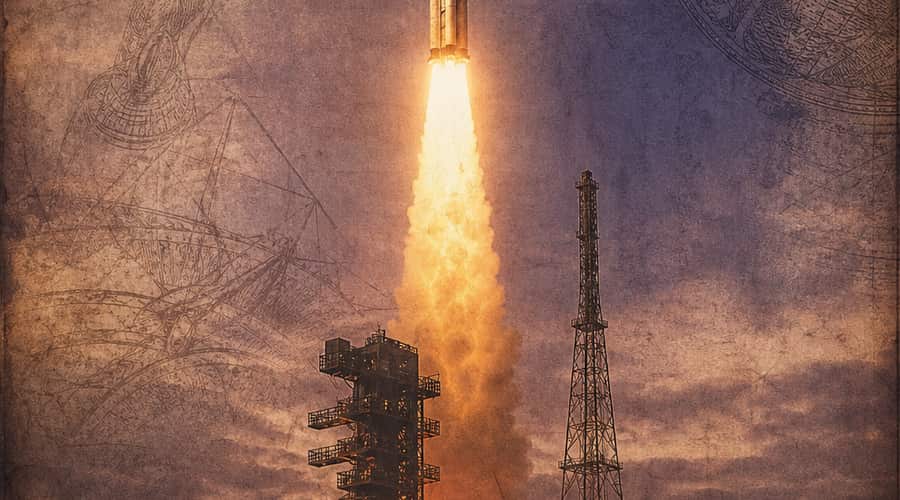
On July 18, the Hyderabad based startup launched Vikram-1 from the Satish Dhawan Space Centre in Sriharikota, and the rocket deployed customer payloads into a 450 kilometer low Earth orbit. It worked. Al Jazeera, citing AFP and Reuters, reported that the flight made India the third country, after the United States and China, to reach orbital launch capability through private enterprise.
That is a real milestone, so don't flatten it into startup theater. Skyroot named the mission Aagaman, Sanskrit for arrival. The name is a little obvious, but fair enough. A private Indian rocket had just left ISRO's spaceport and reached orbit with payloads on board, which is exactly the arrival India's space reforms were meant to produce.
Space.com reported before the launch that Vikram-1 was a seven story vehicle built to place multiple payloads into a 450 kilometer orbit, including hardware from Skyroot, German company DCUBED, Indian startups Grahaa Space and Cosmoserve Space, and symbolic payloads from Cosmos Diamonds and artist Ajay Kumar Mattewada. Al Jazeera reported after the flight that the rocket also carried experimental equipment, a lab grown diamond, and a miniature 18 carat gold sculpture commemorating India's national space program. That's a strange mix. It is also a useful one, because orbital test flights need paying customers, technical validation, and spectacle in roughly that order.
The rocket itself is not just a larger version of Skyroot's earlier work. Vikram-1 uses three solid fueled lower stages and a restartable liquid fueled upper stage, according to Space.com. That restart capability matters. It gives the rocket the final control needed to place small satellites exactly where customers want them. Al Jazeera described the vehicle as 22 meters tall, capable of carrying up to 350 kilograms to low Earth orbit. Modest numbers, by global standards. But small satellites don't need a Falcon 9 every time. You need the right ride, at the right cadence, at a price that makes sense.
This also isn't Skyroot's first flight. The company, founded in 2018 by former ISRO engineers Pawan Kumar Chandana and Naga Bharath Daka, launched the suborbital Vikram-S from ISRO facilities in November 2022. Vikram-1 is the harder test. Getting above the atmosphere is one thing. Reaching orbit, deploying payloads, and then doing it again for customers is the business.
Real Money Is Now Riding On Repeat Flights
You don't get this far without money, and Skyroot has raised plenty of it. Bloomberg reported in May that the company became India's first space tech unicorn after securing $60 million from GIC and Sherpalo Ventures, with funds managed by BlackRock also participating. The round lifted Skyroot's valuation to $1.1 billion and took total capital raised to about $160 million, according to the company statement cited by Bloomberg. Inc42's funding tracker puts the total at just over $155 million. Either way, this is no longer a science project with a nice pitch deck.
Frankly, that valuation only makes sense if Vikram-1 becomes a repeatable service. One launch gets you headlines. Customers pay for something else: reliability, insurance comfort, scheduling discipline, and a rocket that doesn't turn every payload booking into a national event. Chandana has said Skyroot plans more development flights before full commercial operations. Service is targeted for 2027. That's a narrow window to prove this was not a perfect one off.
Skyroot isn't racing alone. Pay attention to the shape of the field. Agnikul Cosmos, based in Chennai, has been developing Agnibaan and has already tested a single piece, 3D printed engine architecture. Bellatrix Aerospace is working on something different: in-space propulsion, including an orbital transfer vehicle called Pushpak. These companies aren't all trying to become the same company. Good. India's private space market will be stronger if launch, propulsion, satellite movement, and manufacturing mature together, rather than waiting for one national champion to do everything.
Policy Did Its Job, Now The Market Has To
None of this happened in a vacuum. India opened more of its space sector to private companies in 2020 and created IN-SPACe to let firms use ISRO infrastructure and technical support. Six years later, Sriharikota hosted an orbital rocket that ISRO did not build or fly. That is the point of the reform.
The next test is less dramatic and more important. Skyroot has to turn a successful July 18 launch into a schedule customers can trust. SpaceX needed four Falcon 1 attempts before reaching orbit in 2008, so Skyroot's first orbital success is unusually clean. But launch companies are not judged only by their first good day. They're judged by the second flight, the third, and the boring operational rhythm after that.
For founders and investors, that's the useful lesson here. India's private space sector has crossed from permission into proof, but proof is not yet a business model. Vikram-1 reached orbit. Now Skyroot has to make orbit look routine.
Also read: Kioxia Loses $229 Million Patent Fight With Viasat as Shares Crash in Tokyo • Ant, Tencent, Alibaba and Baidu Race to Build China's Enterprise AI Agents • David Sacks Says US AI Safety Rules Let China's Kimi K3 Win on Security Fixes