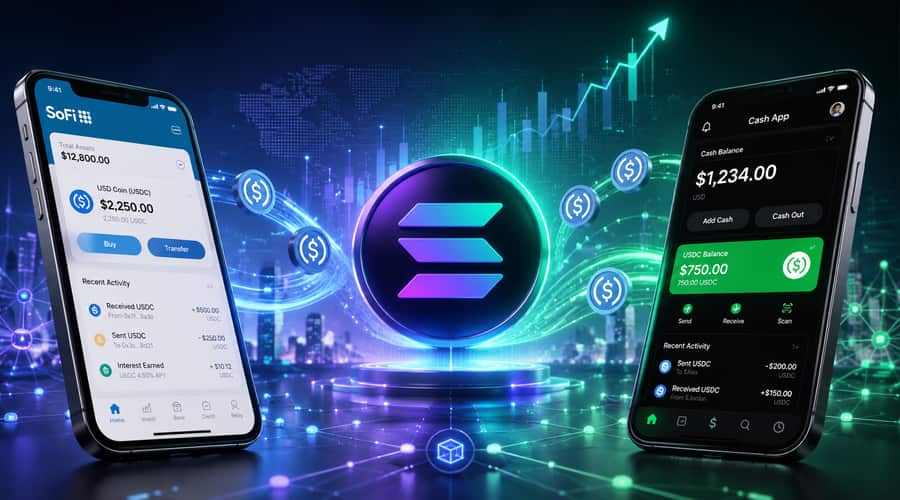
Solana just picked up two serious consumer finance signals at once, with SoFi and Cash App putting dollar-pegged payments in front of mainstream users.
Stablecoins have spent years being described as the next payment rail. This week, that idea moved closer to ordinary financial apps. SoFi is putting its own bank-issued SoFiUSD inside its banking platform, while Cash App is letting eligible customers send and receive USDC across several networks, including Solana.
The important part is not that another token exists. Crypto has plenty of those. The important part is distribution. SoFi says it has nearly 15 million members, and Cash App says 59 million customers transact on the platform each month. When platforms of that size add stablecoin support, the test shifts from whether blockchain payments can work to whether people will use them without thinking about blockchains at all.
SoFi's move is the more bank-like of the two. The company announced on May 27 that SoFiUSD, issued by SoFi Bank, N.A., is available for members to buy, sell, hold and convert directly in the SoFi app. The token is redeemable 1:1 for dollars and is available on Ethereum and Solana, with SoFi presenting the launch as the first time a U.S. national bank-issued stablecoin has been made available directly on a banking app.
Cash App is taking a different route. It is not issuing a new dollar token. It is supporting USDC, the Circle-issued stablecoin, on Solana, Ethereum, Polygon and Arbitrum. As Cash App said in its May 27 announcement, stablecoins in the app automatically convert to U.S. dollars, so users see one unified balance rather than managing a separate stablecoin wallet.
For Solana, the timing matters. PayPal added PYUSD to Solana in 2024 to get faster and cheaper transactions for commerce. Stripe has also been moving deeper into stablecoin infrastructure through acquisitions and product work, adding more pressure on payment companies to choose chains that can handle low-cost, high-frequency transactions.
That is where Solana wants to be judged. Ethereum still has the largest institutional history and the deepest settlement brand in crypto, but payments are not only about brand. They are about cost, speed, throughput and the ability to hide complexity from the user. If sending a stablecoin feels slower or more expensive than sending money through an app, the product has already lost.
SoFi and Cash App are not identical endorsements of Solana. SoFiUSD is also on Ethereum. Cash App supports four networks. These companies are keeping optionality, which is exactly what serious financial platforms tend to do. Still, Solana being in the first group for both launches tells the market something. It is no longer being treated only as a trading chain or an NFT chain. It is being treated as a consumer payments rail.
That creates a different kind of competition among layer-one networks. The winning chain for stablecoin payments may not be the one with the loudest community or the highest speculative activity. It may be the one that large apps can plug into while users barely notice the chain underneath. This is where infrastructure either becomes boring enough to matter, or remains too visible to scale.
Regulation is pushing stablecoins into the mainstream
The U.S. regulatory backdrop is also changing the conversation. Stablecoin rules under the GENIUS Act are moving through implementation, with regulators defining how permitted issuers, reserves, redemption rights and compliance standards should work before full effectiveness. That makes launches from bank and fintech platforms more than product experiments. They are positioning moves before the market settles into a clearer legal structure.
SoFi has an obvious reason to move early. A bank-issued stablecoin lets it argue that digital dollars can sit closer to regulated banking than offshore crypto markets. That does not remove every risk. Public blockchains are still open networks, transfers can be irreversible, and regulators will keep paying close attention to consumer protections. But the structure gives SoFi a cleaner story than many earlier stablecoin projects had.
Cash App's approach may prove just as important because it lowers the learning curve. Users do not need to decide whether they want to hold USDC as a separate asset. They can send and receive value while the app handles conversion into dollars. That sounds simple, but simple is what mainstream payments require. Most people do not care which network settles a transaction. They care whether the money arrives, what it costs and whether they trust the app.
The bigger question now is volume. Announcements are easy to count. Payment behavior is harder to change. If stablecoins inside SoFi and Cash App become mostly a deposit and withdrawal feature for crypto users, the impact will be limited. If they start supporting remittances, merchant settlement, creator payouts and app-to-app transfers, the infrastructure story becomes much larger.
That is what investors and builders should watch next. Solana has gained another credible opening into mainstream finance, but the market will judge it by usage, reliability and whether fintech companies keep expanding stablecoin utility beyond the first launch screen. The chain has won attention. Now it has to win routine payment flow.
Also read: Strategy's Bitcoin bet is becoming a governance test • Arcium moves encrypted computation on Solana past the testnet • Solana's SOL burn proposal puts validator economics under pressure