Solana's official nod to Pudgy Penguins was more than a playful post, it was a reminder that meme-native brands can still move attention, liquidity, and community energy when the chain itself decides to lean into the joke.
Crypto loves to pretend it has outgrown memes right before another meme proves it has not. Solana's early-morning post spotlighting Pudgy Penguins did exactly that. It took a project that started as an Ethereum NFT collection in 2021, expanded it into toys, games, and a Solana-based token, and turned it into a social moment that felt part brand campaign, part community rally, and part chain identity flex. The timing mattered too. The post landed at 4:57 a.m. UTC, which only added to the sense that the internet was being invited into a very specific kind of late-cycle crypto theater.
Pudgy Penguins has become one of the rare NFT brands that escaped the confines of profile pictures and found a broader consumer life. The collection began with 8,888 cartoon penguins built around love and positivity, but it did not stay there. Today the brand sits across toys, games, licensing, and the PENGU token on Solana, with the token trading around $0.010 and carrying a market cap near $630 million, according to recent market data. That is not just a meme coin story anymore. It is a case study in how intellectual property, community behavior, and token liquidity can reinforce each other when the brand is strong enough and the chain is willing to amplify it.
Solana's decision to highlight Pudgy Penguins is interesting because it is not neutral. Chains do not usually spotlight a project unless they think the association helps their own narrative. In this case the fit is obvious. Solana has spent years positioning itself as the home of fast, cheap, consumer-friendly crypto activity, and meme culture has always been one of its best marketing assets. If a blockchain wants to look lively, it needs more than throughput charts. It needs symbols people actually enjoy sharing. Pudgy Penguins gives Solana that in a way few projects can, because the brand is already visually distinct, widely recognized, and easy to remix into memes, dance clips, and profile-image culture.
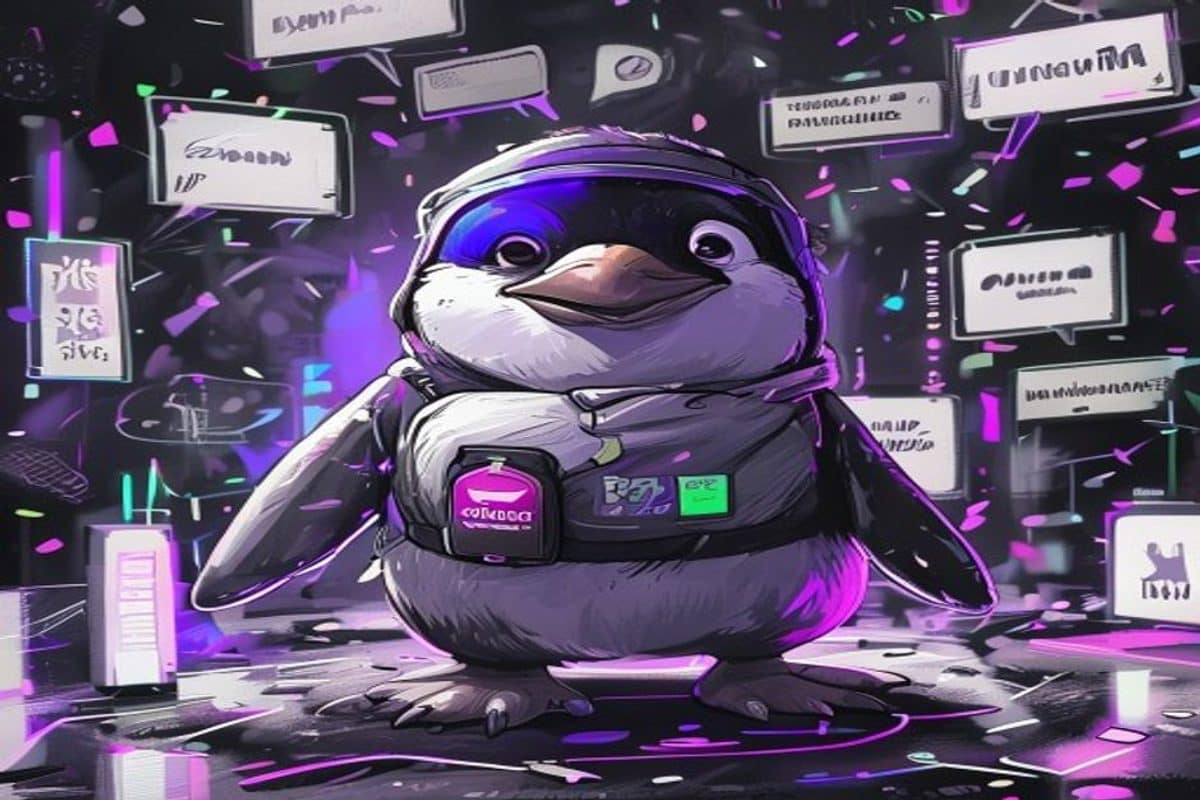
The response showed how effective that can be. Users started posting penguins in Solana gear, dancing videos, and other playful edits that made the original post feel less like a corporate promotion and more like a coordinated community huddle. That matters because attention in crypto is rarely generated by institutions alone. It is generated when a chain, a brand, and a group of users all decide to act as if the joke is also the product. The best meme ecosystems understand this. They do not resist the humor. They organize around it.
That is why Pudgy Penguins has endured. A lot of NFT brands peaked when the market was purely speculative and then vanished when liquidity disappeared. Pudgy evolved. The team expanded into consumer products, then linked that brand equity to a token on Solana, giving the project a second life that is both cultural and financial. When $PENGU trades with high volume and a stable price around $0.010, the token is not just a speculative line item. It is a measure of whether the community still believes the brand has room to grow outside the original NFT thesis.
The Meme Layer Still Matters
It is easy to dismiss moments like this as superficial, but that misses the point. Memes are not decoration in crypto. They are distribution. They help a project stay visible in a market where attention is the scarcest asset. They also lower the cost of participation. A penguin in Solana colors is easier to share than a technical thread about liquidity routing, and that matters because the broader audience often encounters the brand through social media long before they ever look at tokenomics.
That makes the current PENGU setup unusually strong. The token has real market depth, a recognizable mascot, and a chain that has every incentive to keep pushing the brand into circulation. The fact that collectors like Chapin and Hardik jumped into the conversation only reinforced the sense that this was a fun but meaningful community event. In crypto, fun is often the first sign that a market still has life. When people stop making memes, they usually stop caring. When they make more memes, they are still trying to participate.
There is a strategic side to this too. Solana does not need every user to care about Pudgy Penguins as an investment. It benefits if they care about it as a cultural object. That is enough to keep the brand visible, keep the token liquid, and keep Solana associated with the kind of internet-native behavior that most other chains cannot manufacture on demand. A serious network still needs serious infrastructure, but a memorable network needs a social identity. Right now Solana is happy to let Pudgy Penguins help supply that identity.
What PENGU Signals Now
The market context gives this all a little more weight. With PENGU around the $630 million market cap range and trading near $0.010, the token is no longer a tiny side bet. It sits in that awkward but interesting middle zone where the market takes it seriously enough to watch, but not so seriously that it stops being playful. That is often where the best meme assets live. They are liquid enough to matter, recognizable enough to trend, and strange enough to keep pulling in new participants.
What Solana really showed with the post is that it understands how to use that zone. The chain is not just hosting meme activity. It is participating in it, and that is a different kind of marketing power. It says the ecosystem knows its audience and is comfortable speaking the same cultural language. That may not sound like a major strategic insight, but in crypto it is. The projects that last are usually the ones that can translate between brand, community, and market structure without sounding like they are trying too hard.
Pudgy Penguins has done that better than most. Solana's latest spotlight gave the brand another burst of visibility, but it also underscored something bigger. Even in a market obsessed with infrastructure, user activity still responds to personality. The chain that can keep a meme alive may end up owning more attention than the one that simply claims to be faster. And in crypto, attention is often the first asset that turns into everything else.
Also read: Aftermath Finance's Sui exploit shows how fast a small accounting bug can become a real DeFi run • Eric Trump turned American Bitcoin into a wealth machine for insiders and a trap for investors • Pump.fun burns its own credibility along with 36 percent of its token supply