South Korea's chip ambitions are real, but the published $651 billion claim needs a harder footing. The verifiable story today is SK Hynix raising new capital for AI memory while Samsung fights to regain ground in HBM.
The safest way to read South Korea's AI chip story is through the companies already carrying it. SK Hynix has become the memory name every AI investor watches, Samsung is still the industrial giant with the fabs, and President Lee Jae-myung's government wants the country treated as more than a supplier sitting behind Nvidia's logo.
What we can't do is dress an unverified number up as certainty. A claim that Seoul is unveiling more than 1,000 trillion won, roughly $651 billion, in semiconductor, AI and robotics investment needs a clear primary source or a credible outlet behind it. A live search did not turn up reliable confirmation for that specific national package, the claimed Gwangju fab buildout, or the July 2 Asan data center announcement. Frankly, a number that large can't be carried by confidence alone.
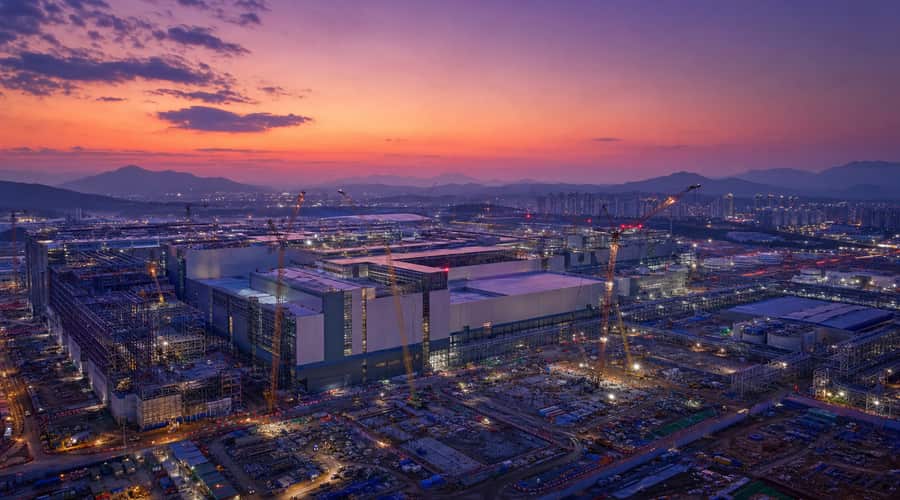
The current, checkable development is SK Hynix's capital push. Tom's Hardware reported that SK Hynix filed to raise up to 45.45 trillion won, about $29.4 billion, through a Nasdaq American Depositary Receipt offering scheduled for July 10, 2026. The company said the proceeds would go toward advanced AI memory fabs, EUV equipment, its Y1 fab in the Yongin Semiconductor Cluster and an advanced packaging plant in Cheongju. That is not a vague national vision. That's steel, tools and wafer capacity.
You should care about that distinction because high-bandwidth memory is one of the places where the AI boom becomes painfully physical. Nvidia can sell as many accelerators as the market will take, but those systems still need HBM stacked close to logic chips, packaged correctly and delivered on time. SK Hynix supplies HBM into that chain, including parts used in Nvidia's AI accelerators, and its lead has become valuable enough to reorder South Korea's own market hierarchy.
Business Insider reported that SK Hynix shares jumped 13% after the Nasdaq filing news, while Samsung Electronics rose 5.3% in the same rally. The move followed a rough selloff in Korean tech stocks, which is exactly why this story shouldn't be written as a clean victory lap. AI memory demand is strong, but chip stocks are now trading like national infrastructure, growth bet and crowded market trade all at once. That combination moves fast.
Samsung's problem is different. It has scale, process technology, memory, foundry operations and packaging ambitions under one roof, but it has spent the AI memory cycle chasing SK Hynix in the product that matters most right now. If Samsung closes that gap, South Korea has two domestic suppliers with serious leverage over the AI hardware stack. If it doesn't, the country's chip strategy leans more heavily on one company than policymakers would like to admit.
The Times of India, citing Reuters, recently noted that SK Hynix had overtaken Samsung Electronics as South Korea's most valuable listed company after a long bet on HBM. That is the kind of detail that tells you more than a ceremonial investment headline. For decades, Samsung was the shorthand for Korean technology power. Now the market is saying AI memory has changed the order, at least for the moment.
Advanced packaging is the next pressure point. Tom's Hardware said SK Hynix's Cheongju facility is aimed at HBM packaging and is expected to be completed by the end of 2027. That matters because packaging is where memory and compute are forced to work together, not as a diagram in a slide deck but as a manufacturable product. TSMC still holds enormous influence there through CoWoS, and nobody should pretend that a Korean plant instantly erases that lead. It does, however, show where SK Hynix knows the bottleneck sits.
Lee's government has every reason to push harder. The United States has the CHIPS Act, Taiwan has TSMC, and China has made semiconductors a national priority despite export controls. South Korea can't sit back and hope Samsung and SK Hynix win on private capital alone while every rival government treats chips as strategic ground. If Seoul is going to announce a larger industrial package, the details need to be specific: who invests, where the plants go, when construction starts and what the government pays for.
The real story, for now, is narrower and stronger than the original version. South Korea's AI chip bet is not proven by a $651 billion headline that search does not substantiate. It's proven by SK Hynix raising tens of billions for fabs and packaging, Samsung fighting to recover its HBM position, and a government that knows memory has become one of the control points of global AI. That's enough of a story. It doesn't need an unsupported number on top.
Also read: China's GLM-5.2 matches a banned US AI on cybersecurity tasks and there's no export order that can stop it • Momenta's Hong Kong IPO prices at HK$295.60 as Chinese autonomous driving bets on software margins over profits • Micron Technology briefly overtook Meta and Tesla in market value after revenue quadrupled on AI memory demand