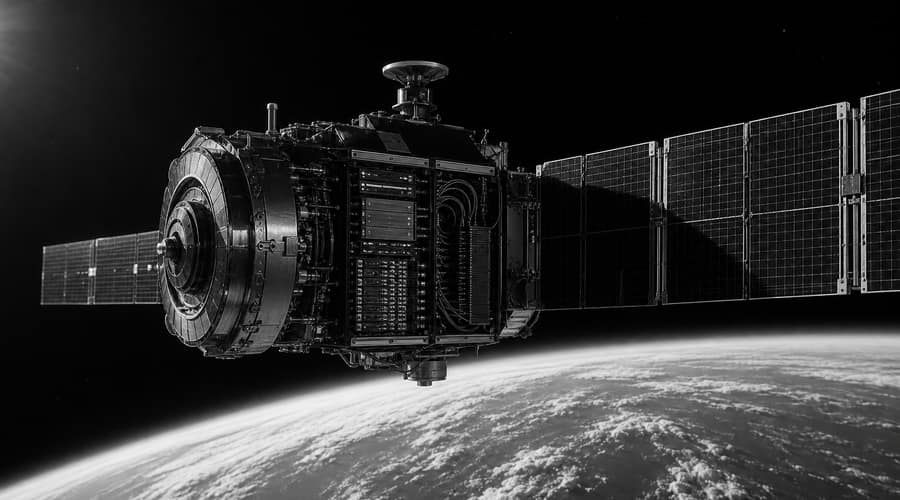
Space-based AI data centers have real money behind them now, but the math is still the story. Rockets, not chips, may decide whether this becomes infrastructure or just an expensive demo.
Starcloud is the company to watch because it has already put serious hardware where everyone else still has diagrams. SpaceNews reported in March 2026 that the Redmond, Washington startup raised a $170 million Series A at a $1.1 billion valuation, making it the fastest Y Combinator company to reach unicorn status. In November 2025, Starcloud launched a satellite carrying an Nvidia H100 GPU, then said it had run a large language model in orbit. That's not a pitch deck claim. It's a machine in space doing the thing.
You should still keep one hand on your wallet when you hear the bigger promise. Starcloud and Crusoe have announced a plan to put Crusoe Cloud on a Starcloud satellite planned for late 2026, with limited public GPU capacity expected in early 2027. Nvidia has backed Starcloud through its startup programs, which makes sense. More GPUs in more places is good for Nvidia, whether those GPUs sit in Texas, Virginia or low Earth orbit.
Cowboy Space is taking the louder swing. Space.com reported last month that Baiju Bhatt, the Robinhood co-founder, had raised $275 million for Cowboy Space, formerly Aetherflux, at a valuation reported around $2 billion. The company wants to build solar-powered AI infrastructure in orbit, but Bhatt has also decided the launch problem is too important to leave to someone else. Cowboy Space plans to make the upper stage of its own rocket the data center itself, with a roughly one-megawatt spacecraft supporting hundreds of GPUs and a first full spacecraft targeted for 2028.
That's a brave answer to a brutal constraint. If the rocket is the toll booth, owning the rocket changes the business. If Cowboy Space can't actually build and fly that rocket, the vertical integration story becomes a very expensive way to discover what SpaceX already knows.
Orbital is more modest and, for that reason, easier to understand. Founded by Euwyn Poon, who sold e-scooter company Spin to Ford in 2018, Orbital raised $5 million from a16z's Speedrun accelerator and is aiming first at AI inference rather than model training. TechRadar reported that Orbital's first satellite mission is planned for April 2027 on a SpaceX Falcon 9 and will test Nvidia hardware in orbit. The Register has also noted the awkward point inside Orbital's own story: the launch economics don't yet pencil out.
The clean story is not the whole story
The clean version of orbital compute is easy to sell. No land fight. No local grid queue. No water-hungry cooling system. Solar panels in orbit see more constant sunlight than panels on the ground, and Google's Project Suncatcher paper argues that space-based solar can support future AI infrastructure if launch costs fall far enough. Google has said it is working with Planet Labs on two demonstration spacecraft around 2027, using Google's TPU chips.
Frankly, that last name should make every startup in this market nervous. Google isn't waiting for Starcloud to prove the category before it sketches its own roadmap. Amazon already has Project Kuiper in low Earth orbit. Microsoft already sells Azure Orbital for satellite connectivity. The hyperscalers have cloud customers, chip strategies, launch relationships and the patience to let a weird infrastructure bet mature. A startup may get there first. Big Tech may still own the toll road later.
The numbers are the part you can't charm away. Wood Mackenzie has put current orbital data center costs at roughly three to four times comparable ground infrastructure, including a 30.5-kilowatt example priced at about $3.1 million in space versus $382,000 on Earth. SemiAnalysis has been even blunter, mapping a path to cost parity only around 2040 if launch costs fall to about $100 per kilogram. Today's public low Earth orbit prices are nowhere near that. Falcon 9 changed the industry, and it still isn't cheap enough for the most aggressive versions of this story.
Starcloud's own model is much sunnier. The company has argued that a 40-megawatt orbital cluster could cost about $8.2 million to operate over ten years, compared with $167 million for comparable terrestrial infrastructure. You can see why investors like that slide. You can also see the missing proof. No company has yet deployed, maintained, cooled, networked and sold a large orbital data center at commercial scale.
That is why the next two years matter more than the valuations. Starcloud's Crusoe deployment, Orbital's 2027 pathfinder and Cowboy Space's rocket plans will give you something better than forecasts: hardware, failures, delays and real operating data. Space compute doesn't have to beat every ground data center to matter. It has to find the jobs where latency, power, location and sovereignty make orbit worth the pain.
For now, the honest verdict is simple. Space-based AI data centers are no longer science fiction, but they are not yet infrastructure. They are funded experiments sitting on top of a launch-cost curve, and the curve still has to move.
Also read: Big Tech is borrowing like never before and the Fed just made that a lot more expensive • You could be facing an AI chatbot at your next job interview • Lloyds Banking Group bets £100 million on AI as it recruits the executive who rewired DBS