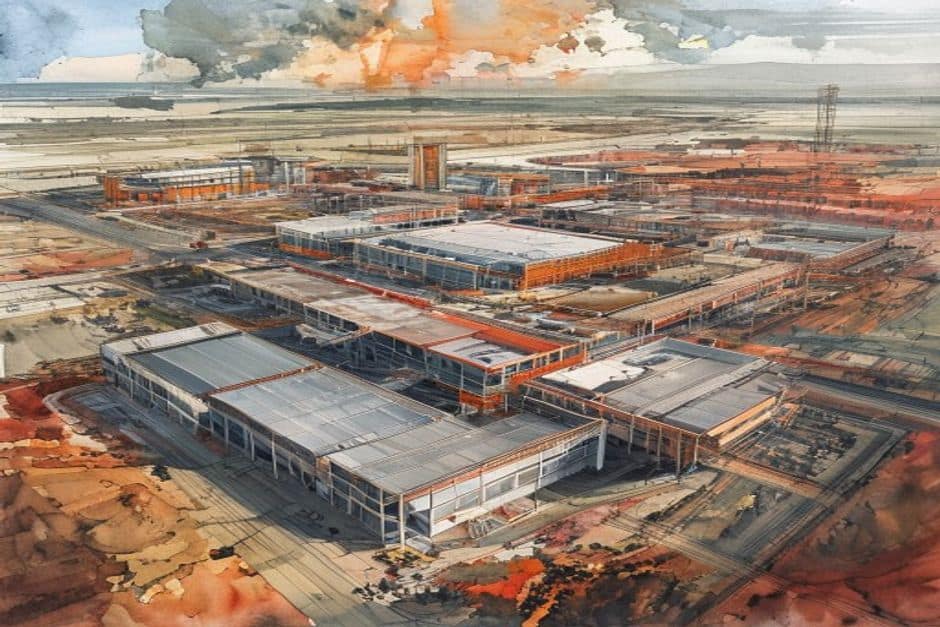
SpaceX filed plans this week for a semiconductor manufacturing facility in Grimes County, Texas, estimating an initial investment of at least $55 billion that could rise to $119 billion across additional phases, in a joint project with Tesla and xAI that would produce AI chips for robotics, autonomous driving, and space-based data centers under a single capital structure controlled by Elon Musk.
The project, called Terafab, was announced by Musk in March and is now taking on formal shape through a public county notice seeking property tax incentives. Intel has agreed to assist with chip design, fabrication, and packaging, describing Terafab's goal as producing one terawatt per year of computing power. The facility is designed around two chip categories: edge-inference processors for Tesla's Full Self-Driving system, Optimus humanoid robots, and robotaxi fleets, and radiation-hardened high-performance chips for SpaceX's orbital data centers and xAI's satellite compute infrastructure. Musk's stated allocation points roughly 80 percent of output toward space applications, with 20 percent for terrestrial use. SpaceX absorbed xAI as a wholly owned subsidiary in February, and Musk has suggested the entity may eventually be rebranded as SpaceXAI.
The reason Musk is building this at all is straightforward, and he said it directly. The semiconductor industry is not producing chips fast enough for what he expects his companies to need across AI, robotics, and space. "We either build the Terafab or we don't have the chips, and we need the chips, so we build the Terafab". That logic is not as irrational as critics suggest. Nvidia's GPU allocation is constrained, TSMC is running at capacity, and hyperscalers are already designing custom silicon to reduce exposure to supply risk. Musk is taking that trend to a more extreme conclusion by attempting to own the entire stack from wafer to workload inside his own corporate ecosystem.
The vertical integration ambition here is more aggressive than anything the hyperscalers have attempted. Amazon, Google, and Microsoft all design custom chips, but they manufacture at TSMC, Samsung, or partner foundries. Apple designs its own silicon but does not own a fab. Musk is aiming to control design, fabrication, packaging, and deployment under one organisational structure, with multiple corporate entities sharing the output. Intel's involvement is notable because it represents the first significant external manufacturing commitment from a company that has historically focused on its own products, and because Intel's existing process technology and engineering capacity would give Terafab a faster path to 2-nanometer production than starting from zero.
For SF readers, the implications extend well beyond the scale of the numbers. Terafab signals that AI infrastructure is becoming a winner-take-most game for entities that can finance fabs, power contracts, land, and captive customers simultaneously. SpaceX has the capital structure, the customer base across Tesla and xAI, and the political alignment with the current administration to pursue property tax incentives and permitting at a scale that smaller players cannot match. That creates a compounding advantage. If Terafab reaches even a fraction of its stated output, SpaceX and Tesla will have access to more compute at lower marginal cost than any AI company currently relying on third-party cloud GPU reservations. That changes competitive economics not just for xAI, but for any model builder competing against a company that effectively owns its own silicon supply chain.
The pressure on Nvidia is real but not immediate. Nvidia's H100 and B200 architectures dominate today's training and inference workloads, and the CUDA ecosystem lock-in runs deep through the entire research community. Custom silicon from Google, Amazon, Apple, and now potentially Terafab has always undercut Nvidia at specific narrow tasks while failing to dislodge it from general-purpose GPU workloads. The more relevant pressure is on cloud providers and the startups that depend on them. If xAI gains cost advantages from in-house silicon, it can undercut Grok pricing in ways that hosted models cannot match. Startups building on cloud GPU APIs are already paying the most expensive tier of AI infrastructure costs. Terafab would not help them directly, but it would shift the economics for the large AI players they compete against.
There are credibility questions. Musk announced Terafab without timelines, and his track record of over-promising production schedules is long and well-documented. A $119 billion semiconductor facility would be the largest ever built by a substantial margin. The talent requirements, regulatory approvals, and raw construction timeline involved are extraordinary, and the gap between announcing a project and producing working 2-nanometer chips is measured in years, not quarters. What the filing confirms is that this is not a thought experiment. The county hearing notice, the Intel partnership, and the tax incentive process represent early-stage but real institutional commitments. Whether that translates into production capacity depends on execution. And on whether the semiconductor industry, once again, turns out to be harder than Musk expected.
Also read: Skymizer's HTX301 fits a 700B parameter model on a single PCIe card and that changes the on-prem AI calculus • Anthropic is putting Claude inside Office and that changes the enterprise AI fight • Principal raised $3.64 billion for AI data center development and the story is bigger than the number