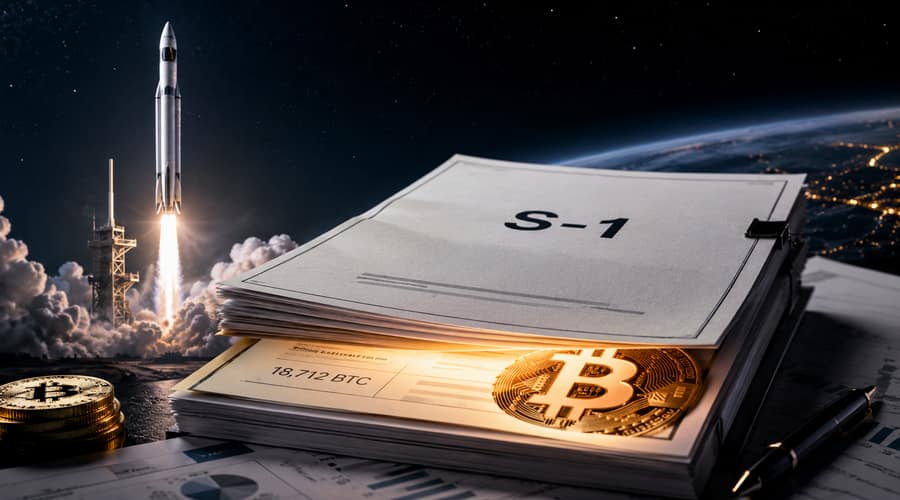
SpaceX's public prospectus is current and consequential, but the claimed 18,712 Bitcoin disclosure is not supported by the credible reporting checked for this audit.
SpaceX's long-awaited S-1 has finally put real numbers around one of the most closely watched private companies in the world, and the filing is already giving investors more than one story to digest. The core event is fresh: the company filed its prospectus on May 20, 2026, with plans to list on Nasdaq and Nasdaq Texas under the ticker SPCX. What should be removed is the unsupported claim that the filing revealed 18,712 bitcoin worth roughly $1.45 billion.
That distinction matters because the public filing is important enough without adding a number that credible sources do not clearly back. As Fortune reported from the S-1, SpaceX disclosed $18.7 billion in 2025 revenue, up roughly 33% from 2024, while also showing a $4.27 billion net loss in the first quarter of 2026 and an accumulated deficit of $41.3 billion as of March 31. Those are the figures investors will have to underwrite before they decide whether a company built around rockets, Starlink, AI infrastructure, and Elon Musk's Mars ambitions deserves a valuation in the neighborhood of $1.7 trillion.
The Bitcoin angle is still relevant, but it needs to be handled carefully. A recent CoinDesk report citing Arkham Intelligence data put SpaceX's known Bitcoin position at 8,285 BTC, worth about $603 million at the time of that report in April. That is a meaningful treasury exposure, but it is not the same as saying Reuters and Bloomberg confirmed an S-1 disclosure of 18,712 BTC. In an IPO story, that difference is not cosmetic. It changes the size of the claim, the sourcing standard, and the level of confidence readers should have in the number.
The filing is already big enough
The better story is that SpaceX's prospectus has opened a window into a company that has become far more complicated than the rocket business most people still imagine. Starlink appears to be the financial engine, with Fortune noting that it accounted for more than two-thirds of revenue and posted $1.2 billion in profit in the most recent quarter. The space and AI divisions lost money in that same period, which means the offering is not a simple growth story. It is a bet that several capital-intensive businesses can be worth more together than they would be apart.
That is why the financial disclosures are likely to matter more than the viral Bitcoin chatter. Public investors will look at revenue growth, losses, voting control, related-party complexity, and the durability of Starlink's cash generation. They will also have to decide how much weight to put on Musk's control of the company. The S-1 says he holds 85% of voting power through special Class B shares, giving him effective control over board elections and other shareholder matters. For some investors, that will be part of the appeal. For others, it will be the first risk factor they read twice.
Bitcoin still creates a disclosure issue
If SpaceX holds a material Bitcoin position, even closer to the on-chain estimate than the viral S-1 number, it still raises practical questions. Public company investors will want to know how the asset is custodied, how it is valued, whether it is insured, and how management thinks about volatility on a balance sheet that is already carrying large operating losses. Those are normal questions, not crypto-specific alarmism. A treasury asset that can move sharply in either direction changes how investors read liquidity and risk.
There is also an accounting issue. New fair value rules have changed how companies report crypto assets, which means a large Bitcoin position can flow through financial statements in ways that are easier to see than under the older impairment model. That makes the disclosure standard higher, not lower. A company preparing for what could be the largest IPO ever does not get much room for ambiguity on assets that can swing hundreds of millions of dollars in market value.
The takeaway is straightforward. SpaceX's IPO filing is current, market-moving, and full of material details, but the article should not present the 18,712 BTC claim as verified by Reuters, Bloomberg, or the S-1 unless that exact disclosure is confirmed from the filing or a reliable primary report. The stronger version of the piece keeps the focus on what is verified: a fresh public prospectus, a massive proposed listing, rising revenue, widening losses, Musk's voting control, and a Bitcoin exposure that deserves scrutiny without being inflated beyond the available evidence.
Also read: Pocatello's data center rejection shows local AI backlash turning into law • SpaceX's IPO filing could reset private tech pricing • Crypto Twitter goes quiet as retail traders vanish