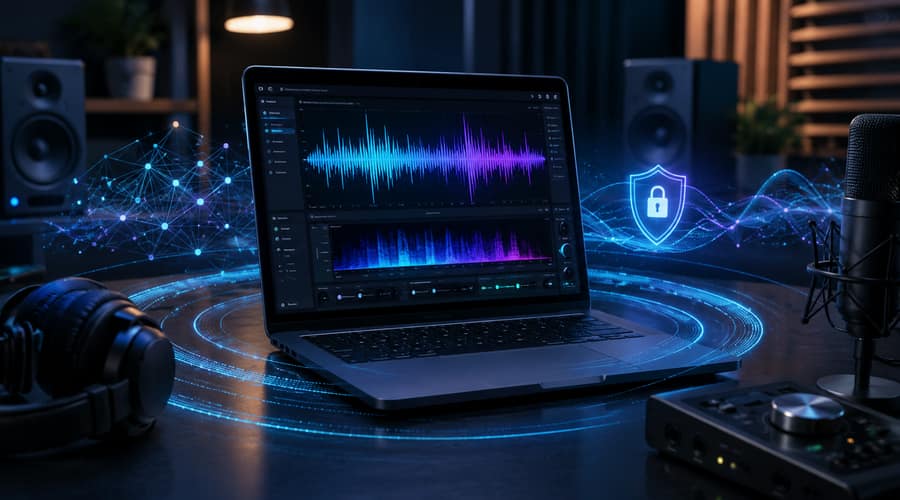
A new community-built app for running Stable Audio models locally shows where creative AI is heading: closer to the workstation, less dependent on the cloud, and more useful for people who need fast private iteration.
Stable Audio Studio is not just another prompt box for making a short sound clip. The app, shared today by its developer, gives Stable Audio users a dedicated local interface for text-to-audio generation, with controls for duration and steps, a built-in library, and a simple editor for working with the results.
That matters because generative audio has been moving in two directions at once. On one side are polished web services such as Suno and Udio, which make song creation feel simple but keep most of the machinery behind a hosted product. On the other side are open-weight models, local tools, and developer workflows that let producers and builders decide where the model runs, how it is tuned, and what happens to the output after it is created.
Stable Audio Studio sits firmly in the second camp. The first version is aimed at models such as stable-audio-open-1.0, a Stability AI model used for stereo sound effects, ambient textures, rhythmic loops, and short instrumental production elements. The important part is not that it suddenly turns every laptop into a finished music studio. It is that it makes local AI audio generation feel less like a research script and more like a tool a working creator could actually keep open while building.
For music producers and sound designers, local generation has practical value that goes beyond the open-source talking point. A game studio prototyping creature sounds, a podcast team making transition beds, or a composer sketching production elements may not want every prompt, reference file, or draft idea passing through a hosted service. Privacy is part of the appeal, but so is speed. The creative process works best when people can try something, reject it, adjust it, and try again without treating each generation like a formal request.
That is why the timing is useful. Stability AI released Stable Audio 3.0 on May 20, 2026, only ten days before this community app appeared. As TechCrunch reported, the new family includes four models: Small SFX, Small, Medium, and Large, with the smaller models designed for on-device use and the Medium and Large models capable of generating audio up to 6 minutes and 20 seconds. Stability AI says three of the models are open weights, while Stable Audio 3.0 Large is available through its API and self-hosting options for enterprise deployments.
The company is also making a clear licensing argument. Stability AI says the Stable Audio 3.0 models are trained on fully licensed data, that users own their outputs under its Community License, and that organizations with more than $1 million in annual revenue need an Enterprise License for commercial coverage. That last detail is easy to miss, but it is central to the business story. Open weights can build developer enthusiasm, but Stability still needs a path to revenue from companies that want legal clarity, higher scale, and support.
The market is no longer just about better songs
AI music is often discussed as a contest over who can generate the most convincing three-minute track. That is too narrow. The stronger business question is who owns the creative workflow around the model. Suno and Udio have built consumer-friendly creation products, but they are also operating under legal pressure from the music industry. Stability AI is trying to tell a different story: licensed training data, open-weight access, local deployment, and professional tooling.
Stable Audio Studio adds an interesting wrinkle because it shows what can happen when the model layer is available outside the official product surface. A community interface can move quickly, serve a niche, and test features before they are worth turning into a commercial product. That same dynamic helped image generation spread through local apps, plug-ins, and node-based tools. Audio has been slower because the outputs are harder to judge, edit, and integrate into production, but the pattern is starting to look familiar.
The current app is still early. Based on the developer post, users are already asking for Stable Audio 3 features such as audio input restyling, inpainting, and outpainting. Those are exactly the kinds of controls that matter to professionals because most real audio work is not blank-page generation. It is fixing a section, extending an idea, matching a mood, or producing variations that fit an existing project.
For Stability AI, this is both an opportunity and a test. The company has had a turbulent few years, including leadership changes and pressure to turn influential models into sustainable products. Stable Audio 3.0 gives it a stronger technical and licensing base in a crowded creative AI market. Community tools such as Stable Audio Studio help prove there is real builder interest around that base.
The next question is whether local audio generation becomes a hobbyist layer or a professional workflow. If Stability can turn open model adoption into paid enterprise use, licensing trust, and better tools for musicians, it has a chance to compete on more than novelty. The companies that win creative AI will not simply generate the flashiest demo. They will become the place where work actually gets made.
Also read: Meta is preparing an AI pendant for the wearable race • Kevin O'Leary is turning a data center fight into a China story • Utah is raising the price of AI data center ambition