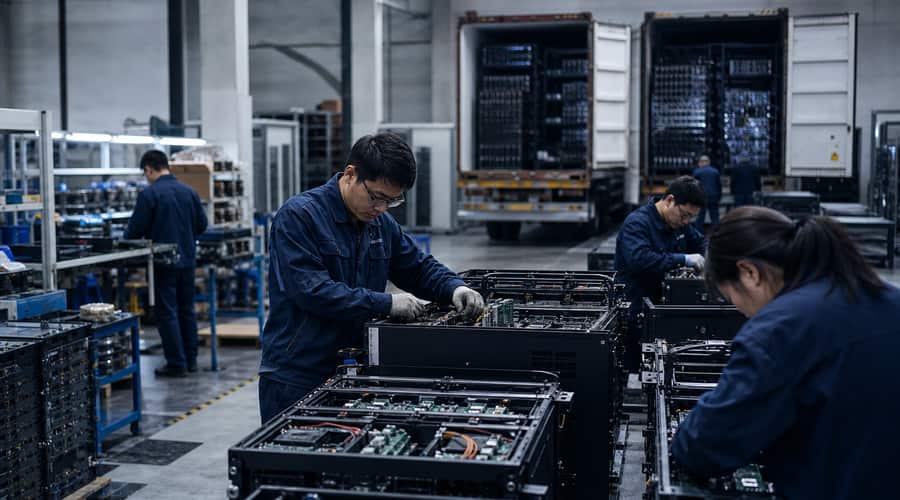
Blue Owl-backed data center operator Stack Infrastructure is considering a sale of its Asia operations at a valuation that Bloomberg reports could reach approximately $30 billion, a figure that reframes data center real estate from a capital-intensive utility business into a strategic financial asset whose pricing reflects anticipated AI compute demand rather than current contracted revenue, and that reveals how deeply asset managers have embedded themselves into the physical infrastructure layer on which every frontier model, hyperscaler workload, and enterprise AI deployment ultimately runs.
Stack Infrastructure is not a household name outside data center and infrastructure finance circles, but its footprint is substantial. The company operates carrier-neutral wholesale data center campuses across North America, Europe, and Asia, selling long-term capacity to hyperscalers, large enterprises, and cloud providers under multi-year contracts that provide predictable cash flow against the capital-intensive cost base of building and operating data halls. Blue Owl Capital, one of the larger alternative asset managers, has been a significant backer of Stack's expansion, applying the infrastructure-as-yield investment thesis that has made data centers attractive to institutional capital seeking real assets with contractually predictable income streams. The Asia operations specifically include facilities across markets including Japan, India, and Southeast Asia, where AI-driven data centre demand has been accelerating as regional hyperscaler expansion, government digital sovereignty initiatives, and the growth of regional AI infrastructure investments converge on limited existing carrier-grade capacity. Selling those operations at a $30 billion valuation would represent one of the largest single data center transactions in the Asia-Pacific region and one of the largest infrastructure sales of 2026.
The valuation math behind $30 billion requires context to evaluate. Data center assets are typically valued on a per-megawatt basis, reflecting the revenue-generating capacity of the power infrastructure rather than the real estate itself. Premium hyperscale data center capacity in high-demand markets including Tokyo, Singapore, and Mumbai is currently trading at valuations in the range of $10 to $20 million per megawatt of IT load capacity, depending on committed occupancy, lease term length, and power availability quality. A $30 billion valuation for Stack's Asia portfolio implies a significant amount of megawatt capacity across multiple markets, much of it likely pre-committed under long-term agreements with hyperscaler tenants whose own capex programs create the occupancy certainty that justifies the premium multiple. The question that sophisticated buyers will apply to the asset is whether the contracted revenue underpins the valuation directly or whether the $30 billion price requires assuming that current market rates for new data center capacity in Asia will hold or increase through the duration of the long-dated leases that will be assigned in the transaction. If AI compute demand growth sustains current power pricing, the valuation is defensible. If demand softens or if more efficient AI chips reduce the power consumption required per unit of AI workload, the megawatt-based valuation model faces pressure.
The asset manager angle is where this story connects to the broader structural shift in who controls compute infrastructure. Blue Owl, Blackstone, KKR, Brookfield, and Digital Bridge have collectively deployed tens of billions of dollars into data center platforms over the past three years, moving the ownership of critical AI infrastructure from the balance sheets of technology companies and specialist REITs onto the balance sheets of private credit and infrastructure funds whose limited partners include pension funds, sovereign wealth vehicles, insurance companies, and endowments. This ownership shift has two significant consequences. First, it means that the capital allocation decisions that determine where AI compute capacity is built, how fast it expands, and at what price it is available to cloud providers and end customers are increasingly being made by investment professionals whose return requirements and holding period preferences are not aligned with the technology roadmaps of the AI companies consuming the capacity. An infrastructure fund with a seven-year hold period and return requirements of 12 to 15 percent net IRR makes data center investment decisions differently than a technology company investing in its own infrastructure for strategic competitive advantage. Second, it means that the secondary market for data center assets is becoming liquid enough to support price discovery through competitive sales processes, which makes infrastructure valuations more transparent but also more susceptible to the reflexive dynamics of financial asset markets where expectations of future demand get priced in before the demand materialises.
The valuation-versus-revenue gap question is the one that will determine whether the Stack Asia sale at $30 billion is a rational transaction or a leading indicator of infrastructure overvaluation. The committed contracted revenue from hyperscaler tenants under multi-year leases provides a floor that makes the asset fundamentally different from speculative development land. But the premium above that contracted revenue base reflects the buyer's belief that they can continue to lease additional capacity at current or higher rates as existing contracts roll and as the portfolio expands. That premium is an AI demand bet, and its rationality depends on whether the next five years of Asian hyperscaler expansion, enterprise AI adoption, and regional cloud growth deliver the megawatt absorption that the valuation implies. The comparable transaction that buyers will use to calibrate their offers is the broader data center M&A market, where Digital Realty, Equinix, and private platform sales have set recent precedents at valuations that have held up because hyperscaler capex programs have continued at scale. Stack's Asia portfolio will trade at the intersection of those precedents and the specific contracted occupancy its assets carry into the transaction.
For founders and AI infrastructure investors watching from the application layer, the Stack Asia situation illustrates the degree to which the physical and financial plumbing of compute has become strategically significant rather than a background commodity. When a single data center portfolio's Asia operations can command a $30 billion valuation, the capital required to build, own, or influence compute infrastructure is measured in tens of billions rather than the millions or low hundreds of millions that characterise early-stage technology investment. That scale means that the ownership of compute infrastructure is consolidating into the hands of a small number of asset managers, sovereign funds, and infrastructure platforms whose investment criteria and governance structures are fundamentally different from those of the technology companies building the models and applications that require the compute. Understanding who owns the infrastructure layer, what their return requirements imply for pricing and availability, and how their hold periods interact with AI development timelines is increasingly relevant due diligence for any company whose product roadmap depends on compute availability at predictable costs over a multi-year planning horizon.
Also read: Podcast Index Says 39% of New Podcasts May Be AI-Generated and the Real Problem Is What Synthetic Audio Does to Discovery, Ads, and Platform Economics • OpenAI May Be Building a Personal Wiki for ChatGPT and the Real Prize Is Durable User Context • OpenAI and Anthropic Are Reportedly Buying Their Way Into Enterprise Services and That Changes Who Actually Gets Paid in AI