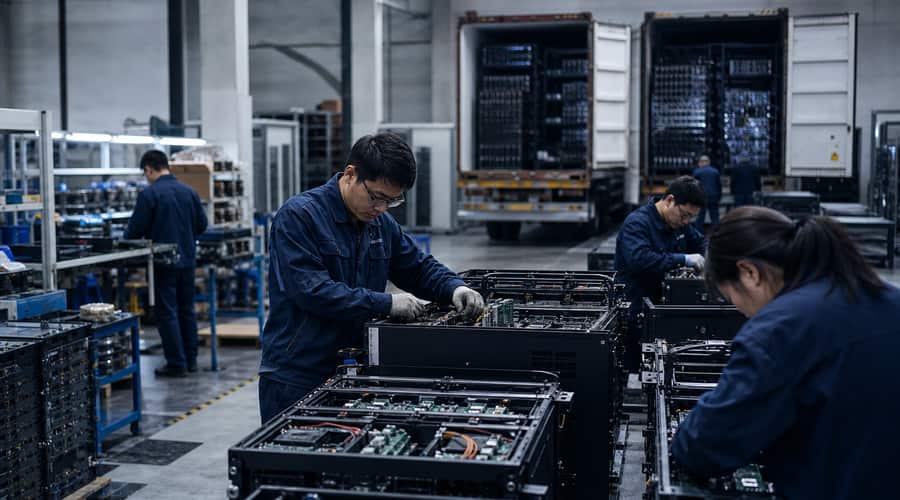
The Stanford HAI institute's 2026 AI Index Report finds China has effectively erased America's once-commanding lead in artificial intelligence, driven by a sharp decline in the flow of global AI talent to U.S. institutions.
For years, the story of the global AI race was simple: America led, everyone else followed. That story is over. Stanford University's Human-Centered AI institute released its annual AI Index this week, and the headline finding is blunt , China has "nearly erased" the United States' long-standing advantage in artificial intelligence. What was once a clear hierarchy has become a tight bipolar contest, and the forces driving that shift are structural, not temporary.
The most consequential factor isn't compute or capital. It's people. The United States built its AI dominance in large part by attracting and retaining the world's best researchers, but that pipeline has slowed to a trickle. Retention rates for Chinese AI researchers at U.S. institutions have fallen notably, with a growing share choosing to return to China or simply never leaving in the first place. Those researchers are now feeding China's tech giants and state-backed research entities, accelerating a model development cycle that Washington has struggled to anticipate, let alone outpace.
The data in the Stanford report is specific enough to warrant attention beyond the headline. In 2023, China overtook the United States in total volume of top-tier AI research papers , a benchmark that, for decades, had been America's to lose. On the patents front, Chinese entities accounted for 61.1% of global AI patent grants in 2022. Tencent has now surpassed Google's parent company Alphabet in total issued AI patents, a detail that would have seemed implausible five years ago.
The U.S. still holds an advantage in what the report classifies as "significant" machine learning models , 61 released in 2023, compared to 15 from China. But the Stanford researchers are careful to note that this gap is narrowing faster than most projections anticipated, and that raw model count is a lagging indicator. What matters more is deployment capacity, research throughput, and the talent base that sustains both , and on those dimensions, the trajectory is moving against Washington.
What This Means for Investors and Policymakers
For the technology investment community, the report is a structural signal, not just a geopolitical one. The AI sector can no longer be modeled as a Silicon Valley monopoly with occasional international challengers. Competitive pressure across generative AI, computer vision, and robotics will compress margins and accelerate innovation cycles , which is good for buyers of the technology and complicated for anyone betting on sustained pricing power from any single national ecosystem.
The national security dimensions are harder to price but impossible to ignore. AI is increasingly load-bearing infrastructure for defense systems, critical data networks, and logistics. A talent base that once concentrated in California and a handful of East Coast research universities is now distributing itself globally, with a meaningful and growing share anchored in Beijing and Shenzhen. Restricting chip exports, as U.S. policy has attempted, addresses one layer of the competition. It does not address the human capital layer, which may ultimately be the more durable competitive variable.
The harder policy question , one the Stanford report raises without fully answering , is whether the U.S. can reverse a talent trend that is shaped by career incentives, visa friction, geopolitical anxiety, and the simple fact that Chinese institutions are now well-resourced enough to offer world-class research environments. Funding and rhetoric will not be sufficient. What to watch next is whether the current administration treats the talent slowdown as the strategic priority the Stanford data suggests it is, or whether the focus remains on hardware controls while the human capital gap quietly widens.
Also read: China has effectively erased Americas lead in artificial intelligence according to a new Stanford report showing Beijing now dominates scholarly research and is reversing the brain drain of top experts • OpenAI's Codex is now something anyone with a ChatGPT account can actually use without touching a terminal • OpenAI's Codex for Almost Everything moves AI from chatbot to autonomous operational engine