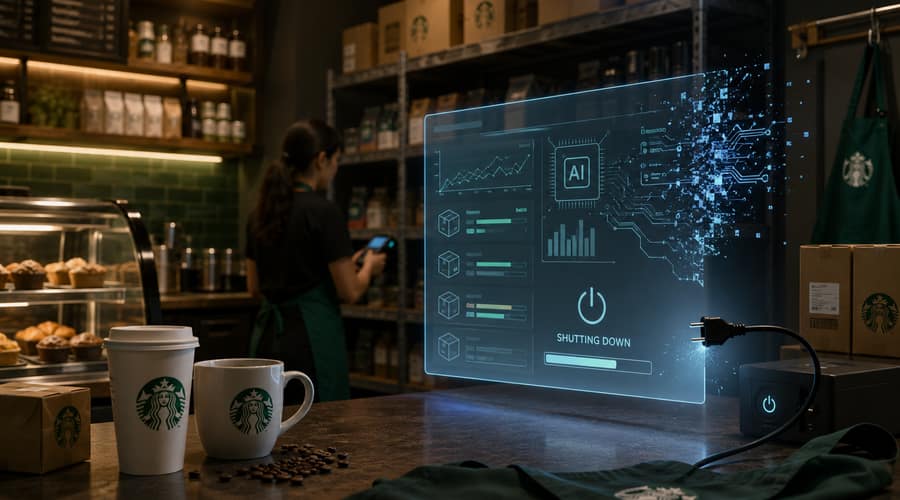
Starbucks wanted AI to make inventory faster and more reliable. Nine months later, the company is going back to manual counting for parts of the store.
Starbucks has pulled the plug on Automated Counting, the AI inventory tool it rolled out across North America last year to help workers track milk and beverage components. The decision is not just a small software retreat. It is a useful reminder that enterprise AI is only valuable when it survives the noise, speed and mess of the real workplace.
According to Reuters, Starbucks told employees this week that the program would be retired after nine months in use. The tool had been introduced as part of CEO Brian Niccol's broader effort to fix product shortages, a problem he has said was weighing on sales and customer experience. It was supposed to give stores better visibility into what was on hand and what was running low. Instead, workers and managers reported that it frequently miscounted items, mislabeled products and sometimes missed similar milk types altogether.
That matters because inventory at Starbucks is not a tidy spreadsheet problem. It is a physical-store problem. Products move fast, packaging looks similar, shelves change during rushes, and baristas are already switching between drinks, customers, cleaning and restocking. If an AI system adds a second check instead of removing one, it does not feel like automation. It feels like another task.
When Starbucks announced the system in September 2025, the pitch was direct. Employees would use tablets to scan shelves, refrigerators and display cases. The software, built with NomadGo, used computer vision, 3D spatial intelligence and augmented reality to recognize and count inventory. NomadGo said at the time that its Inventory AI could count up to eight times faster than manual methods with 99% accuracy, while Starbucks said the tool would help partners spend more time on drinks and customers.
The scale was ambitious. Starbucks said automated counting would be live in company-operated coffeehouses across North America by the end of September 2025, with reports at the time putting the deployment at more than 11,000 locations. That made it a visible test case for a broader class of AI products now being sold into retail, restaurants and logistics: tools that promise to turn messy physical operations into clean, real-time data.
But the gap between a controlled demonstration and a high-volume store can be wide. A model that performs well when products are arranged clearly can struggle when the back room is crowded, lighting is inconsistent or packaging changes. A system that saves time when it is right can consume more time when employees have to verify every result. In food retail, where the cost of being wrong can mean waste, stockouts or frustrated staff, a small accuracy problem quickly becomes an adoption problem.
Why this setback matters
Starbucks framed the decision as a move to standardize inventory counts while it focuses on consistency and execution at scale. That language is careful, but it points to the real issue. The company is trying to make operations more predictable at the same time it is fighting margin pressure and rebuilding store performance. Reuters noted that Starbucks recently posted its strongest quarterly sales growth in two and a half years, but operating margins in North America have fallen to 9.9% from 18% two years earlier.
Technology is supposed to help with that pressure. Faster inventory counts should reduce waste, improve replenishment and free labor for customer-facing work. But when the technology is unreliable, it can push the burden back onto workers while still leaving management with uncertain data. That is especially dangerous in a chain where local execution matters. A store does not need an elegant AI strategy if it runs out of oat milk at the wrong moment.
For AI vendors, the message is uncomfortable but useful. Retailers are not buying demos. They are buying fewer missed items, fewer wasted hours and fewer customer disappointments. The winning tools will be the ones that can handle imperfect shelves, tired users and changing product mixes without demanding too much patience from store teams.
NomadGo said it is continuously learning from customer and user feedback, according to reports citing Reuters. That is the right posture, but the market will want proof. The next wave of retail AI startups will likely pitch themselves around tighter integrations, better worker workflows and more transparent error handling. Accuracy claims alone will not be enough.
Starbucks is not walking away from technology. Niccol has made digital platforms part of the company's turnaround plan, and the chain still has strong incentives to make store operations smarter. The lesson from Automated Counting is narrower and more important: AI that works in retail has to earn trust one shift at a time. The next vendor that wins a Starbucks-sized mandate will need to prove it can count in the real world, not just in the sales deck.
Also read: DeepSeek is making its 75 percent API discount permanent • Softcat raises guidance as AI infrastructure demand surges • Malaysia mandates ID-based age checks for social media