China's new data-center plan makes Taiwan's year-old chip controls newly important. Huawei and SMIC are now central to Beijing's AI buildout, but the supply chain around them is getting harder to reach.
China wants to spend its way into AI independence, and that puts Huawei Technologies and Semiconductor Manufacturing International Corp. back in the center of the semiconductor fight. A reported 2 trillion yuan, or roughly $295 billion, data-center plan would lean heavily on domestic suppliers, which means Beijing is asking its own chip industry to carry a much bigger load just as the rules around advanced technology are tightening.
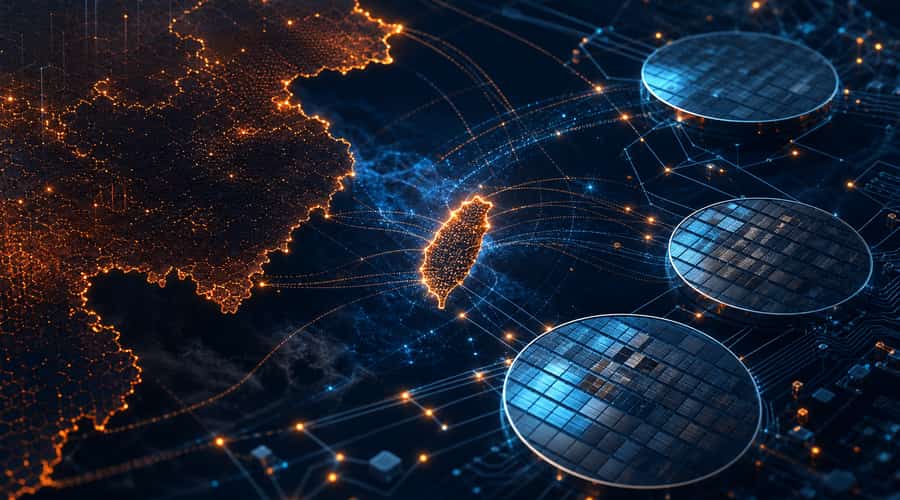
That is where Taiwan matters. Taipei added Huawei, SMIC and several subsidiaries to its strategic high-tech commodities export control list in June 2025, requiring Taiwanese companies to seek approval before supplying certain advanced technologies, materials and equipment. The move was not announced this week, but it has fresh relevance because China's latest AI infrastructure ambitions depend on precisely the kind of domestic chip capacity those companies are trying to build.
As Bloomberg recently reported, China is discussing a five-year plan to build a national network of AI-focused data centers, with at least 80% of key technology sourced from domestic suppliers such as Huawei. That target is not just a procurement preference. It is a political and industrial bet that China can reduce its exposure to Nvidia, AMD and other U.S.-linked suppliers while still keeping pace in large-scale AI deployment.
The problem is that chips are not built by slogans or budget lines. Huawei's Ascend processors have become the most visible alternative to Nvidia hardware inside China, and SMIC remains the country's most important foundry for advanced chip manufacturing. But producing AI chips at scale requires tools, wafers, chemicals, packaging systems, testing capacity, software support and process knowledge. Taiwan sits across many parts of that network, not only through TSMC, but through the broader ecosystem that supports high-end semiconductor production.
That makes Taipei's controls more than a compliance detail. If Taiwanese companies need licenses before selling sensitive technology or services to Huawei and SMIC, every transaction becomes slower and more exposed. Some approvals may still be possible, depending on the product and end use, but the direction of policy is clear. Advanced chip capability is no longer treated as ordinary commercial infrastructure when it can feed directly into national AI systems.
China has been preparing for this moment for years. U.S. export controls have already limited access to Nvidia's most capable AI chips and restricted the equipment needed to manufacture advanced semiconductors. Chinese firms have responded by stockpiling parts, redesigning systems and pushing domestic alternatives. Huawei has also worked to make its Ascend chips more attractive to cloud providers and AI developers that can no longer assume a steady supply of U.S. hardware.
Still, a domestic replacement strategy only works if the replacement can arrive in volume and perform reliably. It is one thing to build a showcase cluster or support a favored national project. It is another to supply the broad base of cloud companies, state-backed data centers, research labs and enterprise AI users that a national computing network would require. Delays in manufacturing yield, packaging capacity or software compatibility can slow the whole plan.
Taiwan's supply chain now carries more political weight
For Taiwan, this is a difficult but predictable position. Its chip industry grew by serving global customers and solving hard engineering problems, not by advertising itself as a geopolitical instrument. That separation is becoming harder to maintain. Washington sees advanced semiconductors as a security asset, Beijing sees restrictions as containment, and Taiwan controls some of the most important industrial capacity in the middle.
TSMC is the clearest example, because it manufactures chips for Nvidia, Apple, AMD and other global technology leaders. But the pressure does not stop with the biggest name. A testing firm, materials supplier or equipment service company may not be designing headline processors, yet its work can still support advanced manufacturing. Once Huawei and SMIC are on a controlled list, routine commercial decisions become legal and strategic decisions too.
There is also a business cost. China remains a major market for electronics, industrial components and manufacturing services. Taiwanese suppliers have to protect access to U.S. technology and financial systems while also managing exposure to Chinese demand. That is not an abstract policy debate. It affects contracts, customer screening, legal budgets and the willingness of companies to touch business that once looked straightforward.
Beijing will not treat these constraints as a reason to retreat. If anything, the pressure will push China to localize more of the semiconductor stack, from design software to production tools and advanced packaging. That may accelerate investment into domestic suppliers, but money cannot immediately replace decades of accumulated manufacturing expertise. Semiconductor bottlenecks tend to move rather than disappear.
The market implication is simple. China's AI race is no longer only about who can train the strongest model or announce the largest data-center budget. It is about whether Huawei, SMIC and their partners can turn national spending into chips that ship on time, run at scale and satisfy the country's biggest AI buyers. Taiwan's controls make that test harder, and they show why AI leadership now depends as much on supply chains as it does on software.
Also read: China turns AI infrastructure into a state-backed compute race • China is turning AI infrastructure into a state project • ICEYE becomes a €10 billion test for defense tech valuations