Tencent is testing a WeChat AI agent that could turn China's biggest super app into the place where everyday AI actually gets used. The key point isn't the chatbot. It's the 1.4 billion-user service layer underneath it.
Tencent's AI agent is not trying to win the app store. It is trying to disappear into WeChat, which is a much more dangerous place for rivals to meet it.
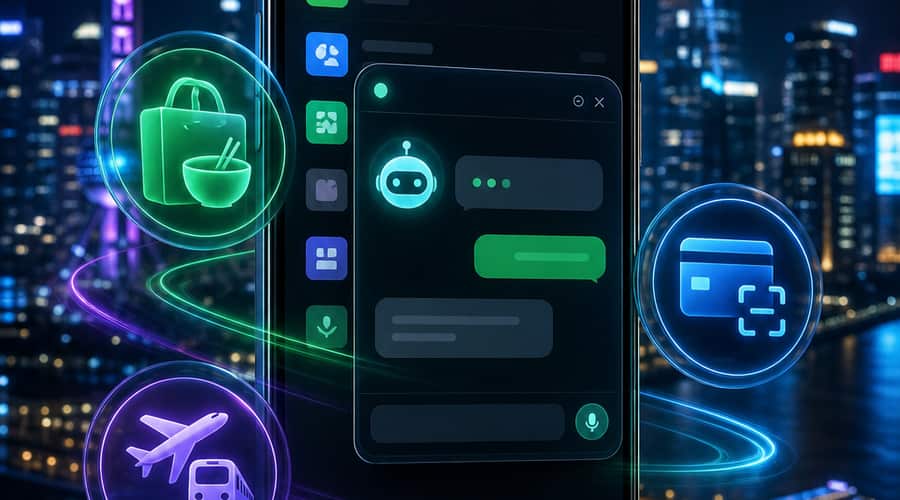
According to the Financial Times, Tencent is testing a prototype agent inside WeChat that can help users complete tasks across the app's mini-programs, from ride-hailing and payments to shopping and travel. Users would reach it by swiping right on the main WeChat screen, then typing into a chat box rather than opening one service after another. Tencent shares closed up 10.5 percent in Hong Kong on June 2 after the report was published, their biggest intraday move since late 2022.
That market reaction was not hard to understand. WeChat is already the screen through which hundreds of millions of people chat, pay bills, book services, run small businesses and deal with public agencies. The FT described it as China's most-used app, with 1.4 billion users and millions of mini-programs. If an AI agent can sit on top of that and actually complete tasks, it starts with a distribution advantage that standalone AI apps have to spend years fighting for.
Here's the thing: most AI assistants still ask you to leave your life and enter theirs. WeChat can do the opposite. You are already in the app. The payments are there. The merchants are there. The ride-hailing and food delivery entry points are there. A useful agent does not need to persuade you to change habits first. It can attach itself to habits Tencent already owns.
The timing is still not settled. The FT reported that Tencent aimed to begin the required compliance process as soon as June, then test the agent with a small group of outside users before a phased rollout. It also reported that no public launch date has been set, because the compliance process is uncertain. That is an important correction to the easy version of this story. Tencent may be moving quickly, but consumer AI in China still has to pass through regulators before it reaches full scale.
That regulatory delay is not a footnote. It is the difference between a product demo and a mass-market product. China's large internet platforms can move faster than smaller rivals once approval comes through, but they also draw more scrutiny because of the amount of user behavior, payment data and service access they hold. Tencent declined to comment to the FT. Keep that dry fact in the story, because it tells you where this still sits: ambitious, internally real, but not yet a public product.
The Standalone AI App Has A WeChat Problem
ByteDance's Doubao, Moonshot AI's Kimi and other Chinese AI apps can still win on model quality, interface and specific use cases. Doubao has become one of China's most visible consumer AI products, while Kimi has built a following among users who want long-context reading and research help. Those are real products, not placeholders.
But they face a blunt problem. If your assistant lives in a separate app, the user has to remember to open it. If Tencent's assistant lives inside WeChat, the user may meet it at the exact moment they need something done.
That is why the WeChat agent is more than another feature in China's AI race. It tests whether the winning consumer AI surface is a chatbot destination or a control layer inside an app people already use all day. For Tencent, this is also a way to turn WeChat's old strength into a new one. The mini-program ecosystem once made WeChat feel like a phone inside the phone. An agent could make it feel less like a menu and more like a command line for daily life.
Western companies will study this closely, but they cannot copy it cleanly. Apple has the operating system surface. Meta has WhatsApp's global messaging reach. Google has Android and search. None of them has a single consumer app in the United States that combines messaging, payments, shopping, services, business tools and public interactions in the way WeChat does in China. You cannot orchestrate what is scattered across separate logins, separate apps and separate commercial relationships.
Apple can push AI deeper into the phone. Meta can put assistants into chats. Google can tie AI to search and Android. Those are serious positions. They are not WeChat.
For you, the useful read is simple. Do not judge this story by whether Tencent has the best model in China this month. Judge it by whether WeChat gives the model enough places to act. AI agents only become interesting when they stop answering questions and start completing jobs. Tencent already owns a vast number of the places where those jobs happen.
If the compliance process drags, the launch could slip. If the agent is clumsy, users will ignore it. But if Tencent gets this right, the standalone AI app will look less like the future of consumer AI and more like a temporary bridge. The stronger bet is the app you already use, quietly learning how to do more of the work for you.
Also read: AWS just made enterprise AI agent infrastructure a solved problem and startups should be worried, TikTok's algorithm is surfacing AI slop to new users at three times YouTube's rate and advertisers should be paying attention, Tesla's Megapod trademark signals a serious play to sell AI infrastructure, not just cars