Texas wants the AI infrastructure boom, but the water bill is becoming harder to treat as a local detail.
The next fight over artificial intelligence in Texas may not be about chips, models or venture capital. It may be about whether a fast-growing data center industry can keep expanding in a state where water planning is already under strain.
That is a very different conversation from the one tech companies prefer to have. AI infrastructure is usually sold through jobs, tax base, power contracts and the promise that Texas can move faster than other states. But servers do not run on ambition. They need electricity, cooling, land, transmission access and, depending on the design, a meaningful amount of water.
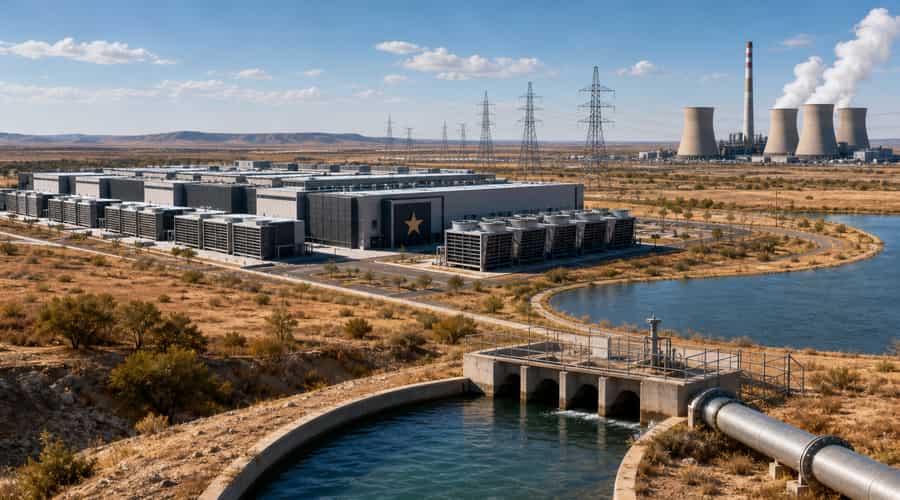
As KUT reported this week, new research from the University of Texas at Austin estimates that data centers could rise from less than 1% of total Texas water use today to between 3% and 9% by 2040. The estimate includes the water used directly at facilities for cooling and the water consumed indirectly by power plants generating electricity for those facilities.
That second part matters. A company can say its own building uses little water, and that may be true on site. But if the workload is powered by gas, coal or nuclear generation that consumes water for cooling, the water footprint has simply moved to another column. For a sector built on massive electricity demand, that accounting distinction is not a technicality. It is the story.
The Axios counterpoint published May 13 adds important context. Sierra Club analysis of federal data found that Texas power plants still consume far more water than data centers do today. Gas plants consumed 56 billion gallons in 2024, coal plants consumed 34 billion gallons and nuclear plants consumed 26 billion gallons. That puts the near-term burden squarely on the power system, not just on the server farms.
For entrepreneurs and investors, this is the practical takeaway: the AI infrastructure race is becoming a resource allocation fight. A site that looks attractive because it has cheap land and friendly permitting may look different when local officials ask where the water comes from, who pays for the pipes and whether residents will face restrictions while industrial users keep growing.
Texas has a strong case as a data center market. It has abundant energy development, large parcels of land, a business-friendly political culture and proximity to major population and enterprise centers. It also has a grid that can add renewables quickly when incentives align. The U.S. Energy Information Administration said this week that solar generation in ERCOT could exceed coal for the first time in 2026, a shift that matters because wind and solar use very little water compared with thermal power plants.
But cheap power is not the same as secure water. The state draft water plan says Texas needs at least $174 billion over the next 50 years to avoid a major water crisis. It also projects declining supplies as population growth, drought and industrial demand continue to collide. Corpus Christi is already living with the politics of scarcity. Central Texas communities are asking harder questions about every large new industrial user.
Disclosure is becoming the real permit
The uncomfortable issue is that Texas still does not have the kind of transparent, facility-level picture that would make this debate easier. The University of Texas paper calls for greater transparency, better coordination among operators, utilities and local governments, and planning that links water availability with grid capacity and permitting. That is a polite way of saying the current system is not built for the speed of AI demand.
Data center developers often point to closed-loop cooling systems, reclaimed wastewater and more efficient designs. Those tools are real. They should be part of the buildout. But claims about low water use are only useful if local planners can compare them across projects, technologies and energy sources. Without consistent disclosure, every approval becomes a trust exercise in a market where the demand curve is moving faster than public infrastructure.
This is also where the direct facility narrative can mislead. A hyperscale operator may reduce water use inside the fence while signing power arrangements that increase indirect water consumption somewhere else. If the power comes from a low-water mix, the facility looks better. If the power comes from gas generation during high-demand periods, the footprint changes. The same AI workload can carry very different water consequences depending on how it is powered.
For startups building around AI, this may feel distant from product strategy. It is not. Infrastructure costs feed into compute prices. Local opposition slows construction. Disclosure rules can change site economics. Water availability can shape where model training, inference clusters and cloud regions are built. The companies that understand these constraints early will make better decisions than those treating data centers as invisible plumbing.
Texas does not have to choose between AI growth and water discipline. But it does have to stop pretending the two can be planned separately. The next phase of the market will reward operators that can show not only how much compute they can deliver, but how honestly they account for the resources behind it.
Also read: AI coding mandates are creating a trust problem for software startups • Banks are trying to narrow the CLARITY Act stablecoin deal • LinkedIn is cutting staff while its business is still growing