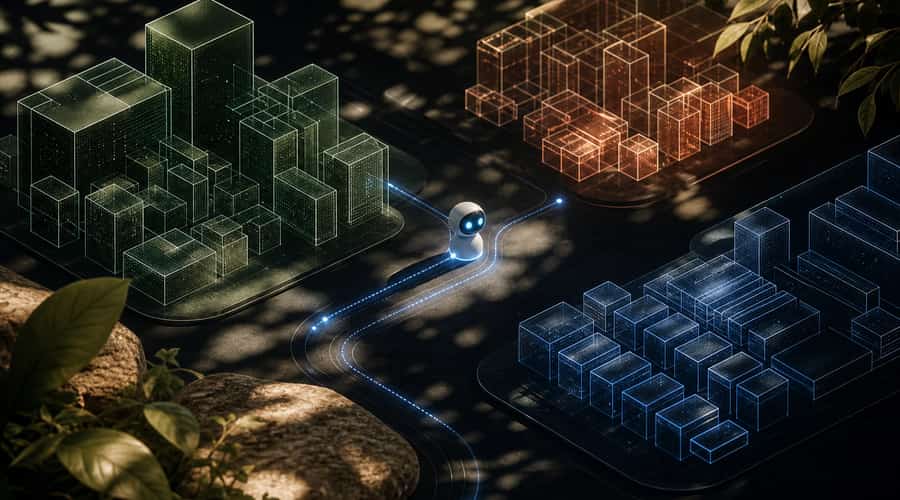
Technical users are unlocking a fundamentally different version of AI than everyone else, and the divide is now wide enough to show up in enterprise data.
Andrej Karpathy has a name for it: the implementation gap. It describes something that anyone working close to the technology has felt for months but struggled to articulate. While public conversation about AI tends to oscillate between breathless optimism and frustrated disappointment, engineers and developers are quietly living in a different reality altogether. They are getting reliable, production-grade performance from systems that general users would barely recognize as the same technology.
The inflection point came in late 2025, when a new generation of open-weight foundation models matured enough to run locally on consumer hardware. Models in the 70B to 400B parameter range, led by Meta's Llama architecture and Mistral's aggressively open offerings, became deployable on affordable cloud instances or even high-end workstations. That shift changed everything. Technical users no longer had to route every query through a rate-limited, safety-constrained commercial API. They could fine-tune on proprietary datasets, build complex multi-step reasoning chains, and strip away the guardrails that make general-purpose interfaces feel cautious and repetitive.
NVIDIA's GB200 Blackwell superchips, released in early 2026, compressed the cost curve further. Local inference, once the domain of well-funded research labs, became economically viable for individual developers and small teams. The result is a cohort of technical users running models with a precision and consistency that consumer-facing tools simply cannot match in their current form.
Enterprise surveys from Q1 2026 put a figure on the divergence. General user satisfaction with consumer AI tools has plateaued at 68%, a number that has barely moved in two quarters. Developer productivity metrics, by contrast, jumped over 200% year-over-year. Those two data points, sitting side by side, tell the whole story. Non-technical users are encountering an AI that hedges, repeats itself, and struggles with multi-step logic unless guided carefully. Technical users are building autonomous workflows that operate with minimal supervision.
The gap is not primarily about intelligence or capability at the model level. It is about access. Consumer interfaces are designed for the broadest possible audience, which means aggressive content filtering, simplified prompting, and outputs optimized for safety over precision. That is a reasonable design choice for a mass-market product. But it also means the average person using a web interface in April 2026 is interacting with a substantially constrained version of what the underlying model can actually do.
What This Means for the AI Industry
For the major labs, the competitive picture is shifting in a way that is not immediately obvious from the outside. The moat is no longer the model. Meta gave that away. Mistral gave that away. The moat is now distribution, ecosystem, and the tooling that sits between raw model access and something a non-technical person can use effectively. Whoever solves the last-mile problem, translating the capabilities that engineers currently unlock manually into something accessible without a computer science background, owns the next phase of the market.
There are early attempts. Autonomous agent frameworks, no-code fine-tuning interfaces, and curated model marketplaces are all pushing in this direction. None of them have cracked it yet. The friction between what the model can do and what a non-technical user can extract from it remains substantial, and the commercial pressure to close that gap is only building as enterprise buyers start asking why their developers are reporting transformational productivity gains while the rest of the organization sees incremental ones.
The practical takeaway for anyone not yet in the technical cohort is straightforward: the version of AI you are using today is not a ceiling. It is a floor. The tools to access something considerably more powerful are becoming cheaper and more accessible by the quarter. The question worth watching is whether the consumer platforms adapt fast enough to close the gap themselves, or whether a new category of product emerges specifically to bridge it.
Also read: Why a Legal Tech Startup Is Interviewing Candidates on Sundays • How US Retirees Are Using AI to Build New Lives and Businesses in Mexico • Anthropic's Claude suffers a widespread API outage just as enterprise procurement season heats up