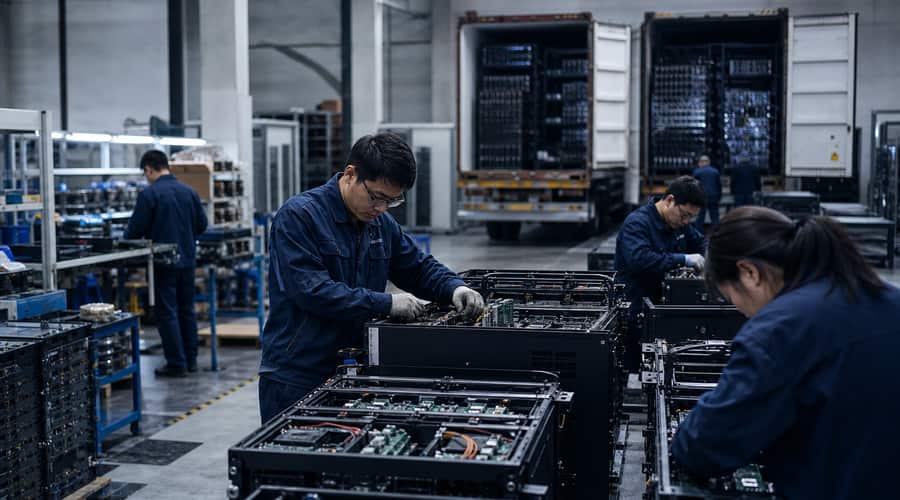
The next great funding cycle is not only about AI models. It is about the data centers, power grids, factories, defense systems, and supply chains needed to make the new economy real.
The global economy is moving into a capital spending cycle so large that it changes the basic question for founders. It is no longer enough to ask whether software can scale quickly. Investors now want to know who owns the infrastructure, who pays for it, how long it takes to earn back the money, and whether the startup can survive in a market where the most important assets are expensive, physical, and slow to build.
That is the useful part of the multi-trillion-dollar capex story. AI data centers are the most visible piece, with Nvidia chips, cloud contracts, cooling systems, and power-hungry campuses dominating market attention. But the broader cycle is not just a Silicon Valley spending spree. Energy, manufacturing, reshoring, defense, grid upgrades, semiconductors, and industrial capacity are all pulling capital toward long-lived assets that look very different from the asset-light startup playbook of the past decade.
As Fortune recently reported, Goldman Sachs has put a rough baseline around the AI buildout, estimating about $7.6 trillion in aggregate AI capital expenditure between 2026 and 2031 across compute, data centers, and power. JPMorgan has separately projected more than $5 trillion in global data center, AI infrastructure, and related power spending over the next five years. The numbers vary by model, but the direction is clear. The economy is putting serious money into things that must be built before they can be monetized.
AI is still the headline because the checks are so large. Microsoft, Amazon, Alphabet, Meta, Oracle, OpenAI, and their partners are committing hundreds of billions of dollars to cloud regions, chips, power agreements, and specialized data centers. These companies are not just buying servers. They are locking up electricity, land, fiber, transformers, memory, advanced packaging, and construction capacity.
That has a knock-on effect across industries that once sat outside the core tech conversation. Utilities are dealing with load growth they did not expect this quickly. Equipment makers such as Vertiv and Schneider Electric are becoming central to the AI supply chain because cooling and power management now determine how much compute can actually run. Semiconductor manufacturers need fabs, clean rooms, lithography tools, and chemicals. Defense contractors are investing in autonomous systems, sensors, and secure manufacturing. Industrial companies are rethinking where production should happen after years of supply chain shocks and geopolitical tension.
Reshoring matters here because governments are pushing capital in the same direction. The U.S. CHIPS Act, European industrial policy, Japan's semiconductor subsidies, and defense spending across NATO are all part of the same pattern. Public money is being used to make private investment less risky in strategic sectors. That does not make every project smart, but it does mean the market is no longer treating physical capacity as a boring back-office concern.
Startups face a different funding test
For founders, this is a very different backdrop from the software boom of the 2010s. Back then, the best companies could raise venture money, hire engineers, push product updates, and scale with relatively low capital intensity. The new cycle rewards companies that can navigate procurement, permitting, hardware supply, project finance, government incentives, and enterprise contracts that may take years to close.
AI startups feel this most directly. The more compute they need, the more dependent they become on hyperscalers, Nvidia supply, cloud credits, and infrastructure partners with stronger balance sheets. A model company may look like a software business to users, but behind the scenes it can behave like a leveraged industrial customer. Training costs, inference margins, and cloud commitments can decide whether growth is valuable or just expensive.
This is why the funding model is changing. Venture capital can still fund product, talent, and early market entry, but it is not always the right tool for billion-dollar infrastructure needs. The companies that win may combine equity with debt, customer prepayments, joint ventures, equipment financing, sovereign capital, and project finance. That sounds less glamorous than a clean SaaS round, but it is how large physical systems usually get built.
There is also a chance that non-AI industrial startups benefit from the same wave. Companies working on grid software, power electronics, robotics, advanced materials, factory automation, modular construction, cybersecurity for critical infrastructure, and energy storage suddenly have a more receptive market. Their customers have budgets because the constraint is no longer imagination. It is capacity.
The risk is that capital floods into infrastructure faster than demand can justify. History is full of buildouts that created lasting value but punished the first investors, from railroads to telecom fiber. Data centers may prove essential and still be overbuilt in the wrong places, with the wrong power costs, or for workloads that become cheaper faster than expected. Founders should take that warning seriously.
The practical takeaway is simple. The startup economy is becoming more industrial. The best opportunities may still use software, but they will increasingly touch power, chips, factories, logistics, defense, and the physical bottlenecks around them. Watch where the capex goes, because over the next few years that may tell us more about the next generation of startups than pitch decks ever will.
Also read: AI agents are turning one novelist's website into a warning sign • Microsoft's Kenya data center shows AI infrastructure can stall anywhere • Maryland challenges AI grid costs as data centers strain power bills