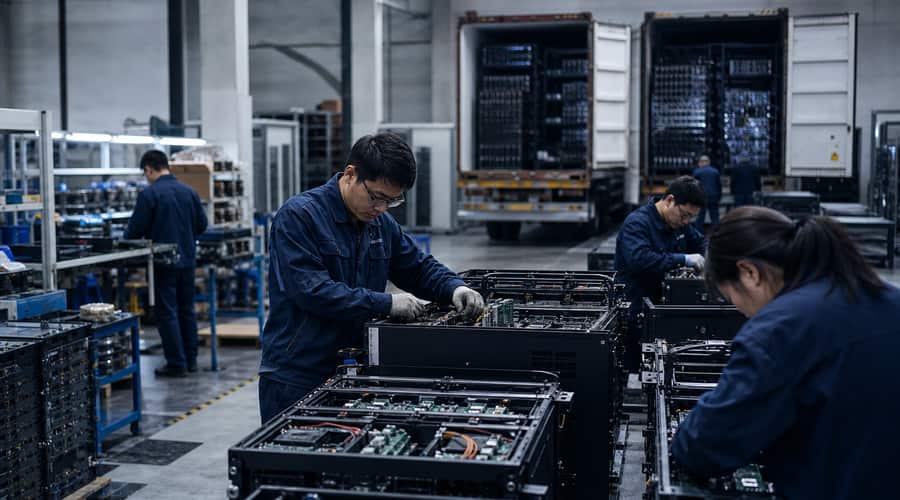
U.S. prosecutors have unsealed a series of indictments, including a case involving Super Micro Computer's co-founder and at least two other criminal networks, that show billions of dollars in restricted Nvidia AI chips moving from the United States to China through Thailand, Malaysia, and Singapore via shell companies, relabelled hardware, and staged dummy servers, suggesting that export controls are losing ground to a well-organised transshipment economy.
The mechanics of the smuggling cases make the policy problem concrete. In one pattern, buyers falsely identified U.S. data center companies or Thailand-based front operations as the end users when placing orders for restricted Nvidia H100 servers. Once delivered to warehouses in the United States or Taiwan, the hardware was relabelled, sometimes under a fake brand called SANDKYAN, then misclassified as adapters or generic components before shipment onward through Thailand or Malaysia to Hong Kong and mainland China. In the Super Micro case, prosecutors allege approximately $2.5 billion worth of servers left for Thailand-based companies between 2024 and 2025, with around $510 million in a single six-week period in spring 2025. These are not artisanal operations. They are logistics networks designed to move restricted technology at scale.
Thailand has emerged as the central transshipment node in multiple indictments, a geography that reflects market access, light regulatory oversight, and proximity to mainland China via Hong Kong routing. Malaysia, Singapore, and Vietnam have also appeared in enforcement cases, and U.S. senators including JD Vance and Elizabeth Warren have written to the Commerce Department demanding a suspension of export licences for advanced Nvidia chips to Southeast Asian intermediaries. Washington separately moved to consider capping H200 chip sales to Chinese buyers at 75,000 units per company, alongside AMD MI325 shipments, to try to create demand-side limits in cases where direct export controls are being circumvented.
Alibaba's role in the current enforcement focus is specific and still developing. Bloomberg reported in January 2026 that Chinese officials had told Alibaba and other large tech firms they could begin preparing orders for Nvidia H200 chips under a framework that might allow licensed sales. That created a legal gray area where some Chinese buyers may have been acting on official guidance while others used parallel smuggling channels to obtain the same chips faster. U.S. agencies are now reviewing whether restricted chips reached Alibaba's data centers through Thai transshipment, and neither Alibaba nor U.S. authorities have publicly confirmed the details of that investigation. The broader pattern is established even if the Alibaba-specific case is still under scrutiny.
For SF readers, the enforcement landscape matters because it reveals how fragile the supply-side assumptions behind AI chip scarcity actually are. Export controls were designed to slow China's access to frontier accelerators. If those controls can be systematically circumvented through Southeast Asian transshipment at billion-dollar scale, the intended friction is not holding. That affects every downstream market. Startups and cloud providers in the West that compete with Chinese AI labs depend in part on the premise that their counterparts have less compute. If smuggling networks erode that gap, the competitive moat narrows. It also reinforces that GPU scarcity in the legitimate market is partly policy-driven, and policy can change in ways that matter to infrastructure planning.
The pressure on Nvidia is subtle but real. The company cooperates closely with the Bureau of Industry and Security and has stated publicly that it does not support illegal diversion. But its chips are the object of desire precisely because they are so capable that sophisticated actors will absorb the cost and legal risk of smuggling them. That creates a reputational and regulatory exposure that Nvidia cannot fully control. The company can audit end-user agreements. It cannot easily stop determined transshipment once hardware leaves the licensed distribution chain. The enforcement burden falls on distributors, resellers, and the government agencies trying to track controlled technology across complex multi-hop shipping routes.
The strategic consequence that matters most for the long term is domestic Chinese chip development. Every enforcement action, every seized pallet, and every criminal indictment makes restricted Nvidia chips slightly harder and more expensive to obtain through smuggling channels. That increases the return on investment for domestic alternatives like Huawei Ascend and Baidu Kunlunxin. It may not be enough to close the capability gap in the near term, but it concentrates demand in ways that strengthen the business case for domestic supply. China's decision to push companies toward domestic accelerators is partly ideological and partly a rational response to an enforcement environment that is visibly tightening. The irony is that stricter enforcement may accelerate exactly the technology independence Washington is trying to prevent. The answer is not looser controls. It is faster domestic semiconductor development on the other side of the Atlantic and Pacific, which is exactly what the U.S. CHIPS Act and European chip initiatives are trying to do, on timelines that are measured in years rather than quarters.
Also read: TSMC's record quarter is proof that AI infrastructure spending is real, not just projected • Minnesota's first-in-the-nation AI nudification law shows regulation is moving from rhetoric to criminal liability • Baidu's Kunlunxin IPO shows China's AI chip race is now a capital markets story