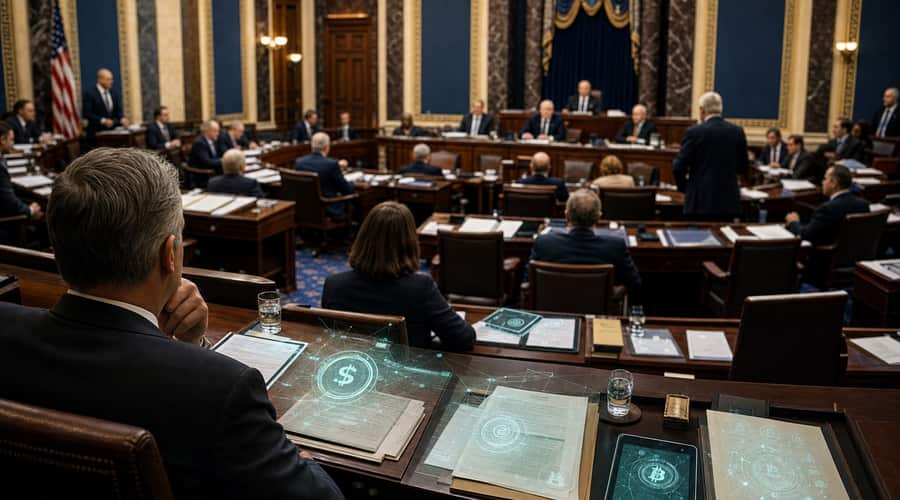
The CLARITY Act is the closest Congress has come to writing real crypto market rules into US law. If the Senate can't move before the August recess, token issuers and exchanges don't get clarity, they get another year of guessing.
Congress has spent years talking about crypto rules and then letting the hard part slide. The Digital Asset Market Clarity Act is different because it has already survived real votes: the House passed it 294-134 in July 2025, and the Senate Banking Committee advanced its version 15-9 on May 14, 2026, with two Democrats joining Republicans. According to Barron's, that committee vote was enough to lift Coinbase shares and turn the bill into the industry's best shot at a federal market structure law.
You should care about the calendar, not the speeches. As of June 19, the bill still doesn't have a Senate floor vote, and the chamber has only a tight run of working days before the August recess. The Senate can make time when leadership wants to make time, but crypto legislation still has to compete with budget work, surveillance law, housing bills and everything else members would rather finish before they leave Washington.
The bill's central move is simple: it tells the market which digital assets sit with the SEC and which belong with the CFTC. That question has shaped almost every serious crypto business decision in the US for years. If you're issuing a token, listing assets on an exchange, building a wallet or funding a DeFi protocol, you don't want to learn the rules through an enforcement action after the product is live.
Under the Senate Banking text released in May, Bitcoin and similar decentralized commodities would fall under CFTC oversight. Tokens initially sold through investment contracts could start under SEC rules and later move into a commodities framework once the network meets a decentralization test. That part is the live wire. Ethereum, Solana and Avalanche are not identical projects, but every large network that grew out of a token sale has an obvious interest in how Congress defines that path out of securities treatment.
Investor's Business Daily reported that the Senate text runs 309 pages and also includes stablecoin provisions, disclosure rules, insider trading language and studies on DeFi, cybersecurity and quantum computing. That's a lot for one bill to carry. Frankly, it is also why this thing can still stall even after a strong committee vote. The crypto industry wants a clean jurisdictional answer. Senators are trying to attach consumer protection, ethics language, banking compromises and agency turf lines to the same vehicle.
The Senate Is The Bottleneck
The House is not the problem now. Rep. Dusty Johnson, who chairs the House Agriculture subcommittee on digital assets, said on June 18 that the House would move quickly if the Senate acts before recess. That is the right signal, but it doesn't solve the vote count. A Senate floor vote needs 60 votes, not 51, so Republicans need Democratic support beyond committee.
The two Banking Committee Democrats who backed the bill, Ruben Gallego and Angela Alsobrooks, did not give Senate leaders a blank check. Barron's reported that Democrats wanted stronger ethics language aimed at government officials profiting from crypto holdings, an issue that has become harder to separate from the bill because President Donald Trump and his family have been active around crypto ventures. You may like that fight or hate it, but it is not a side issue in the Senate. It is one of the reasons a committee win does not automatically become a floor win.
There is also a second bill track to reconcile. The Senate Agriculture Committee has worked on digital commodity intermediary rules, and its approach overlaps with Banking's market structure text. That means the Senate still has to merge jurisdiction, registration and intermediary language into something members can vote on. As CCN noted, the bill still has several procedural steps before it reaches the President's desk: Senate passage, agreement with the House, final passage in both chambers and a signature.
DeFi is where the bill gets most practical for builders. The current text gives non-custodial software a safer position: writing and deploying smart contracts does not automatically make a developer a regulated financial intermediary if they do not custody customer assets or operate the service as a middleman. After years of SEC pressure on protocol founders and decentralized exchange teams, that is not a minor drafting point. It is the difference between shipping code and hiring securities counsel before every release.
Centralized exchanges get the opposite bargain. Coinbase and other trading platforms gain a route to clearer listings, but they also get more paperwork and a more formal registration path. Token issuers face the same trade. Ambiguity has been expensive, but clarity will not be free.
If the Senate misses August, the industry does not fall apart. Coinbase keeps trading, Uniswap keeps building, and Bitcoin will not wait for Congress to organize itself. But the US market stays stuck with the same awkward system it has now: enforcement first, legislation later, and businesses trying to infer national policy from lawsuits and agency statements. That is a poor way to regulate a trillion-dollar market.
The CLARITY Act is closer than any crypto market structure bill before it. That is true. It is also not law, and in the Senate that difference is everything.
Also read: Bitcoin's liquidation machine keeps running because leverage never left the building; A DeFi Portfolio Strategy Built to Survive the Next Bear Market; EarnOS raises $18.5 million to pay real people for engaging with brands as bot traffic swamps the web