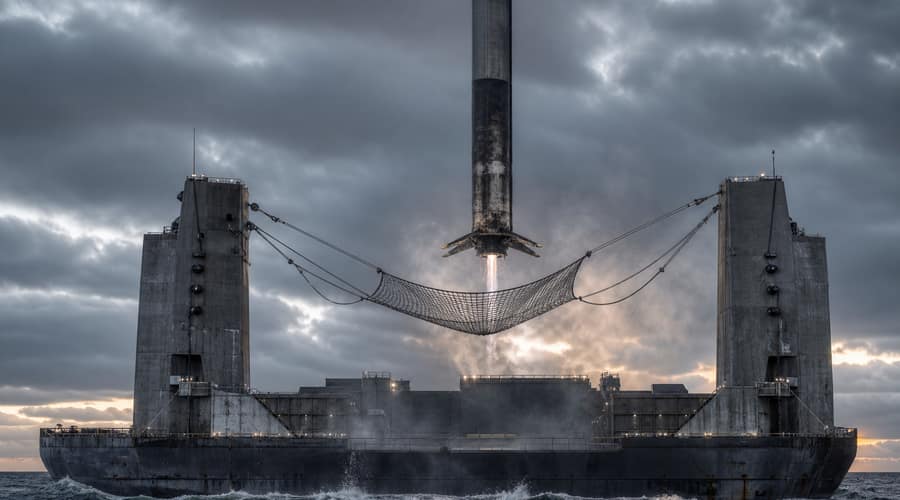
China's net catch at sea is a real reusable-rocket milestone. It is not proof that SpaceX has been caught, because the hard part is doing this again and again.
China did something on July 10 that you don't see every launch day: it sent the first stage of a Long March-10B back toward a ship in the South China Sea and caught it in a net.
It worked.
According to the Associated Press and Space.com, the rocket lifted off from Hainan Island on its maiden flight, placed a satellite into orbit, and then brought the first stage down onto a sea-based recovery platform. The booster did not settle onto landing legs like a Falcon 9. It used hooks and a net-like cable system on the ship, a method China Aerospace Science and Technology Corporation has described as the world's first network-based recovery of a launch vehicle.
That is why the SpaceX comparison arrived so quickly. MarketWatch framed the flight as a new step in the race to rival Elon Musk's rocket company, and Chinese coverage leaned into the same point. You can see why. A reusable first stage is not a side feature in modern launch. It is the piece that changes cost, cadence, and how quickly a country can put satellites into orbit.
The Net Is The Point
Here's what separates this from the SpaceX playbook. Falcon 9 boosters descend on deployable legs, usually onto a drone ship or a landing zone. Starship's Super Heavy booster is built around a different theater entirely, with SpaceX using tower arms, nicknamed chopsticks, to catch it at the launch site.
China's Long March-10B chose the ship instead of the legs. The vehicle comes down to a floating platform, and the recovery hardware does more of the work. If the approach holds up over repeated flights, it could save mass on the booster by avoiding heavy landing legs. More room for payload, in plain English.
The rocket itself is not a small test article. Space.com reported that the Long March-10B stands about 207 feet tall, uses kerosene and liquid oxygen on the first stage, and uses liquid oxygen and methane on the second. It is designed to carry about 16 metric tons to low Earth orbit in reusable mode. That puts it in the class China needs for big satellite deployments, not just demonstration flights.
There is also a lunar shadow over this. The Long March-10B shares development roots with the Long March-10 family that China is building for future crewed missions, including the country's plan to land astronauts on the moon before 2030. So this is not only about a single booster landing cleanly. It is about whether China's state-backed launch program can turn reusability into normal operating procedure.
SpaceX Still Owns The Cadence
Frankly, the scoreboard still belongs to SpaceX. AP reported that SpaceX has logged more than 600 successful booster landings and recently flew one Falcon 9 booster for a 36th time. That is the standard China is chasing. One catch is a milestone. Hundreds of recoveries are an industrial system.
The payload comparison also keeps the story grounded. AP put Long March-10B's low-Earth-orbit capacity at 16,000 kilograms, against 22,800 kilograms for Falcon 9. SpaceX also flew 165 orbital launches in 2025, according to Space.com, nearly doubling China's total launch activity for the year. That gap is not branding. It is hardware, operations, suppliers, launch pads, engines, recovery ships, and teams that already know how to turn a landed booster around.
China has been trying to close that gap in public. LandSpace attempted a reusable Zhuque-3 booster recovery in 2025 and lost the stage during landing. A Long March-12A recovery attempt also failed later that year, according to spaceflight records cited by industry reports. The Long March-10B net catch lands differently because it came on the rocket's first orbital flight and left China with an intact booster it plans to fly again before the end of 2026.
That last detail is the one to watch. If CALT reflights the same stage this year, the story moves from spectacle to proof. If it struggles to repeat the recovery, SpaceX remains far ahead and China has a very good video. Both things can be true at once. The catch was real, and the race is still mostly about repetition.
Also read: Researchers hacked a quantum neural network on real trapped-ion hardware and gutted its accuracy • Sam Altman Calls Elon Musk Homeboy in Their Latest Fight Over AI Infrastructure • Langulife Bets Real Conversation Beats Another Round of Flashcards