Three nuclear startups hit Trump's July 4 reactor deadline, but you should read the milestone carefully. Criticality is real progress, not a working nuclear power business.
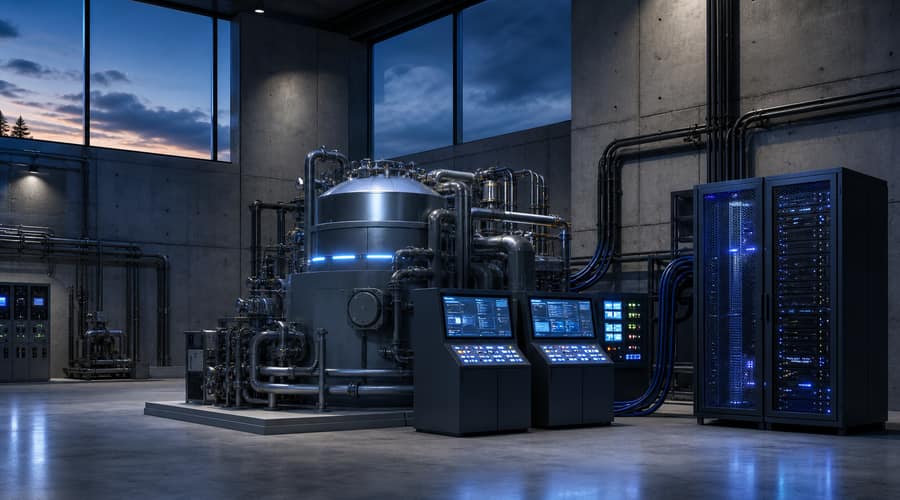
On July 1, Valar Atomics stood up in Emery County, Utah, and did the thing AI power optimists have been waiting to see: it used a nuclear microreactor to send electricity into Nvidia hardware. According to Tom's Hardware, Valar's Ward 250 reactor produced about 100 kilowatts of thermal energy during the demonstration, pushed heat through a pressurized helium loop, and used a thermoelectric generator to power an Nvidia Blackwell chip serving a live website.
That is a sharp demo. It is not a data center deal.
The bigger story is the four-week sprint around it. Antares Nuclear's Mark-0 reached criticality on June 4 at Idaho National Laboratory. Valar's Ward 250 followed in June at the San Rafael Energy Lab site in Orangeville, Utah, then showed power production in Emery County on July 1. Deployable Energy's Unity reactor reached the same basic milestone by the end of June. Wired and Barron's both reported this week that the three companies met the Trump administration's July 4, 2026 goal for at least three advanced reactor concepts to reach criticality.
Criticality is the point where a nuclear chain reaction sustains itself. If you care about power, that definition matters. It means the reactor physics worked well enough to turn on. It doesn't mean the company has proved years of reliable operation, commercial fuel supply, customer pricing, insurance, grid interconnection, or the boring paperwork that decides whether a power project survives contact with reality.
Antares still deserves attention. The Department of Energy said its Mark-0 test was the first advanced reactor in the Reactor Pilot Program to reach criticality, and the Associated Press reported that the California company is aiming to begin producing electricity by late 2027 and field systems by the end of 2028. Antares is not pitching a suburban utility plant first. Its early market is defense, where remote bases, radars, servers, and drone charging all make diesel logistics look weak.
You can see why Washington likes that version of the story. A microreactor small enough to move and steady enough to run a forward site is easier to sell politically than another decade-long fight over a giant plant. Axios reported that BWX Technologies supplied the TRISO fuel for Antares's test, which gives the milestone more weight than a slide deck. Fuel was loaded. The chain reaction happened. The company now has a real test result to put against its roadmap.
The Nvidia demo is smaller than the headline
Valar is playing a different game. Its public image is built around AI power, not only defense. The July 1 Nvidia demonstration gives it the clearest visual of the three companies: uranium atoms fissioning in one room, a Blackwell chip running from the resulting current in another. You don't need to love nuclear marketing to understand why that image travels.
But look at the scale. Tom's Hardware reported that Valar turned the reactor up to 37 percent capacity and generated 100 kilowatts of thermal energy during the stage demo. That is enough to make a point, not enough to run the kind of AI campus that Microsoft, Google, Amazon, or Oracle are trying to feed. A single dense AI rack can draw well over 100 kilowatts. A serious campus needs hundreds of megawatts. Some plans talk in gigawatts.
Here's the thing: electrons reaching one Nvidia system prove a circuit, not a market.
Valar says its Ward 250 design is meant to scale into larger installations, and Tom's Hardware reported that the company is working with Nvidia on a 30-megawatt closed-loop AI factory that doesn't use local water. That is more concrete than the usual nuclear startup promise, because it names a partner, a power level, and a use case. Still, there is no public hyperscaler offtake agreement attached to the July 1 demo. No signed Microsoft campus. No Google power purchase. No multi-year data center revenue line you can underwrite.
Deployable Energy is the quiet one in this group, but its Unity reactor rounds out the DOE deadline because it points at a third market: container-sized power for remote and defense sites. Barron's described the three winners as privately held startups, with Antares and Valar based in California and Deployable Energy in Houston. That mix tells you something. The first commercial buyers for microreactors may not be the loudest AI companies. They may be military and industrial customers willing to pay more for power where the grid is weak or absent.
The money is already chasing the possibility. Antares announced a $96 million Series B in December 2025. Valar raised $130 million before its later financing burst, with investors including Palmer Luckey and Palantir chief technology officer Shyam Sankar. Those names help. They don't remove the hard parts.
Nuclear startups have now cleared a test that critics used to say would take much longer. Good. You should still separate a reactor reaching criticality from a business delivering power for years at a price customers will sign. The first happened before July 4. The second is the whole company.
Also read: HCLTech beats Infosys to land a $1.14 billion AI deal with Mercedes-Benz, Alibaba Bans Claude Code After Hidden Anthropic Tracking Code Surfaces, Israel Turns Its Pact With Argentina Into an AI Foothold in Latin America