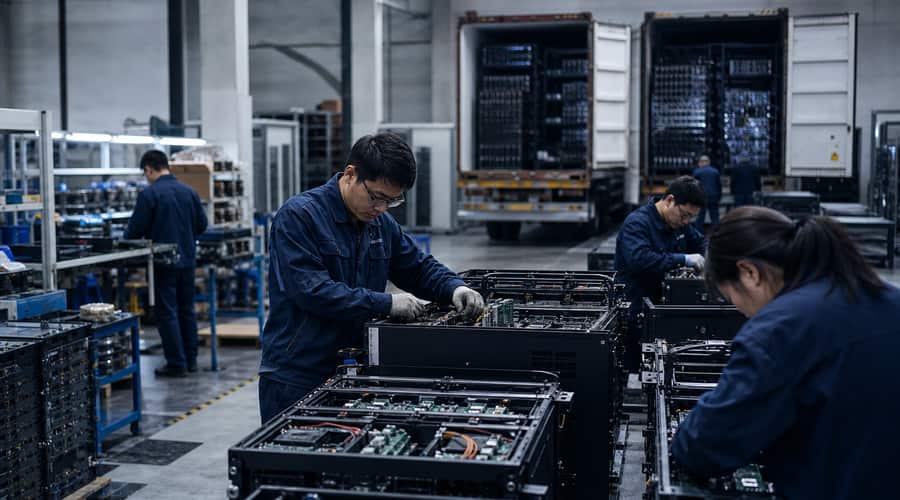
Nearly half of US data centers planned for this year face delays or cancellation as Trump's tariffs choke off the critical power equipment needed to build them.
Donald Trump wanted the United States to win the artificial intelligence race against China, and he said so explicitly in a series of executive orders that made rapid data center construction a top national priority. The ambition was clear: outbuild everyone, outcompute everyone, and cement American dominance in the most consequential technology since the internet. But the policy execution has run headfirst into a wall built by the administration itself.
Tariffs on Chinese imports are now directly responsible for stalling the very infrastructure Trump promised to accelerate. According to reporting from Bloomberg, almost half of the US data centers originally planned for this year are expected to be delayed or canceled because developers cannot import enough transformers, switchgear, and batteries. These are not optional components. They are the backbone of any data center's power infrastructure, the equipment that takes electricity from the grid and makes it usable for thousands of GPUs running in parallel. Without them, there is no facility. Without the facility, there is no compute capacity. Without compute capacity, the AI race slows to a crawl.
The core problem is deceptively simple. Data centers demand enormous amounts of electrical power, and that power has to be managed, converted, stored, and distributed through specialized industrial equipment. Transformers step down high-voltage grid electricity to usable levels. Switchgear controls and protects the flow. Battery systems provide backup and stability when demand spikes or the grid hiccups. A single large AI data center can consume as much electricity as a small city, and the power infrastructure required to support that load is not something you can source from a domestic supplier on short notice.
The United States has limited domestic manufacturing capacity for heavy electrical equipment. For years, the industry has relied on imports from China and Southeast Asia to fill the gap. Trump's tariffs, which were designed to protect American manufacturing and reduce dependence on foreign supply chains, have instead made it dramatically more expensive and logistically difficult to build the facilities that AI companies like OpenAI, Google, and Microsoft desperately need. The irony is sharp enough to cut through steel beam.
Global demand for data center capacity has been surging at an unprecedented pace since generative AI went mainstream in late 2022. Companies like Amazon Web Services, Microsoft Azure, and Google Cloud have committed tens of billions of dollars to expand their infrastructure footprints. Meta has announced plans for a data center so large it would cover a significant portion of central Louisiana. These are not speculative ventures. They are driven by real and growing demand from enterprises adopting AI tools across every industry, from healthcare diagnostics to financial modeling to autonomous vehicles. The market need is there. The political will, at least rhetorically, is there. The physical supply chain is not.
What This Means For The AI Industry
The immediate impact is straightforward: higher costs and longer timelines. Data center developers now face a brutal choice. They can absorb the tariff costs and accept thinner margins, they can pass those costs on to the cloud providers who lease their capacity, or they can shelve projects entirely until the economics improve. All three options are bad for the pace of AI development in the United States.
Longer term, the bottleneck could reshape where AI infrastructure gets built. If the United States cannot reliably supply the power equipment needed for domestic data centers, companies may accelerate investments in regions with more favorable trade dynamics. Parts of Europe, the Middle East, and Southeast Asia have been aggressively courting data center investment, and supply chain friction at home only makes those alternatives more attractive. This is not a hypothetical concern. It is already happening, as major cloud providers have been expanding their presence in markets like Singapore, the United Arab Emirates, and Ireland precisely because regulatory and trade conditions are more predictable.
The policy contradiction at the heart of this situation deserves attention. You cannot declare AI dominance a national priority and simultaneously impose trade barriers that prevent the construction of the infrastructure required to achieve it. The tariffs were not designed with data centers in mind. They were designed for a broader economic and geopolitical agenda. But technology infrastructure does not care about political messaging. It cares about transformers, switchgear, batteries, and the long supply chains that deliver them. Right now, those supply chains are broken, and no executive order can fix that.
For startups and enterprises betting their strategies on access to affordable AI compute, this is a signal worth watching. If data center capacity growth slows, compute costs could rise, availability could tighten, and the competitive advantage of being early to AI adoption could diminish. The companies that secure long-term compute contracts now may be very glad they did. The ones that assume infinite capacity will always be available may be in for an uncomfortable surprise.