American lithium startups are testing a simpler way into Europe’s battery supply chain: use old industrial sites, existing wells, and brine that is already moving through the ground.
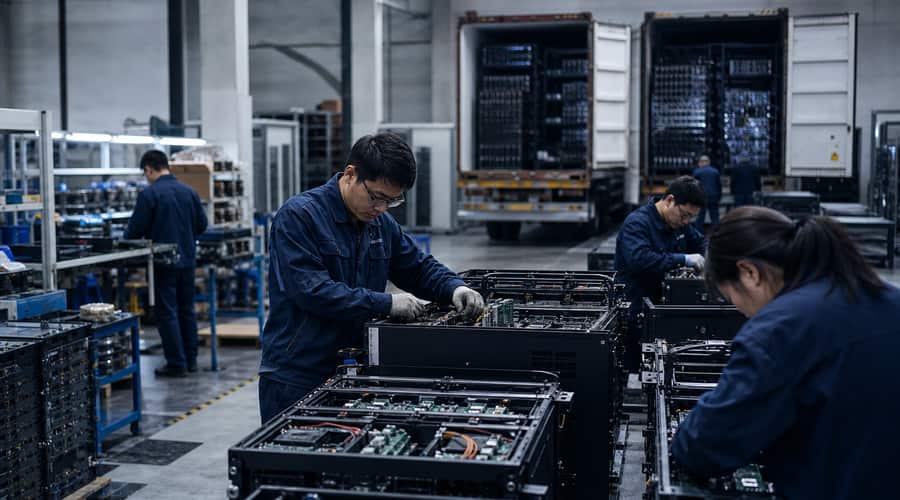
Lilac Solutions did not come to Germany with the pitch of opening a new mine on untouched land. The Oakland company brought a containerized direct lithium extraction system to Neptune Energy’s operating gas site in Steinitz, Saxony-Anhalt, and processed lithium-bearing brine from existing natural gas wells. The pilot began in May 2025 and, according to Lilac, became its first European lithium pilot with Neptune Energy.
That detail matters because Europe does not have a simple lithium shortage. It has a permitting shortage, a political tolerance shortage, and a growing gap between what its automakers need and what the continent can produce at home. For companies like Lilac, the argument is that Europe’s fastest lithium route may run through brownfield industrial land rather than through new open-pit mines.
Neptune’s Altmark position explains why the idea has attention. In September 2025, Neptune said independent assessors Sproule ERCE had defined resources of 43 million tonnes of lithium carbonate equivalent in the region, after work commissioned in August. That would put Altmark among the largest identified lithium resources in the world. The company has also said the region combines lithium-bearing brine, existing energy infrastructure, and decades of subsurface operating experience.
The Upper Rhine Valley is moving in the same direction. Vulcan Energy Resources, the Australian-listed company developing geothermal lithium in Germany and France, has offtake agreements with major industrial customers, including Volkswagen. The more recent development is that Vulcan’s Lionheart project has moved from ambition into construction and financing. Reports in April and May 2026 showed the company beginning major construction work at its Frankfurt lithium chemical plant and reaching financial close on a EUR 2.2 billion funding package. Its current commercial production target is 2028, not the earlier 2026 schedule attached to some older offtake plans.
For European automakers, that timing is uncomfortable but still important. Battery plants being built by Volkswagen, Stellantis, Mercedes-Benz, Renault, and their suppliers need reliable lithium hydroxide and lithium carbonate streams. Importing from Australia, Chile, Argentina, and China works until prices spike, logistics tighten, or governments start treating battery materials as strategic leverage. Domestic supply is not just an environmental talking point. It is a hedge against being forced to build electric vehicles with someone else’s supply chain.
According to the European Commission, the Critical Raw Materials Act sets a 2030 benchmark for the EU to extract at least 10 percent of its annual consumption of strategic raw materials inside the bloc, with shorter permitting timelines for designated strategic projects. That is useful, but it does not make local opposition vanish. Conventional mine approvals in Europe can still take years because communities worry about water use, tailings, traffic, and long-term landscape damage.
This is where direct lithium extraction has its political advantage. At a site like Steinitz, brine is already connected to industrial operations. Lilac’s ion-exchange technology is designed to pull lithium from that brine, concentrate it, and return the depleted fluid underground. In plain terms, the sales pitch is no open pit, no tailings dam, and no new scar across farmland. That does not remove every environmental question, but it changes the conversation from whether to approve a new mine to whether existing industrial infrastructure can produce a battery material with less surface disruption.
Water is the second reason this model is attractive. Hard-rock lithium mining and evaporation-based brine production both carry visible environmental costs, especially in regions already sensitive to land and water pressure. Closed-loop brine projects promise a smaller footprint. Local officials can present them as a way to repurpose legacy energy assets rather than invite a new extractive industry into rural communities.
The economic case is less settled. Lithium prices fell sharply after their 2022 highs, putting pressure on producers and making investors more skeptical of expensive projects. DLE companies argue that modular equipment and existing wells can lower upfront costs. That may be true in some basins, but commercial scale remains the test. A pilot that runs for months and produces battery-grade material is not the same thing as a plant producing thousands of tonnes a year under contract.
There are also risks that do not disappear because the technology sounds cleaner. Mineral rights in Europe can be fragmented across surface owners, regional authorities, and subsurface license holders. Geothermal brine projects in parts of the Rhine Valley have faced scrutiny over induced seismicity. Regulators will also want evidence that reinjection, chemical handling, and long-term reservoir management can be controlled safely.
Competition is tightening at the same time. Standard Lithium is advancing direct lithium extraction in Arkansas. EnergyX, backed by General Motors, has worked on pilots in South America and has shown interest in Europe. Vulcan has the advantage of deep local partnerships and a project now moving through construction. Lilac has the advantage of technology that can be dropped into existing brine operations. The winners will be the companies that turn pilots into permitted, financed, repeatable production systems.
The question for Europe is whether urgency can overcome habit. The lithium is there. The industrial sites are there. The automakers are waiting. If brownfield brine extraction scales, Europe gets a realistic path to meaningful domestic battery material supply before the decade is over. If it stalls, the continent’s 2030 targets will look less like a plan and more like a warning.
Also read: Bernie Sanders wants the government to own half of OpenAI and Anthropic and the AI industry is already pricing in the risk • GoPro is running out of road as the AI memory crunch turns a camera company into collateral damage • Tencent's plan to embed a full AI agent inside WeChat puts 1.4 billion users at the center of China's platform war