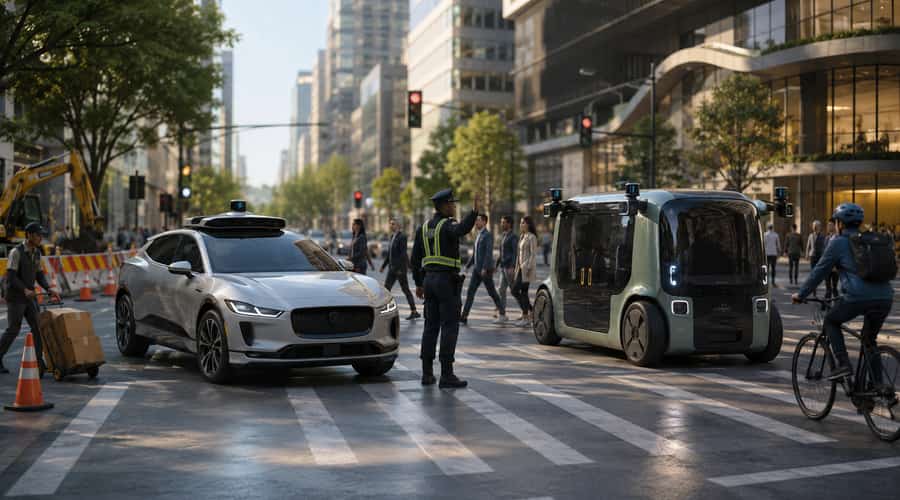
A frozen meeting between a Waymo and a Zoox robotaxi in San Francisco is more than a viral clip. It shows that autonomous fleets now need to learn how to negotiate with each other, not just with human drivers.
The awkward part of the robotaxi future is not always a dramatic crash or a regulatory showdown. Sometimes it is two expensive autonomous vehicles facing each other in the street, both apparently waiting for the other one to make the first move.
That is what made the latest San Francisco standoff between Waymo and Zoox travel so quickly online. According to a report from Torque News, a video shared on May 31 showed an Amazon-owned Zoox vehicle and an Alphabet-owned Waymo vehicle stopped in an apparent face-off while human drivers worked their way around them. The scene was funny in the way these moments often are. It was also useful, because it made a hard technical problem visible to everyone.
San Francisco is not a clean test track. It is hills, construction, delivery vans, cyclists, impatient drivers, emergency vehicles and streets that often demand a small act of negotiation before anyone moves. Human drivers handle that mess imperfectly, but they do it with eye contact, nudges, hand waves and a sense of when strict right-of-way rules no longer answer the question. Robotaxis do not have that social layer in the same way.
Waymo and Zoox both build for caution, which is exactly what the public says it wants until caution becomes paralysis. A driverless car that is too assertive becomes a safety story. A driverless car that is too conservative becomes a traffic story. The business challenge is finding the narrow space between those two outcomes, then repeating it thousands of times a day.
For years, autonomous vehicle companies talked about edge cases as if they were rare exceptions to be solved on the road to scale. That was true when fleets were small and testing was limited. It becomes less true when robotaxis are operating in the same dense markets, using different hardware, different software and different ideas about what a safe next move looks like.
Waymo is the clear leader in U.S. robotaxi deployment. Its own safety data says it had driven 170.7 million rider-only miles without a human driver through December 2025, and its cars are now a familiar part of daily traffic in several major markets. Zoox is earlier in its commercial arc, but it is no longer just a laboratory project. The company says its Explorers program is live in San Francisco, and it opened a rider lounge in Union Square this month to support complimentary robotaxi rides around the city.
That makes the interaction between the two companies more important. A Waymo vehicle does not need to understand Zoox as a corporate rival. It needs to understand the Zoox vehicle as a road user with its own intent, safety envelope and decision logic. The reverse is also true. If neither vehicle is willing to commit, the system defaults to waiting.
There is no sign from the public reports that this particular incident caused injuries or property damage. That matters. A short deadlock is not the same as a collision. But it still creates a cost for everyone else on the street. Human drivers lose time. Emergency access can become harder. Public confidence takes another small hit.
Coordination cannot be an afterthought
The deeper question is whether autonomous vehicle operators need stronger ways for fleets to communicate with each other. Today, much of the work is still done by onboard perception and prediction. The vehicle observes the world, classifies what it sees and decides what to do. That is powerful, but it also means each company is reading the same street through its own private system.
Inter-fleet communication standards could help, at least in theory. A robotaxi might signal intent more precisely than a turn signal or brake light can. It might tell nearby autonomous vehicles that it plans to yield, reverse, pull over or proceed. The difficulty is that standards require competitors to agree on shared behavior before the market fully knows which behaviors work best.
There is also a liability question hiding inside the technical one. California’s DMV administers permits for autonomous vehicle testing and deployment, and manufacturers must report certain collisions involving property damage, injury or death. NHTSA also requires identified autonomous vehicle operators and manufacturers to report certain crashes when automated driving systems are engaged. A deadlock without contact sits in a less obvious category. It may not be a crash, but it can still be a public-road failure.
That distinction matters for entrepreneurs and investors watching the sector. Robotaxi companies are not only selling transportation. They are selling operational reliability in an environment they do not control. The winners will not be the companies with the cleanest demo videos. They will be the ones that can handle boring, messy, low-speed ambiguity without making the city work around them.
For Waymo, the standoff is a reminder that scale brings scrutiny in proportion to visibility. For Zoox, it shows how quickly a new public presence becomes part of a broader judgment about the category. The market will forgive some awkward moments if the service keeps improving, but it will not tolerate a future where every fleet speaks only its own language.
The next phase of autonomous driving will be less about proving that a car can drive itself in ideal conditions and more about proving that many autonomous systems can share one city without freezing when the script runs out. That is where the real business test begins.
Also read: China's factory slowdown puts pressure on Beijing's tech push • Joby brings the air taxi race back to Manhattan. • OpenAI's Codex limit reset shows coding agents are entering costly scale