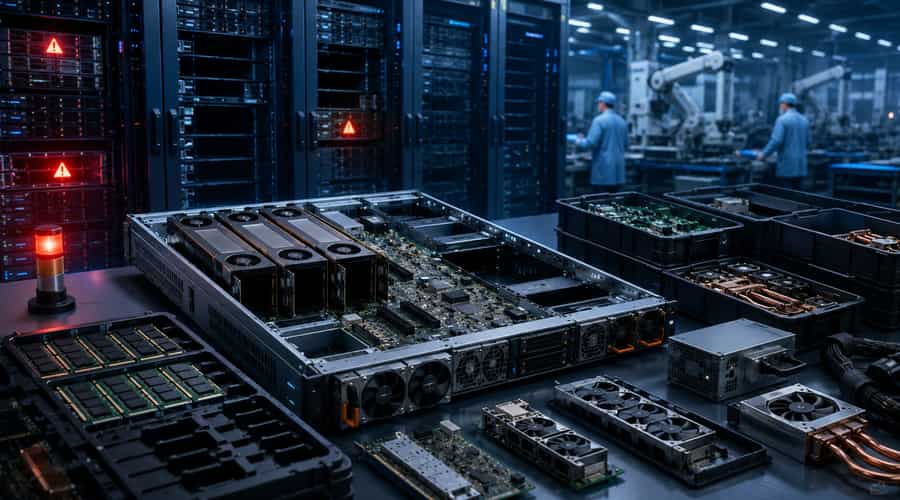
AI infrastructure is no longer hitting one bottleneck. Wiwynn says shortages are now spreading across multiple hardware layers, which could make the build-out slower and more expensive than investors have been assuming.
That is the important shift in the latest warning from Wiwynn, the Taiwan-based server maker that counts Nvidia among its key supply chain partners. Bloomberg reported on May 28 that the company is seeing shortages develop in vital data center components beyond memory chips, a sign that the strain inside the AI boom is becoming more distributed.
For months, the market has treated high-bandwidth memory as the obvious choke point. That remains true, but it is no longer the whole story. Bloomberg's earlier reporting on May 12 described AI data centers as relying on a wide web of tiny, essential parts, from components that transmit data to systems that regulate electricity and keep servers cool. Wiwynn's warning suggests those pressures are now showing up in the order books, not just the engineering drawings.
That matters because the AI spending cycle depends on speed. Hyperscalers are pouring money into new capacity, and if one constraint slips into another, the whole timeline stretches. What looks like a memory shortage can quickly become a networking issue, a power issue, or a cooling issue. At that point, the problem is not one part. It is the stack.
Wiwynn chair Emily Hong told Bloomberg that demand for data center hardware should stay red-hot for three to five years as companies including Meta Platforms and Microsoft continue to lift capital spending. But she also said the race to secure essential components, from memory to networking chips, is pushing hardware prices to record highs.
Bloomberg's report did not frame the issue as a single missing component. Instead, it pointed to shortages developing across vital parts of the data center supply chain, which is exactly what makes this more serious than a one-off memory squeeze. When multiple layers tighten at once, procurement teams lose flexibility. They can no longer simply source around a weak point without creating pressure somewhere else.
That aligns with the broader picture Bloomberg sketched in its May 12 story, where it said bottlenecks are appearing everywhere from memory chips to battery systems. The AI build-out is no longer only a semiconductor story. It is a systems story, and that is a far less forgiving one for buyers.
Wiwynn also said it is hard to pin down where the next crunch will emerge because production capacity is being expanded constantly. That sounds reassuring until you remember how fast demand is moving. If every supplier is racing to add output, the constraint simply migrates to the next layer with the slowest lead time.
What buyers will do next
The likely response from cloud buyers is already taking shape. They will not just chase GPUs and memory, they will lock in more of the surrounding hardware earlier, negotiate for integrated rack-level supply, and spread orders across more vendors to reduce the risk of being trapped by a single shortage.
That kind of procurement shift favors the biggest original design manufacturers, including companies such as Quanta and Foxconn, because they can bundle more of the rack build and control more of the bill of materials. Foxconn's recent earnings update showed how central AI servers have become to its growth story, and it said demand for AI server racks is expected to more than double this year. The company also warned that some cloud and networking products are moving to a consignment model, where clients supply key components instead of Foxconn buying them directly, which is another sign that buyers want tighter control over scarce parts.
Quanta has also been benefiting from strong AI server demand, while the market continues to watch whether other manufacturers will echo Wiwynn's message about shortages extending beyond memory. If they do, it would reinforce the idea that the AI supply chain is entering a more complex phase. The issue would no longer be just availability. It would be allocation, timing, and price.
That is the deeper implication for the capex cycle. If components across memory, networking, power delivery and cooling are all tightening together, then every new data center becomes harder to budget and harder to schedule. The result is not necessarily less spending. It is slower spending, and slower spending changes who captures the economics of the boom.
Wiwynn's warning is a reminder that the AI race is moving from chip scarcity to infrastructure scarcity. Once that happens, the winners are not just the companies with the best models. They are the ones that can secure enough physical hardware to keep those models running.
Also read: ByteDance is building custom CPUs to lessen its chip dependence • AtlasEdge wins 1.2 billion euro debt deal as Europe's data center race intensifies • Mistral AI's Airbus and BMW deals show Europe's industrial AI race is changing