
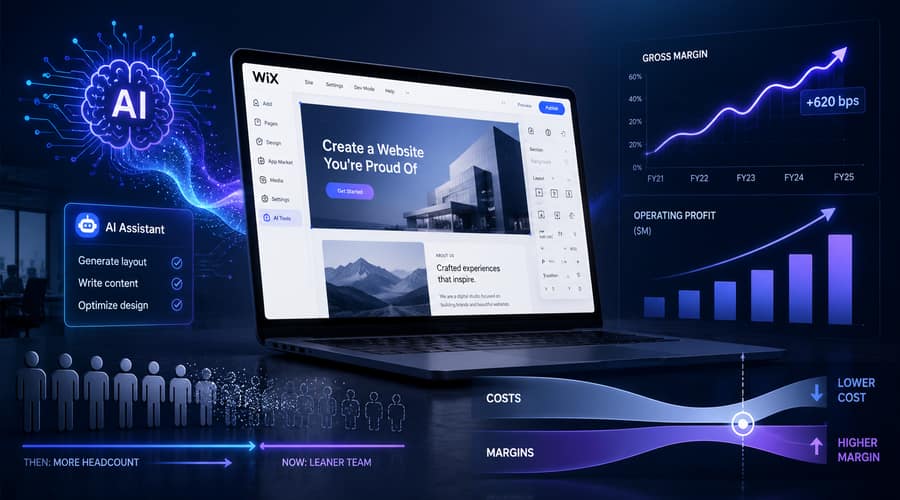
Wix is cutting roughly a fifth of its workforce, and AI is no longer sitting in the background of the story. It is part of the operating model, part of the cost problem, and part of the message to investors.
Wix is laying off about 1,000 employees, roughly 20% of its workforce, in the clearest sign yet that the AI boom is starting to change the shape of established software companies from the inside. This is not a small startup quietly trimming headcount after a funding round went cold. It is a public website-building company telling workers and shareholders that the way software businesses are built has changed.
CEO Avishai Abrahami announced the restructuring in a public post on X on May 28, pointing to the fast evolution of AI capabilities and pressure from currency exchange rates. According to TechRadar, the cuts will affect all departments and come with separation packages for employees. That matters because Wix is not only saying AI can make some work more efficient. It is saying the company itself has to be reorganized around that reality.
The numbers explain why this has become urgent. Wix had 5,277 employees at the end of the first quarter of 2026, so a 1,000-person reduction would take the company down toward a very different operating base. In the same quarter, Wix reported revenue of $541.2 million, up 14% from a year earlier, but it also posted a GAAP net loss of $57.5 million. Growth is still there. The problem is that growth is no longer enough to keep the old cost structure intact.
For years, the cleanest version of the AI story was simple: companies would add AI tools, employees would become more productive, customers would pay more, and software margins would improve. Wix shows why the real version is messier. AI may reduce the need for some roles, but it also requires new products, new infrastructure, new talent, and a willingness to spend before the return is obvious.
That is why the layoff cannot be read only as automation replacing people. It is also a company trying to fund an AI transition while protecting profitability. Wix bought Base44, an AI app-building startup founded by Maor Shlomo, for about $80 million in 2025. It also launched Wix Harmony in 2026, a product built around AI-assisted website creation. Those are not side projects. They are signals that Wix sees its future in software that lets users describe what they want and have more of the build handled automatically.
The tension is obvious. If AI tools make website and app creation easier, Wix has to move faster to stay relevant. But if those same tools compress the value of traditional web-building workflows, Wix also has to defend its pricing, margins, and role in the market. That is the difficult middle ground for many SaaS companies now. AI is both the product upgrade and the competitive threat.
Currency pressure adds another layer. Wix has a large employee base in Israel, while much of its revenue is dollar-denominated. When exchange rates move against the company, local operating costs become harder to carry. Abrahami cited that pressure alongside AI, which makes the restructuring look less like a pure technology decision and more like a financial reset forced by several pressures arriving at once.
The broader signal for software investors
Wix is not operating in a vacuum. Across the technology sector, companies are spending heavily on AI while trying to convince investors that the returns will justify the bill. Microsoft, Google, Amazon, and Meta are committing enormous sums to data centers, chips, and cloud infrastructure. At the same time, enterprise buyers are asking harder questions about cost, reliability, pricing, and actual productivity gains.
That is where this story becomes important for startups. Many AI-native companies have been valued on the assumption that enterprise adoption will move quickly and budgets will expand to meet demand. But if public software companies are cutting headcount to pay for AI transformation, the market is sending a more complicated message. Demand is real, but the willingness to absorb unlimited cost is not.
There is also a reputational issue. Companies can now describe layoffs as part of an AI transformation, and some of that will be true. Some roles will be changed, reduced, or removed because AI tools can take on more of the work. But there will also be cases where AI becomes a cleaner explanation for old-fashioned cost cutting after overhiring, weak margins, or missed investor expectations. Workers know the difference is not always easy to see from the outside.
For Wix customers, the practical question is whether a leaner, more AI-driven company can still deliver better products and support. For investors, the question is whether the savings from lower headcount will arrive faster than the costs of building and running AI systems. For startups, the lesson is sharper: it is no longer enough to say AI makes a product more powerful. The business model has to show who pays, how often they pay, and whether the margin survives after compute, support, and customer acquisition costs are counted.
The next phase of AI will be judged less by demos and more by operating leverage. Wix's cuts are a reminder that the AI boom is not only creating new companies and new products. It is forcing existing companies to decide what kind of organization they can afford to be.
Also read: Apple wants its smart glasses to become the next Apple Watch • Wix cuts 1,000 jobs as AI changes the software company playbook • MiniMax is bringing its AI listing story back to Shanghai