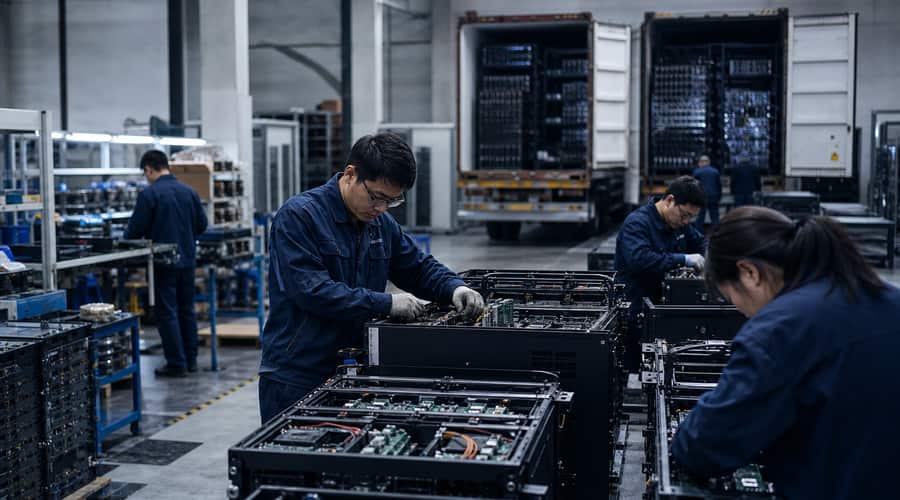
American workers are not rejecting AI at work. They are rejecting AI that watches, judges and replaces them without a human answerable for the decision.
The next fight over artificial intelligence is moving from the product roadmap to the shop floor. A new AFL-CIO poll shows that workers are broadly behind union-style limits on how employers use AI, especially when the technology touches hiring, firing, pay, scheduling, discipline or surveillance.
According to the Guardian's May 12 report, the survey of 1,588 workers conducted from April 14 to April 22 found that 95% support requiring a human final decision-maker for employment decisions. Another 92% support safeguards and transparency around workplace AI, while 78% say action against the negative effects of AI is important. Only 7% said their employer had disclosed AI monitoring at work.
That last number is the one startups should sit with. The issue is not only that workers are nervous about automation. It is that many believe AI is already entering the workplace without notice, consent or a clear way to appeal when the system gets something wrong.
For years, workplace AI has been sold as an efficiency story. Recruiters could screen faster. Managers could schedule smarter. Call centers could coach workers in real time. Warehouses could track productivity with more precision. Those promises still matter, but they are no longer the whole story.
The labor movement is trying to make AI a bargaining issue before companies treat it as ordinary software. AFL-CIO president Liz Shuler has framed the technology as one of labor's next major battlegrounds, and the federation's October 2025 worker-first AI principles set out a broad agenda: stronger bargaining rights, limits on harmful surveillance, transparency, human review, worker input and accountability when automated systems affect livelihoods.
This is not a niche concern for union households. The Guardian report also noted that workers trusted unions more than political parties or employers to protect them from workplace AI harms, with 38% choosing unions compared with 17% for Democrats and 10% for Republicans. That tells you something important about where the credibility gap sits. Workers do not necessarily believe management will police itself.
That matters because the real workplace risk is not a single dramatic replacement moment. It is the quiet layering of systems that measure tone, speed, breaks, keystrokes, location, output and responsiveness until a job becomes something a worker has little room to question. AI does not need to fire someone directly to change the balance of power. It can make the recommendation, narrow the options and leave a manager to rubber-stamp the result.
Startups Will Feel This In Procurement
For founders selling HR software, workforce analytics, monitoring tools, scheduling systems or agentic workflow products, this poll is a market signal. Buyers may still want productivity, but large employers, public agencies and unionized workplaces will increasingly ask how the system handles notice, auditability, appeal rights and human oversight.
That changes what a good product looks like. A scheduling tool that can explain why shifts were assigned may beat one that simply claims to optimize coverage. A hiring platform with clear bias testing, worker-facing disclosures and documented human review may become easier to approve than one built around a black-box score. A monitoring product that treats consent and data minimization as core features may look less risky than a tool that collects everything because it can.
Some founders will see this as friction. That would be a mistake. Regulation and union pressure often feel inconvenient until they become procurement checklists. Once that happens, companies with clean audit trails, configurable guardrails and plain-language disclosures have an advantage. They can walk into a buyer meeting with answers that legal, HR and labor relations teams can understand.
The pressure is also building outside the poll. State-level efforts in places such as California and New York have focused on human oversight, automated decision systems, employee notice and limits on electronic monitoring. The AFL-CIO has also been pushing against federal efforts that would block states from enforcing their own AI accountability laws. The direction is clear even if the legal map remains uneven.
This is where worker consent may become more than a compliance phrase. In sensitive categories, consent can become a product differentiator. If employees know what data is collected, how it is used and how to challenge a decision, adoption becomes easier for the buyer and less hostile for the workforce. That is not soft ethics. It is deployment strategy.
There is a practical lesson here for AI builders. Do not wait for unions, regulators or journalists to define your product as a surveillance system. Build the human checkpoint, the audit log, the explanation layer and the appeal process before a customer asks for them. The market is moving toward tools that can prove they help workers as well as managers.
AI at work is not going away. But the terms of its arrival are now contested, and workers are saying clearly that speed alone is not enough. The companies that understand that early will have a better chance of selling into the next phase of workplace technology, where trust is not a slogan but a requirement.
Also read: Qnity raises its forecast as AI spending reaches the chip supply chain • Medicare is giving AI health startups a real payment test • Hollywood backs an AI consent standard that startups cannot ignore