Zoox now has a robotaxi that looks closer to production, but Amazon still doesn't have the one thing that turns it into a fare business: federal approval to charge riders at scale.
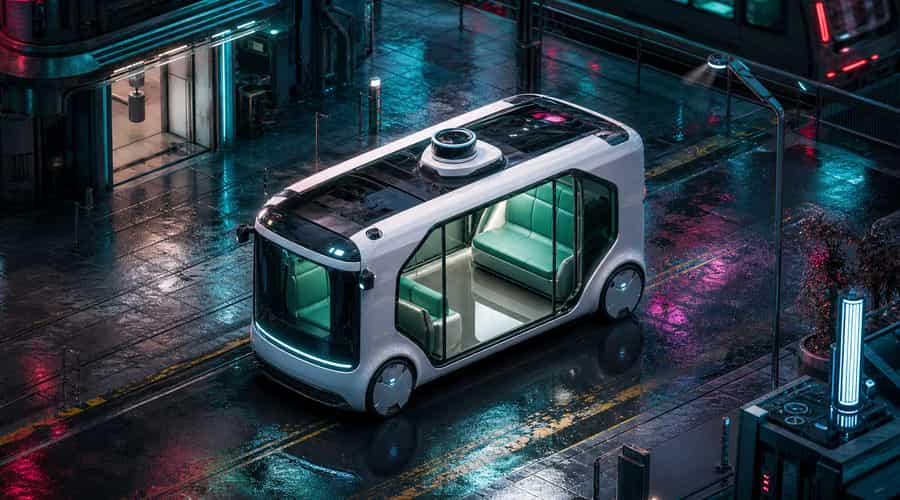
Zoox showed the easier part of the robotaxi story this week. The Amazon-owned company refreshed its purpose-built vehicle with aloe-green seats, stone-grey flooring, a brighter touchscreen, larger cupholders and two-way audio built into the door interface. The vehicle still has no steering wheel, no pedals and no front seat waiting for a human driver. That is the whole point.
It is also the problem.
According to Business Insider, Zoox says it can build up to 100 of the updated robotaxis a week at its Hayward, California facility, the plant it opened in June 2025 with a stated capacity of more than 10,000 vehicles a year once it is fully scaled. The Wall Street Journal reported that the redesigned vehicle is intended for large-scale production and could reach riders later in 2026, subject to regulatory approval. Those last four words carry the story.
You can make a cabin calmer with softer seats and a lighter floor. You can't manufacture a waiver.
Zoox's vehicle is different from Waymo's Jaguar I-Pace fleet or Tesla's early robotaxi tests because it was built around the idea that nobody ever drives it. The carriage-style cabin has face-to-face seating. The vehicle is bidirectional, so it doesn't need to turn around in the way a conventional car does. The Verge noted that the refreshed model adds rotating bidirectional reflectors and clearer front-and-rear cues so riders and people outside the vehicle can better understand what it is about to do. That kind of detail matters when the machine itself is the interface.
But the federal rules were written for cars with human controls. Zoox received a demonstration exemption from the National Highway Traffic Safety Administration in August 2025, after the agency expanded its automated vehicle exemption program. For paid commercial service, the company is still depending on a separate NHTSA petition for temporary relief from safety standards that assume a human driver and traditional controls are present. Business Insider said a Zoox spokesperson tied the production ramp directly to that pending petition.
Until that lands, the business is still mostly a promise with passengers inside it.
Zoox launched free public rides in Las Vegas on September 10, 2025, after Reuters reported the rollout would begin along select destinations on and around the Strip. It later opened free rides to selected users in San Francisco through its Zoox Explorers program. Business Insider reported this week that Zoox has served around 500,000 riders and is operating free rides in San Francisco, Las Vegas, Austin and Miami. Free rides are useful. They generate data, expose weird rider behavior, and show whether people will actually step into a driverless box with sliding doors. But they don't answer the question every transport company eventually has to face: will the ride make money?
Waymo has already started that clock
Six years after Amazon bought Zoox for $1.2 billion, the comparison with Waymo is blunt. Waymo is already collecting fares every week. Recent market reporting puts it at more than 500,000 paid rides a week, with service now spread across a widening list of U.S. cities. Zoox's revenue from passenger fares is still zero.
That is not a small gap you explain away with better upholstery.
Paid rides change the shape of the company. They force pricing decisions, fleet utilization, cleaning schedules, support staffing, pickup behavior, city-by-city politics and the boring mathematics of whether an expensive autonomous vehicle can earn enough in the hours it is actually carrying people. Free rides tell you whether the technology can move. Paid rides tell you whether the operation works.
Zoox does have advantages. Amazon can give it patience, cash and a long runway. Its Hayward factory means the company is not merely retrofitting someone else's car and calling it a platform. A purpose-built robotaxi may eventually be a better product than a conventional car with autonomous hardware bolted on. Frankly, if autonomous ride-hailing is going to look different from Uber with no driver, Zoox is one of the few U.S. companies trying to prove it.
Still, production capacity is not the same as commercial traction. A plant that can build 100 vehicles a week only matters if those vehicles can be deployed, priced and used. A redesigned cabin only matters if riders can pay to sit in it. The updated Zoox vehicle is a credible step toward a real fleet, but the first fare is still waiting on Washington, not Hayward.
Also read: Vishal Sikka's new AI startup wants to do what Infosys once paid him to prevent • Google delays Gemini 3.5 Pro to July as talent exodus deepens the pressure on its AI ambitions • GitHub's record June shows usage-based pricing is the unlock enterprise AI has been waiting for