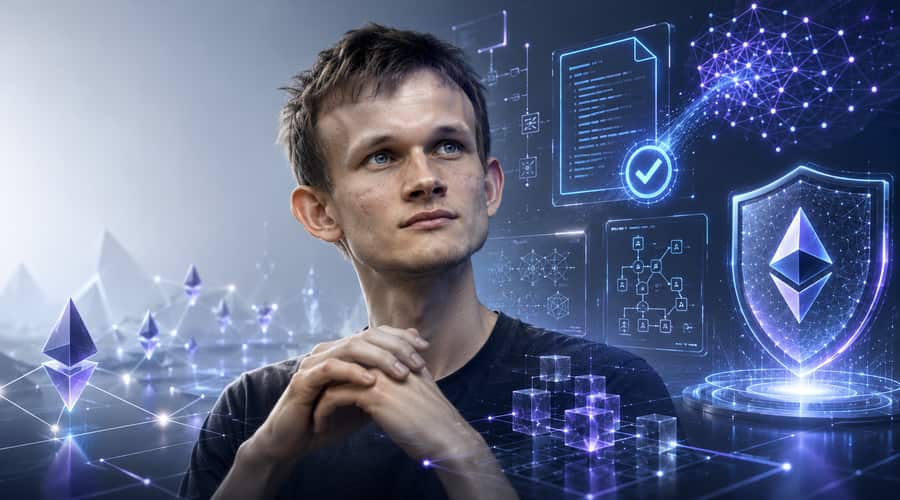
Vitalik Buterin argues that pairing AI with formal verification could make mathematically proven smart contracts practical, shifting the AI-in-crypto debate from hype to hard infrastructure work.
Vitalik Buterin has pushed a simple but consequential idea: do not treat AI as just a faster coder for blockchain projects, treat it as an enabler for large-scale formal verification that can prove code correct and close the gap between specification and implementation. If that works, it could reduce one of crypto's most expensive problems: smart contracts that behave differently from the way their builders intended.
According to recent coverage from KuCoin's market news desk, Buterin sees AI as useful not only for writing code, but also for generating verification proofs, producing far more test cases, and creating multiple independent implementations that can be checked against one another. That matters because manual audits, while still essential, have never been enough on their own. The industry has learned that lesson repeatedly through DeFi exploits, bridge failures, and protocol bugs that looked small until money started moving through them.
Formal verification has long been the gold standard for security because it proves, in mathematical terms, that code meets its specification. The problem is that it has historically been slow, expensive, and dependent on a small pool of experts. Buterin's point is that AI may change the economics. He has pointed to experiments around Ethereum's 2030 roadmap and to LeanEthereum collaborators using AI to help produce a machine-verifiable proof for a theorem underlying STARKs, a sign that the technique is moving from specialist research toward practical tooling.
How AI and verification fit together
Buterin's framing splits the AI win between speed and safety. Use AI to generate code, tests, and candidate proofs, then apply formal methods to show those artifacts actually meet the intended specification. In other words, AI can create volume, while verification supplies discipline. That is the useful version of automation, especially in a market where one unchecked assumption can become a nine-figure loss.
This is not blind faith in software that writes software. Buterin has warned that AI will produce incorrect outputs, and formal verification is not a magical cure for every failure mode. It cannot fix a bad specification. It cannot eliminate hardware risks, oracle problems, or flawed economic assumptions. His prescription is more operational than philosophical: take a meaningful share of the productivity gains from AI and invest them in tests, verification, and independent implementations, so faster development does not simply create faster failure.
Practical implications for DeFi and Layer 2 teams
If AI-assisted verification becomes practical, the change will be visible first in the places where mistakes are most expensive. Smart contract audits could shift from laborious manual reviews toward a pipeline that combines AI fuzzing, automated proof generation, and machine-checked theorems for critical economic invariants. That would not remove human auditors from the process, but it would give them better evidence and more coverage before funds are at risk.
Zero-knowledge circuits and consensus primitives are natural targets because their correctness is central and often expressed in mathematics already suited to proof systems. For Layer 2 teams, the payoff is especially clear. Rollups depend on prover and verifier code that must behave exactly as designed. Better verification would lower operational risk for optimistic and ZK systems that currently rely heavily on bespoke reviews, internal expertise, and the hope that every critical edge case has been found before launch.
The broader market implication is trust. DeFi users do not care whether a protocol was compromised because of a subtle implementation bug, an incomplete test suite, or a flawed assumption buried in a contract. They care that the funds are gone. If AI can help teams formalize specifications earlier and test those specifications more aggressively, it gives serious builders a way to separate themselves from projects that treat security as a final checklist item.
Limits and realistic timelines
Buterin is cautiously optimistic, not deterministic. Nobody is going to drop a single prompt into an AI system and receive a fully secure protocol. There will be bugs, mismatches between implementations, and the usual surprises when theory meets production. The near-term value is more practical: generate more test vectors, turn informal assumptions into machine-readable specifications, and automate the tedious parts of proof writing so human experts can focus on design choices that require judgment.
That distinction is important because the crypto industry has a habit of turning useful tools into sweeping narratives. AI-assisted verification is not another pitch for speculative tokens or trading bots. It is infrastructure work. It affects insurance, custodial risk, protocol governance, and the willingness of institutions to touch on-chain systems where the code is supposed to be the contract.
The path forward is also institutional. Tooling must become easier to use. Developers need training. Auditing firms will have to incorporate proof engineering into their services. Protocol teams will need to decide which modules deserve the heaviest verification burden and which risks are better handled through monitoring, limits, or governance controls.
For projects building DeFi infrastructure or Layer 2 stacks, the immediate move is to pilot AI-augmented verification on the most critical modules, measure whether it finds issues earlier, and share workable patterns across the ecosystem. If those pilots show consistent risk reduction, the industry will have moved from speculative AI talk to an operational practice that actually prevents losses.
Also read: White House signals imminent U.S. Bitcoin strategic reserve announcement, markets brace for impact • Phoenix Trade takes on Hyperliquid in Solana perps war • Iran pushes Bitcoin into shipping insurance for the Strait of Hormuz