AMD is putting more than $10 billion behind Taiwan's chip ecosystem, not as a side bet, but as a supply-chain move for the next phase of AI infrastructure.
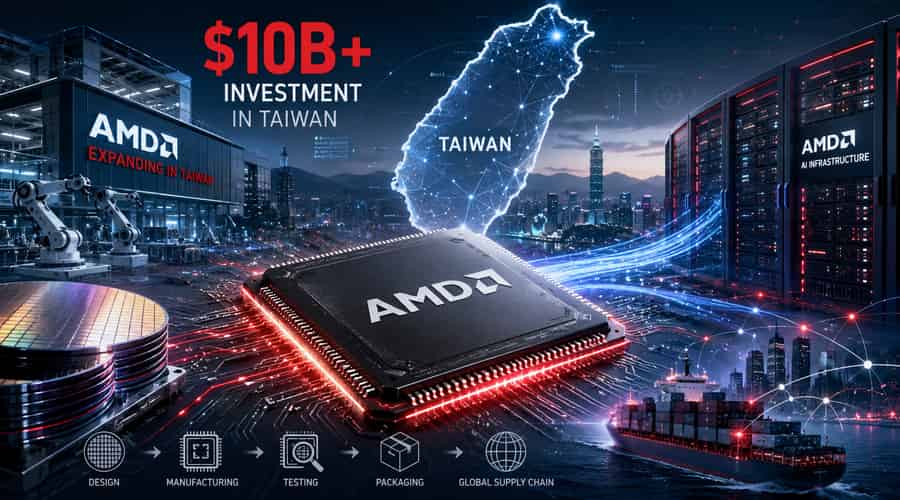
Advanced Micro Devices announced more than $10 billion in Taiwan ecosystem investments on May 21, aiming to expand advanced packaging, manufacturing partnerships and rack-scale AI infrastructure capacity at a moment when every major chipmaker is fighting for the same scarce supply chain. The pledge is less about building a factory with AMD's name on the wall and more about making sure its next generation of AI systems can actually be produced at scale.
That distinction matters. AMD remains a fabless chip company, which means its ability to challenge Nvidia in AI does not depend only on chip design. It depends on TSMC process capacity, packaging partners, substrate suppliers, test providers and server makers that can turn accelerators into systems large cloud buyers are willing to deploy. According to Reuters, AMD said the investment will support Taiwan partners and facilities as the company works to scale AI compute supply.
The timing is not accidental. AI buyers are no longer shopping only for individual GPUs. Hyperscalers want rack-scale systems, predictable delivery schedules and enough supply to support multi-year infrastructure plans. AMD has strong products on paper, but the market will judge the company on whether it can ship enough of them, fast enough, to become a credible second source for customers already dependent on Nvidia.
What AMD is trying to secure
AMD's announcement points directly at advanced packaging, one of the tightest bottlenecks in the AI chip market. The company highlighted work with Taiwan partners including ASE, SPIL, PTI, Unimicron, Sanmina, Wiwynn, Wistron and Inventec, a list that shows how broad the buildout has to be. Packaging, substrates, system assembly and rack integration all have to move together if AMD wants to turn chip demand into delivered infrastructure.
One technical detail deserves attention. AMD said it has achieved a milestone with PTI by qualifying a 2.5D panel-based EFB interconnect technology, designed to support higher bandwidth and better efficiency at scale. That sounds technical because it is, but the business point is simple: packaging methods can decide how quickly high-end AI systems move from roadmap to customer deployment.
The investment also connects with AMD's next product cycle. The company said its 6th-generation EPYC processor, codenamed Venice, is ramping on TSMC's 2nm process in Taiwan, with future plans to ramp production at TSMC's Arizona fab. AMD also linked the Taiwan ecosystem work to its Helios rack-scale AI platform, which combines Venice CPUs with Instinct MI450X GPUs and is targeted for multi-gigawatt deployments beginning in the second half of 2026.
For cloud customers, that is the real message. AMD is trying to prove it can sell a broader infrastructure plan, not just a chip. That matters because large buyers want fewer integration headaches and more leverage in negotiations. If AMD can offer a credible rack-scale alternative, customers such as hyperscalers and AI labs gain more room to diversify their compute strategies.
Why Taiwan remains central
The announcement also reinforces Taiwan's role at the center of the AI hardware buildout. TSMC already anchors the most advanced process technology used by leading chip designers, and Taiwan's surrounding ecosystem gives companies like AMD access to packaging, test, substrates and original design manufacturing capacity in one dense industrial network.
That concentration is powerful, but it also carries risk. Every additional AI infrastructure pledge tied to Taiwan reminds investors and policymakers how much of the global compute race depends on a small group of suppliers in a geopolitically sensitive region. AMD's future Arizona ramp for Venice helps with geographic diversification, but the near-term muscle still sits heavily in Taiwan.
For Taiwan's suppliers, AMD's pledge offers a clear demand signal. Companies involved in packaging, boards, systems and integration can justify new spending when a major customer is attaching capital and product roadmaps to their capacity. That is especially important in advanced packaging, where equipment, qualification and yield improvement take time before they show up as meaningful output.
Investors should still separate the announcement from immediate revenue. A capital commitment does not become productive capacity overnight, and rack-scale AI systems require coordination across many suppliers before shipments can ramp cleanly. The next test will be whether AMD can convert these partnerships into reliable delivery windows for MI450X and Helios systems in 2026.
The broader implication is clear enough. AI hardware competition is moving beyond benchmark charts and into supply-chain control. AMD has to design strong chips, but it also has to secure the packaging and system capacity needed to sell them in volume. If this Taiwan investment works, the company gives customers a more serious alternative path for AI infrastructure, and that could change how cloud buyers think about pricing, procurement and risk over the next two years.
Also read: Solana's usage is rising even as its token price slips • JPMorgan to Hire More AI Talent, Fewer Traditional Bankers, and What It Means for Startups • Gemini 3.5 Flash takes the lead in Zapier's AutomationBench