While tech leaders were booed for praising AI at commencement ceremonies, Apple co-founder Steve Wozniak drew cheers by reminding graduates that they already have "AI, actual intelligence." The contrast shows how leaders can talk about automation without making the next generation feel disposable.
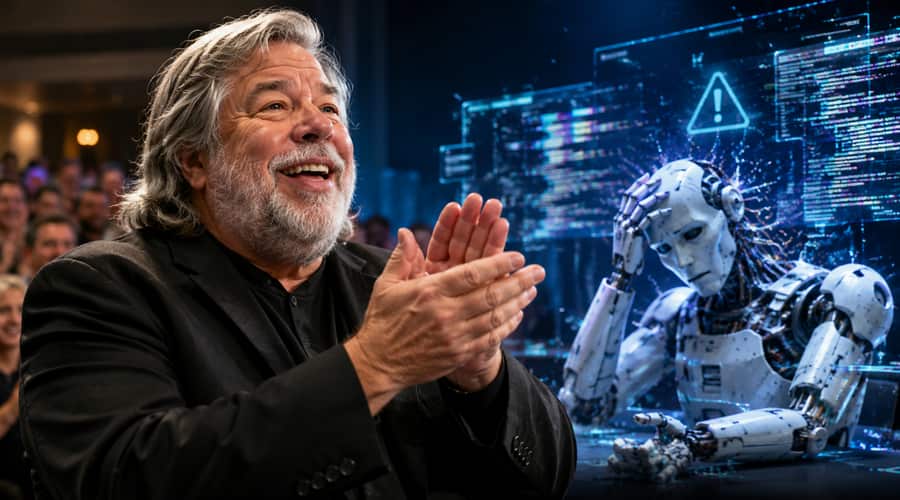
At Grand Valley State University's commencement in Michigan, Wozniak took a different route from the AI boosterism that has been meeting a colder response on campus. "We have AI today, you all have AI: actual intelligence," he told graduates, drawing laughter and applause. The line worked because it validated the people in the room instead of treating them as future inputs in someone else's productivity model.
Wozniak, who has often been more cautious about AI than many Silicon Valley figures, then joked that creating a brain "takes nine months." It was funny because it did not ask graduates to celebrate their own possible displacement. It also landed in a week when other speakers learned that students are no longer willing to clap through generic AI optimism. According to a recent Associated Press report, former Google CEO Eric Schmidt faced repeated boos at the University of Arizona after telling about 10,000 graduates that AI would touch every profession, classroom, hospital, laboratory and relationship.
Why Wozniak succeeded where Schmidt failed
The difference was not just in the words. It was in the stance. Schmidt framed AI as an unstoppable force and urged students to help shape it. That may be a reasonable message in a boardroom or a policy forum, but it sounds thin to graduates who are entering a job market where the first rung of the ladder looks weaker than it did a few years ago.
Wozniak started somewhere else. He affirmed that graduates already possess intelligence, judgment and originality, the qualities that make the technology worth discussing in the first place. That may sound simple, but simple matters when the audience is worried that employers now see junior workers as costs to be automated before they become contributors.
The same tension showed up at the University of Central Florida, where real estate executive Gloria Caulfield called AI "the next Industrial Revolution" and was met with immediate boos. Students were not rejecting technology itself. They were rejecting a narrative that celebrates automation while offering little clarity about how young workers are supposed to build careers when the training jobs are the first to be squeezed.
The anxiety beneath the boos
The reaction is not hard to understand. A Monster survey published this month found that 89% of recent and upcoming graduates are concerned AI or automation could replace entry-level roles. That is not abstract fear. It is the sound of students looking at job listings that ask for experience they have not yet had a chance to earn.
Pew Research Center has also found that half of American adults are more concerned than excited about the increased use of AI in daily life, up sharply from 2021. Among younger workers, that concern is now shaping career thinking. KPMG's 2026 intern survey found that Gen Z interns are prioritizing critical thinking, adaptability, continuous learning and creative strategy as the skills they want to show employers while working alongside AI agents.
That makes the boos less like campus theater and more like a market signal. Graduates know AI tools can be useful. Many of them already use those tools in school, job searches and creative work. What they do not want is a commencement speech that treats technological change as destiny while skipping the harder question of who gets trained, who gets hired and who gets left out.
What founders and leaders can learn
For startup founders communicating about AI to employees or recruiting young talent, the lesson is clear. Do not lead with inevitability. Do not frame AI as a force that will reshape the world and expect automatic applause. Start by naming what people bring that machines cannot: judgment, creativity, empathy and the ability to make decisions when the answer is not obvious.
Wozniak's speech also offered advice that applied beyond commencement. "You should always try to think different. Don't follow the same steps as a million other people," he told graduates. That is not an AI talking point. It is a message about agency, and that is why it worked. It treated students as builders of their own futures, not passengers on a technology curve.
Research highlighted by MIT Sloan has made a similar point for the workplace: AI adoption works better when employees have a voice in how new tools are designed and introduced. Leaders who explain the business case but ignore worker anxiety should not be surprised when resistance hardens. People are more willing to use technology when they understand how it helps them grow, not just how it helps the company cut costs.
The graduation season of 2026 may be remembered for the boos. But the cheers for Wozniak offer the more useful lesson. AI skepticism is not a communications problem to manage away. It is a sign that workers want reassurance, practical pathways and a role in the change. The leaders who can provide that will have a better chance of winning talent as the entry-level job market keeps shifting.
Also read: Polymarket targets Japan approval in global expansion push • DeepSeek seeks 50B valuation in first outside round • Lenovo revenue hits record 83B on AI demand surge