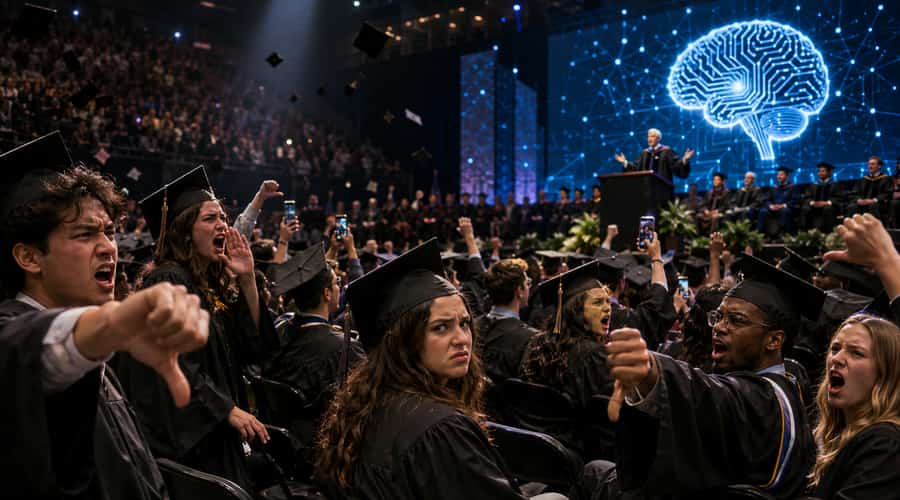
From Arizona to Florida, the Class of 2026 is making its stance on AI unmistakably clear. Graduates are booing speakers who celebrate artificial intelligence because they understand the technology is already reshaping the first rung of the career ladder.
According to an Associated Press report, former Google CEO Eric Schmidt faced repeated boos at the University of Arizona's commencement on May 15 when he told graduates that AI represents an unavoidable technological revolution. A week earlier at the University of Central Florida, real estate executive Gloria Caulfield called AI "the next Industrial Revolution" and was met with immediate jeers, with one graduate shouting "AI sucks" from the crowd.
The backlash is not about the technology itself. It is about what the technology represents for a generation entering a job market where the bottom rungs feel less secure than they used to. As one University of Arizona graduate told AP, the message felt "tone deaf." At UCF, the sharpest reaction came from arts, humanities, and communications graduates, the same students watching creative and junior knowledge-work roles come under pressure from AI tools.
Why AI boosterism backfired with this generation
A March Pew Research Center analysis found that half of US adults are more concerned than excited about AI's growing role in daily life. Among new graduates, the anxiety is more immediate. CNBC and SurveyMonkey's May 2026 AI and jobs survey found that many students rate the current job market as fair or poor, and more than half say AI has made them more pessimistic about their career prospects.
That is the context Silicon Valley often misses. Mark Cuban has warned that the impact may not arrive as one dramatic wave of layoffs, but as a quieter hiring squeeze. Companies can now use AI to absorb routine work that once justified entry-level roles, then ask smaller teams to move faster. Anthropic CEO Dario Amodei has also warned that a large share of entry-level white-collar work could be displaced within the next few years. The message graduates hear is blunt: the apprenticeship model that once defined career progression is being rewritten before they get a chance to use it.
The exceptions prove the rule
Not every AI speaker was booed. On May 10, Nvidia CEO Jensen Huang spoke at Carnegie Mellon University's commencement and received no comparable backlash. The difference was framing. Huang acknowledged the anxiety directly, telling graduates that AI is not likely to replace them, but someone using AI better might.
Huang also pushed against the bleakest version of the white-collar displacement story. He told students that a new industry is being born and that they are entering the workforce with tools no previous generation has possessed. The message was not about inevitability or submission. It was about agency, skill, and the practical advantage of learning to use the technology well. Graduates applauded.
The contrast between Schmidt's and Huang's receptions offers a useful lesson for leaders introducing AI into organizations. A message that says the revolution is unstoppable can sound like resignation, especially to people who feel exposed to its costs. A message that names the risk and explains how workers can gain leverage lands differently. One approach drew boos. The other earned the room.
What this means for founders and employers
For startup founders and enterprise leaders, the graduation backlash carries a concrete warning. The workforce of 2026 is not afraid of AI in the abstract. It is afraid of being replaced by AI at the exact moment it needs to build skills, confidence, and experience. The CNBC and SurveyMonkey survey found that 57 percent of workers and 64 percent of students think companies should discourage the use of AI for junior or entry-level positions. That is not simple resistance to technology. It is a survival instinct.
For startups building AI tools, the lesson is to position products as augmentation, not replacement. UCF graduates reportedly applauded Caulfield when she said that only a few years ago AI was not a factor in their lives. They booed when she framed it as an industrial revolution. The distinction is subtle but critical. One statement acknowledges change. The other can sound like a celebration of obsolescence to the people most exposed to it.
The generation entering the workforce now will not tolerate empty boosterism. It will demand honesty about what is being lost alongside what is being gained. Founders who understand that will build products that earn trust inside real workplaces. Those who do not may find that adoption stalls before the software ever proves its value. The boos at commencement are not a fringe reaction. They are a market signal. Pay attention.