Apoha has emerged from stealth with $36 million in total funding for a harder kind of AI bet: teaching machines how molecules and materials actually behave.
Apoha is not selling another software agent or chasing the same enterprise workflow everyone else is automating. The London startup is building AI around the physical behavior of matter, and its $36 million funding disclosure puts a spotlight on one of the more interesting corners of the market: deep-tech companies where the moat is not only code, but the data produced by the lab.
Fortune reported that Apoha has launched with $36 million in total funding, while public Companies House filings show a statement of capital following a share allotment on 25 March 2026 and a new director appointment days later. That matters because this is not just a website relaunch dressed up as a funding story. The company has been laying the corporate groundwork for a larger phase, and its own materials now describe a business moving from quiet research into commercial deployment.
The company was incorporated in April 2021 and is registered in London as a biotechnology research and development business. Its founders are Shamit Shrivastava, Apoha's co-founder and CEO, and Anshika Srivastava, its co-founder and COO. Apoha's site lists Shrivastava as the mind behind the Liquid Brain and describes Srivastava as focused on scaling the company. Its hiring footprint and public profiles point to a team of roughly a few dozen people, which is exactly the stage where a deep-science startup starts becoming expensive.
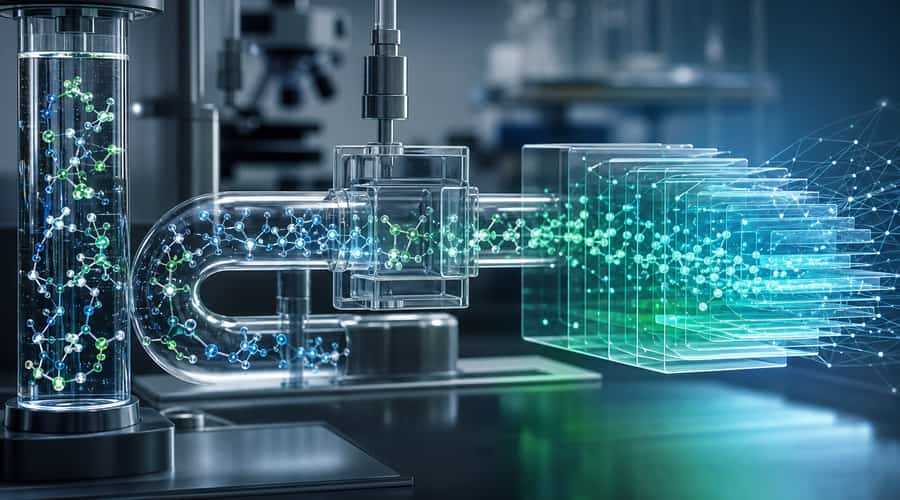
The pitch is simple to understand and difficult to execute. AI models can already read sequences and predict structures. Apoha argues that neither is enough if the question is how a medicine, food ingredient, fragrance, or material behaves under real-world stress. Its answer is Liquid Brain, a sensing platform designed to generate a new class of molecular data around states, or behavior in changing physical conditions.
That is a meaningful distinction. A protein can look promising on paper and still fail because it aggregates, becomes too viscous, behaves badly in formulation, or breaks down under stress. In antibody development, those problems are not side issues. They affect manufacturability, safety, dosing, and whether a candidate can move from a lab result into something useful for patients.
Apoha says Liquid Brain captures continuous, real-time molecular responses and turns them into high-dimensional fingerprints. Its antibody discovery materials say the system can work from as little as 10 micrograms of sample, produce interpretable results in about 20 minutes per sample, and operate without labels, immobilisation, or strict buffer requirements. The company also says its VIBE readout, short for Variations in Interfacial Behavior and their Evolution, has been benchmarked across more than 200 clinical-stage antibodies.
Those details are important because this is where AI for science often gets judged. The model is only as useful as the measurement feeding it. If Apoha can repeatedly turn small physical samples into predictive data, the company is not merely improving a workflow. It is creating proprietary experimental information that competitors cannot scrape from the internet.
Why investors care
The wider AI market has become noisy with large rounds for model labs, coding tools, and agent platforms. Apoha sits in a different category. It is closer to infrastructure for scientific discovery, where the business requires wet labs, hardware, physics, machine learning, and customer trust from industries that do not move fast just because a demo looks good.
That makes the financing more interesting. A pure software startup can often prove early demand with usage charts and revenue expansion. A company like Apoha has to prove that its system can generate data that changes decisions inside pharmaceutical, biotech, food, or materials teams. The upside is that, if it works, the data compounds. Every measurement can make the system more predictive, and every customer program can widen the range of materials the platform understands.
The public-facing evidence suggests Apoha is starting with antibody developability, a market where the cost of late failure is painful and the need for earlier screening is obvious. Its website includes a customer example from Mythic Therapeutics, which says Apoha's technology helped flag liabilities between antibodies that differed by only one or two amino acids. That is the kind of use case investors like because the value is specific, measurable, and tied to decisions that already carry real budgets.
There is still plenty to prove. Deep-tech AI companies can look compelling in theory and still struggle with throughput, reproducibility, sales cycles, and the slow pace of scientific adoption. Apoha will also need to show that Liquid Brain is not limited to a narrow set of assays, but can become a broader platform for medicines, ingredients, and materials. The company's own messaging points in that direction, but the market will care less about ambition than repeated evidence.
The practical takeaway is that AI funding is moving deeper into the physical world. The first wave rewarded models that could generate text, images, and code. The next serious wave may reward companies that can generate proprietary data about biology, chemistry, and materials, then use that data to make better predictions. Apoha's funding is small compared with the giant frontier AI checks, but it may say more about where defensible AI companies are heading.
Also read: JioStar is turning AI-made shows into a real streaming bet • Google must give UK publishers control over AI search use • Delta Electronics says AI data centers now need power as much as chips