Marc Lore's Wonder is bringing bowl-making robots into its kitchens, and the real question is whether speed can become a public-market story.
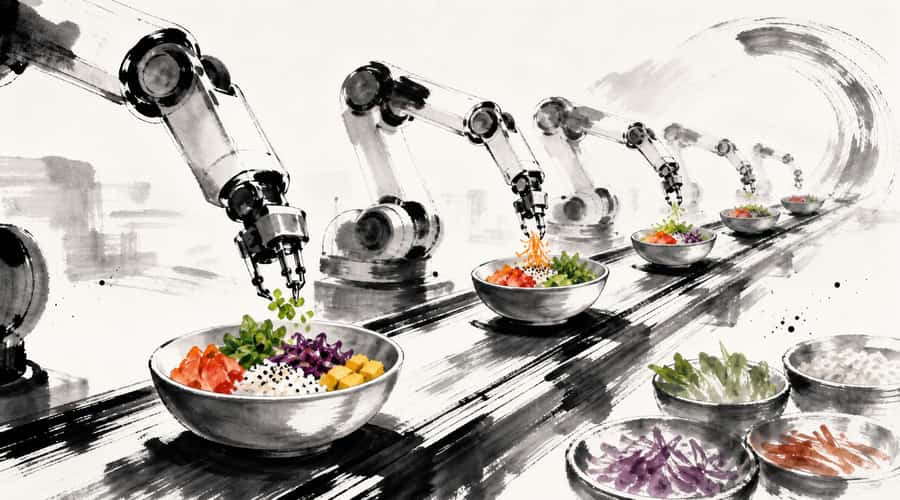
Wonder's latest pitch is simple enough for anyone who has waited too long for a lunch order to understand: one machine can make 500 burrito bowls, salads, and poke bowls an hour, while a human worker usually makes around 30 to 45. That is not a marginal improvement. It changes how investors think about restaurant labor, delivery economics, and whether a food-tech company can scale without becoming just another expensive kitchen network.
Lore unveiled the system, which Wonder calls its infinite bowl machine, at Fortune's Brainstorm Tech conference on June 9, 2026. The machine spins each bowl on a turntable while ingredients are dropped in according to orders coming through delivery apps. The promise is not only speed. It is precision. Wonder says the system can build meals down to personalized macro targets, which fits neatly with Lore's recent push toward AI-guided nutrition and customized meal planning.
The important part is that this is not a science project sitting in a lab. The technology came from Sweetgreen, where versions of the Infinite Kitchen have already been used across dozens of locations. Sweetgreen originally moved into this area by acquiring the robotic kitchen startup Spyce in 2021, a deal Axios reported was valued slightly above $60 million at the time. Wonder now gets a technology stack that has already been exposed to real restaurant traffic, real food variation, and real customer expectations.
Restaurant automation always sounds impressive in a demonstration. The harder test is whether it makes the store more profitable after installation, maintenance, training, downtime, menu limits, and capital costs are included. A machine that can theoretically produce 500 bowls an hour is useful only if demand is dense enough to keep it busy and if the rest of the operation can keep pace.
That is where Wonder is different from a traditional restaurant chain. It is not trying to automate one menu. It operates a multi-brand food hall model, with dishes from chef-led concepts and acquired businesses moving through a shared kitchen system. Wonder also owns Blue Apron and Grubhub, giving it a wider view of meal planning, delivery demand, and customer behavior than most restaurant startups can claim.
That can cut both ways. More brands create more menu complexity, and complexity is usually where restaurant robots struggle. A bowl assembly system works best when ingredients are prepped consistently, containers are standardized, and orders can be translated into repeatable movements. Wonder's bet is that the food court model gives it enough order volume to justify automation, while AI and software reduce the messiness that has slowed earlier robotics efforts.
Lore has built his reputation on taking operationally difficult categories and making them look obvious in hindsight. Diapers.com was sold to Amazon for $545 million. Jet.com went to Walmart for $3.3 billion. Wonder has since raised large sums, acquired Blue Apron, bought Grubhub, and pushed toward a national footprint. Axios noted last year that Wonder raised $600 million at a valuation north of $7 billion, a number that gives the company little room to behave like a modest restaurant experiment.
The IPO story now depends on automation
Lore has been unusually open about his public-market ambitions, calling himself the IPO guy. That makes the bowl machine more than a kitchen upgrade. It becomes part of the explanation for why Wonder should be valued less like a collection of restaurants and more like a technology-enabled food platform.
Public investors will not buy that argument on throughput alone. They will want evidence that automation lifts margins, improves order accuracy, reduces labor strain, and allows new locations to open with a more attractive payback period. They will also want to know whether the system can survive peak demand without creating a new bottleneck somewhere else, because a fast bowl line does not help much if delivery dispatch, ingredient prep, or customer support breaks under pressure.
The comparison with Chipotle is useful because it shows two different automation philosophies. Chipotle has tested Autocado, a machine that cuts, cores, and peels avocados, and has also worked with Hyphen on an automated makeline for digital bowls and salads. But Chipotle's leadership has been careful about preserving the human assembly line experience, especially for in-store orders. Wonder has less legacy to protect. Its customer relationship is already built around delivery, app ordering, and kitchen efficiency.
That gives Wonder more freedom, but also more pressure. A Chipotle customer may accept a slower line because part of the experience is watching the bowl come together. A Wonder customer is mostly judging whether the meal arrives quickly, accurately, and hot enough to justify ordering again. Robots are easier to defend in that context because the customer is buying consistency, not theater.
The next deployment, expected in Wonder kitchens next month, should tell investors more than the conference demo did. If the machine handles live demand, supports personalized nutrition, and improves store-level economics, Wonder will have a sharper IPO narrative than most food startups. If it becomes another expensive piece of kitchen hardware that works best in controlled conditions, the market will treat it accordingly.
For now, the takeaway is clear. Restaurant robotics is moving from novelty to operating strategy. Wonder is trying to prove that a faster bowl is not just a faster bowl, but the foundation for a food business that can scale like software while still serving dinner.
Also read: Commonwealth Fusion is turning fusion physics into an AI power bet • Justin Ernest is showing how venture access is moving beyond funds • ASML's record run still leaves investors arguing it looks cheap