Shenzhen's EngineAI Robotics has filed for a Hong Kong IPO, per Bloomberg, just two weeks after launching a factory that can roll a T800 humanoid off the production line every fifteen minutes.
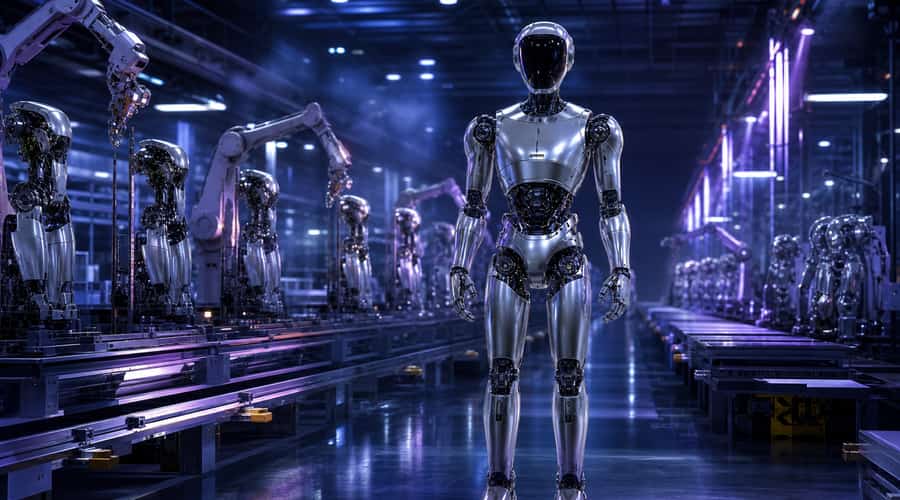
The number EngineAI wants investors to hold onto is four. Four T800 humanoid robots per hour, out of a 12,000-square-meter facility in Shenzhen's Honghualing area that began mass deliveries on May 29. Before each robot ships, it clears 79 full-dimensional quality inspections and 46 working-condition simulation tests. That level of process discipline is unusual for a company still in its second year of commercial production, and it is clearly part of the message EngineAI is sending as it moves toward a public listing.
According to Bloomberg, the company has filed for an IPO in Hong Kong, a choice that is strategic as much as logistical. Chinese AI and robotics companies have been moving toward Hong Kong listings as investor demand for domestic technology names improves, with recent or planned offerings from companies such as Z.ai, MiniMax, Lightelligence, Unitree, and StepFun keeping the market active. US export controls on advanced semiconductors have also complicated the path for Chinese hardware companies seeking American listings. Hong Kong's Stock Connect program provides direct access to mainland capital pools. And for a company whose core story is about Shenzhen manufacturing, listing close to the supply chain ecosystem that makes the story possible carries its own logic.
The April 2026 Series B tells a similar story about who EngineAI is betting on. The $200 million round was led by Henan Investment Group's Huirong Fund alongside Luxshare Precision, the contract manufacturer whose assembly lines also produce iPhones for Apple. Luxshare is not a passive financial investor. Its involvement has reportedly boosted EngineAI's production efficiency by 40 percent, and the two companies are jointly developing a second manufacturing site at Zhengzhou's Yunzhi Science Park. The round pushed EngineAI's valuation past 10 billion yuan, roughly $1.4 billion, before any public market pricing has been set.
The T800 itself debuted at CES in January, priced at $25,000 per unit and aimed at industrial customers. It runs on a solid-state battery, weighs 175 kilograms, and moves through 29 degrees of freedom on a magnesium-aluminum alloy frame. Competitive specs, though not dramatically differentiated from several rivals in the space. What EngineAI is selling above the hardware is scale: the company is targeting delivery of 4,000 to 5,000 T800 units before the end of 2026, a fourfold increase from the roughly 1,000 units it aimed for in 2025. The projection for 2027 reaches between 30,000 and 50,000 units annually.
There is a recognizable playbook here. When Tesla needed public markets to believe in electric vehicles before the vehicles were profitable, it pointed at the Nevada gigafactory and spoke in battery cells per year. BYD eventually ran the same argument and won it on volume. The factory became the proof of conviction, a capital-intensive, physical commitment that the company had solved the harder problem of going from prototype to product at industrial scale. EngineAI is reaching for the same lever. A facility that builds one humanoid robot every fifteen minutes is not only a manufacturing asset. It is a signal that the gap between impressive demonstration and repeatable delivery has narrowed.
Whether that argument holds at IPO depends on how Hong Kong prices a market still early in proving its commercial returns. Industrial humanoid robots are being trialed across Chinese factories and warehouses, but the economics of a $25,000 unit replacing or augmenting human labor remain unproven at the volumes EngineAI is projecting. If the 2026 delivery targets are met and industrial customers renew or expand orders, the production narrative gains weight fast. If delivery slips, the gigafactory comparison cuts the other way: investors remember that the Nevada gigafactory was behind schedule for years before it validated the thesis.
The Zhengzhou expansion keeps the long-term ambition visible regardless of how the listing prices. A second large-scale production line, backed by Luxshare's supply chain depth and state-linked capital from Henan, suggests EngineAI is not waiting for public market confirmation before scaling. The Hong Kong IPO, if it proceeds on the current timetable, will simply determine what that confidence is worth to outside investors.
Also read: BofA flagged seven of ten bear signals and Broadcom's miss confirmed the call • Barcelona startup THEKER closes Europe's largest robotics Series A with $85 million • PIMCO declares AI has crossed a macroeconomic threshold while warning the credit loss cycle has already begun