Washington just put Alibaba, Baidu, BYD and dozens of Chinese groups on a military-linked list, but DeepSeek was left out. If you're building on its models, don't read that as a clean bill of health.
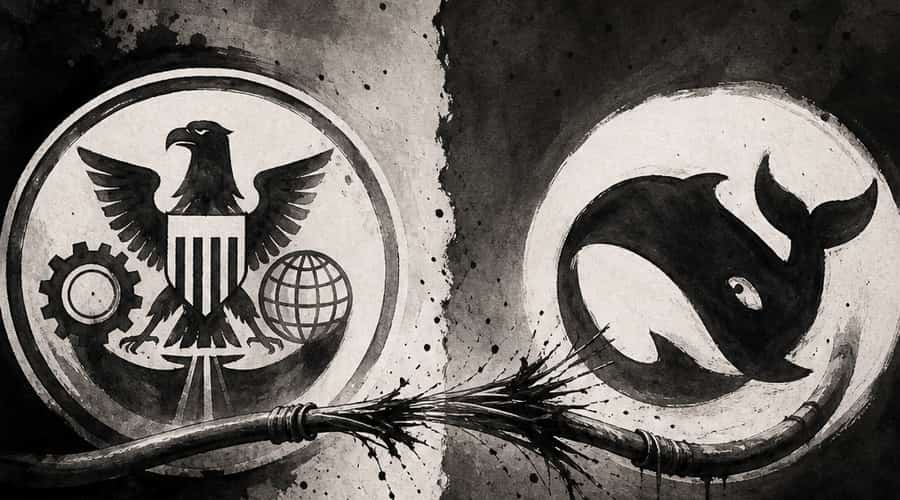
Here's the odd part in Washington's latest China technology move: the Pentagon found room for Alibaba, Baidu, BYD, ChangXin Memory Technologies and Yangtze Memory Technologies, but not DeepSeek. That omission matters because DeepSeek is not a side character in this fight. It is the Hangzhou AI lab that shook U.S. markets in January 2025, forced American AI companies to defend their cost structures, and has become one of Beijing's clearest answers to OpenAI and Anthropic.
The public action was not a Commerce Department Entity List move. It was the Pentagon's annual list of Chinese military companies, known under Section 1260H. AP reported that the list now names 188 entities, up from about 130 the previous year, and blocks listed companies from receiving U.S. defense contracts. The Guardian, citing Reuters, noted that the June update added or restored several major technology names, including Alibaba, Baidu, BYD, CXMT and YMTC. DeepSeek was not on it.
That is a quieter pass than it first looks. The 1260H list is not the same as an export blacklist, and it does not by itself stop a U.S. startup from downloading DeepSeek weights or testing the company's API. But Washington uses these lists as warning labels. Once a company appears there, procurement restrictions, reputational damage and later sanctions pressure usually follow. You don't need to be a defense contractor to feel the chill.
DeepSeek already has plenty of heat around it. In April 2025, Reps. John Moolenaar and Raja Krishnamoorthi released the House China committee report DeepSeek Unmasked, accusing the lab of funneling user data to the Chinese Communist Party, censoring answers on Taiwan and human rights, and using roughly 60,000 Nvidia chips despite U.S. restrictions. Nvidia said at the time that it follows U.S. government rules and that reported Singapore revenue reflected billing addresses, not necessarily shipments into China. That distinction is dry, but it matters. Allegation is not proof.
Anthropic added another charge in February 2026, saying DeepSeek, MiniMax and Moonshot AI used 24,000 fraudulent accounts to generate more than 16 million Claude exchanges for model distillation, according to Business Insider's summary of the company's claims. OpenAI has also told lawmakers that DeepSeek may have used outputs from its systems. DeepSeek has not been publicly proven to have built its models from stolen American outputs, but the concern in Washington is obvious: the cheapest Chinese model in the room may also be the one most entangled with the U.S. systems it is competing against.
The funding round changed the politics
The timing makes the omission more striking. The Wall Street Journal reported today that DeepSeek raised more than $7.4 billion at a valuation above $50 billion, making it China's most valuable AI startup. Founder Liang Wenfeng put in about $3 billion and kept control through a limited partnership structure that he manages. Most outside backers are locked in for five years. Tencent invested about $1.5 billion, CATL put in about $740 million, and China's National Artificial Intelligence Industry Investment Fund invested about $150 million directly into the company.
That is not the same as saying Beijing controls DeepSeek outright. The reported structure points the other way: Liang kept control. But state money is now formally inside the company, and that gives Washington a harder call. If the U.S. names DeepSeek alongside Alibaba and BYD, it is not only taking aim at a model provider. It is taking aim at the most visible Chinese AI startup of the year, just after a financing round built around national technology ambition.
Frankly, developers should treat the omission as a temporary condition, not a verdict. If you're using DeepSeek models because they are cheap, capable and open-weight, that may still be a rational choice. But it is no longer a purely technical choice. A model supplier can become a compliance problem faster than your product roadmap can adjust.
The practical risk is simple. The Pentagon list does not ban DeepSeek today, but the company sits in the middle of every live U.S. anxiety about China and AI: chips, training data, censorship, state capital and military use. A future Commerce Department Entity List action, a government-device ban, or a narrower DeepSeek bill in Congress would not come from nowhere. The record is already there.
So if your stack depends on DeepSeek, build an exit plan now. Keep a tested fallback model, know where your customer data goes, and make sure your contracts don't assume that a Chinese open-weight model will remain politically usable in the United States. The carve-out is real. It just isn't protection.
Also read: How to Automate Business Operations with AI Agents Without Hiring an Engineer • Brookfield's Csquare files for a US IPO and bets that AI demand can redeem a data center business built on troubled foundations • Microsoft walked away from a $3 billion Oracle cloud deal because of a security framework Oracle wouldn't build