Washington tried to fence off Anthropic's strongest models. Wall Street is already treating the spillover as a trade on Chinese open-source AI, with Zhipu on the long side and MiniMax under pressure before a July share unlock.
The Trump administration gave Chinese AI firms the sort of opening they could not have bought. On June 12, the US Commerce Department ordered Anthropic to cut off access to Fable 5 and Mythos 5 for foreign nationals, including foreign-national employees inside Anthropic itself. Business Insider reported that Anthropic received the letter at about 5:21 p.m. ET on Friday and responded by disabling the models for everyone, because selective compliance was not practical.
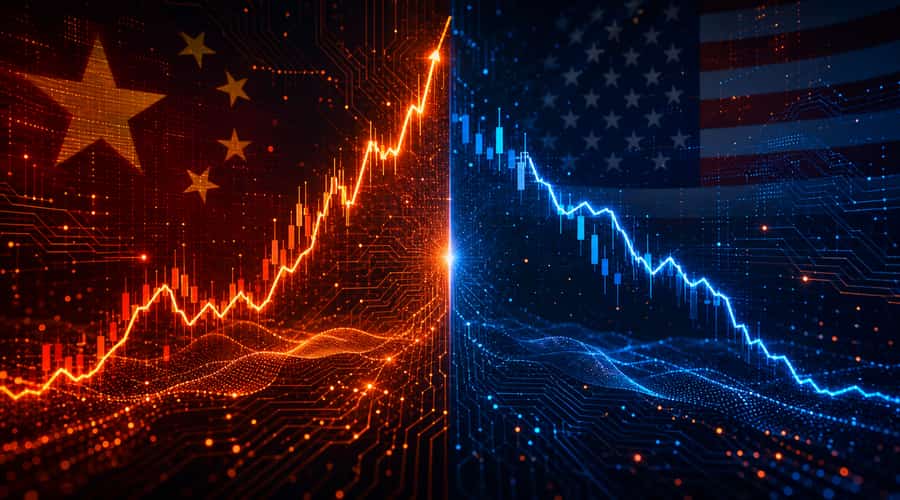
By Monday morning in Hong Kong, investors had found the obvious beneficiary. Zhipu AI, now branded internationally as Z.ai and listed as Knowledge Atlas Technology, rose as much as 48% before closing up 33%. That is not a normal reaction to a regulatory order aimed at a US company. It is what happens when a closed American model suddenly looks politically fragile and a Chinese open-source rival arrives with code, weights and a permissive license at exactly the right moment.
JPMorgan moved first, raising its price target on Zhipu from HK$950 to HK$1,400 while keeping an overweight rating and downgrading MiniMax. Bank of America then initiated coverage with a buy on Zhipu at a HK$1,250 target and a more cautious buy on MiniMax at HK$500. You do not need to dress this up. The banks have turned a policy shock into a long Zhipu, short MiniMax setup, with one company getting the open-source tailwind and the other facing a supply event investors can mark on a calendar.
Zhipu's product timing was almost too neat. On June 17, The Economic Times reported that Z.ai had launched GLM-5.2, a model built for long-horizon coding and engineering work, with a one-million-token context window and an unrestricted MIT open-source license. The model is available through open-source platforms including Hugging Face. That last detail matters more than the usual benchmark bragging. If you're a developer or enterprise buyer outside the US and a Washington order can suddenly shut a leading proprietary model, the ability to download and run weights yourself stops looking like ideology. It looks like risk control.
The benchmark claims should still be handled carefully. The Economic Times, citing model-hosting and benchmark data, said GLM-5.2 performed near or above closed-source rivals including GPT-5.5 and Claude Opus 4.8 on several tests, including Humanity's Last Exam and FrontierSWE. The model's reported FrontierSWE result put it just behind Opus 4.8 and slightly ahead of GPT-5.5. That is impressive enough. It does not need to become mythology until more independent users have pushed the model around in real codebases.
Zhipu already had momentum before Anthropic stumbled. The Wall Street Journal reported that Knowledge Atlas raised HK$4.35 billion in its January Hong Kong IPO, with revenue more than doubling in 2024 to 312.4 million yuan while losses widened to 2.96 billion yuan. Since late March, the shares are up roughly 139%, helped by a February agent-platform release, a post-IPO earnings jump in April and now the export-control shock. This is still an expensive, loss-making AI company. But it now has a cleaner story than most of its Chinese peers: enterprise models, open weights and a geopolitical catalyst that makes Western dependence look less comfortable.
MiniMax is a different case. It is not a weak company, and the stock even rose 7.4% during the same Monday rally. Its problem is mechanical. MiniMax listed in Hong Kong in January 2026 with a true free float of about 5.44%, leaving more than 90% of shares locked up. Around July 7 and 8, six months after the IPO, lock-ups are set to expire for about 44% of pre-IPO shareholders and another 5% held by cornerstone investors. Tiger Brokers has flagged the unlock at roughly HK$84.3 billion of stock becoming tradable.
That is the part you should watch. When nearly half a company's shares can come into the market in one week, the old scarcity premium has to prove it was more than scarcity. Buyers may absorb the supply. They sometimes do. But fund managers do not need MiniMax to be a bad business for the short leg to make sense. They only need more sellers than natural buyers at the wrong price.
Frankly, Washington has helped make Zhipu's sales pitch easier. The Verge reported that the Anthropic order has left the AI industry arguing over whether export controls even fit cloud model access cleanly. That uncertainty is now part of the product comparison. A proprietary US model may be stronger in some tasks, but if access depends on a Friday-evening government letter, enterprise buyers outside the US will ask harder questions. GLM-5.2 can compete on price, licensing and availability, not only on leaderboard points.
This is not a simple bet that China wins and America loses. Anthropic still has technical depth, MiniMax still has real products, and Chinese open-source models still face trust problems outside China. The trade is sharper than that. Zhipu has the right model at the right moment. MiniMax has a large unlock arriving at the wrong one. The July lock-up expiry will tell you whether Wall Street's cleanest AI pair trade is grounded in supply and demand, or whether it has already become too crowded for its own good.
Also read: Nvidia's ENPIRE lets AI coding agents train robots to install the GPUs that run AI • An Indonesian gold retailer's 115-place Fortune ranking jump tells you everything about where Southeast Asia's money is going • Microsoft is running geopolitical arbitrage on AI and Washington has not yet decided what to do about it