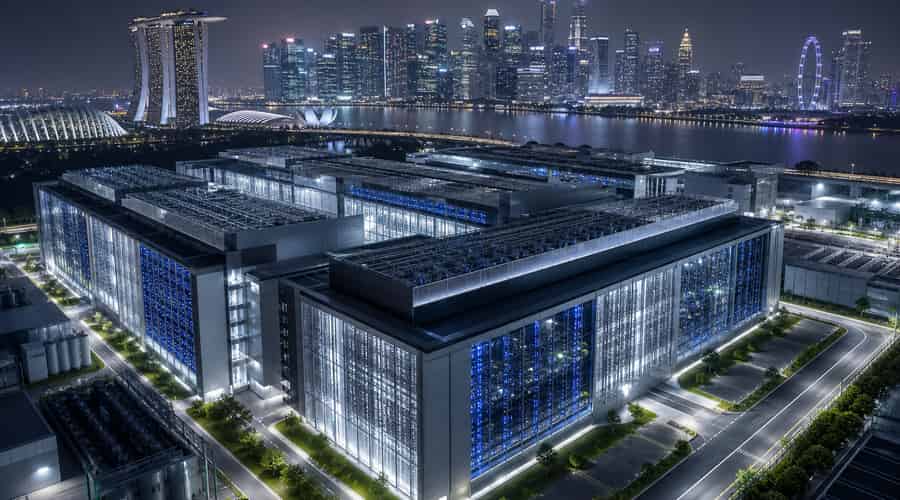
DayOne Data Centers is trying to turn AI infrastructure demand into one of Asia's biggest tech finance stories of 2026, with a $4.5 billion Series C, a possible $7 billion loan, and a planned dual listing in Singapore and New York.
DayOne is not creeping toward the public markets. It is arriving with a balance sheet built to get noticed. The former international arm of GDS Holdings closed a $4.5 billion Series C on June 5, 2026, at a $20 billion valuation, with SoftBank Vision Fund, Ken Griffin, Indonesia's sovereign wealth fund, Coatue, Hillhouse and other large investors on the register.
The useful detail is not only the size of the round. It is who came back. Hillhouse and Coatue led the second tranche after the first $2 billion close in January, and DayOne said the two firms are now its largest shareholders. You do not double down like that a few months before an IPO unless you think the exit window is still open.
DayOne started life as GDS International, the non-China business of Shanghai-based GDS Holdings. The unit was set up in 2022 to hold data center assets outside mainland China, then rebranded as DayOne and separated further from GDS after outside capital came in. The Financial Times reported in May that DayOne is now Singapore-headquartered and planning a dual listing on Nasdaq and the Singapore Exchange that could value the business at about $20 billion.
That Singapore address is not a minor administrative line. It is part of the investment case. A company with Chinese roots, APAC data center assets and US public market ambitions needs more than good growth numbers. It needs a structure that institutional investors can explain to their own committees without spending the whole meeting on geopolitics.
Equity is only one piece of the machine. According to Bloomberg, DayOne is seeking to expand a corporate loan facility to as much as $7 billion, which would make it the largest borrowing of its kind by a data center company in Asia. The existing facility is about $3.4 billion equivalent, and the extra debt would help fund expansion in Malaysia and across DayOne's wider APAC and European footprint.
That tells you how this business actually gets built. AI data centers are not software companies with some office leases and a cloud bill. They need land, substations, cooling systems, grid connections and construction schedules that can run for years. If you have contracted demand from hyperscale customers, lenders will look at those future payments and see collateral. DayOne says it has secured more than 1.5 gigawatts of total capacity bookings since 2022. That is the kind of number debt markets understand.
Bloomberg also reported earlier this year that DayOne was targeting a roughly $5 billion IPO, with JPMorgan and Morgan Stanley involved, and Bank of America and Citigroup also participating. If that deal lands anywhere near the reported target, it would sit among the largest technology listings of 2026. It would also test how much public investors really want direct exposure to AI infrastructure outside the US.
Singapore is doing real work here
Frankly, the Singapore angle deserves more attention than it usually gets. A plain New York listing for a data center operator spun out of a Chinese company would invite predictable questions about national security reviews, customer exposure and Beijing's tolerance for overseas listings. A Singapore and Nasdaq structure does not make those questions disappear. It gives DayOne a better answer.
The Financial Times noted that Singapore has been pushing dual listings with Nasdaq as it tries to bring more high-growth Asian companies to its own exchange. DayOne fits that brief almost too neatly: large enough to matter, international enough to attract global funds, and tied to the AI build-out that every major exchange wants to claim. Singapore wants listings like this because they make the market look relevant again.
For DayOne, the geography is just as important as the financing. The company has campuses or operations across Singapore, Malaysia, Indonesia, Thailand, Hong Kong and Finland. That is not a random map. Southeast Asia and Japan are becoming serious battlegrounds for cloud and AI infrastructure as Microsoft, Amazon, Google and other hyperscalers search for power, land and regulatory conditions that can support bigger workloads.
The Finland footprint adds another clue. DayOne is not only selling an APAC growth story. It is trying to present itself as an international data center platform with enough reach to serve customers across regions, without looking like a domestic Chinese operator wearing a new label. Investors will care about that distinction, and regulators may care even more.
There is still plenty that can go wrong. The IPO could price below $20 billion. Debt markets could get less generous if rates move against infrastructure borrowers. Power constraints can slow even the best-funded data center plans. And customer concentration is always a risk when hyperscale demand looks wonderful on a slide deck but comes from a small group of very powerful buyers.
Still, the direction is clear. DayOne has raised equity like a growth company, borrowed like an infrastructure platform, and positioned itself like a cross-border listing candidate built for the AI cycle. You should read Hillhouse and Coatue's repeat investment for what it is: not a polite endorsement, but a bet that public markets will pay up for scarce AI infrastructure capacity in Asia.
The hard question is whether DayOne is early enough to own that trade, or late enough to be priced as if the easy money has already been made. The IPO will answer that more honestly than any private round can.
Also read: Midjourney is betting its next act on a full-body ultrasonic scanner and a spa chain • Noam Shazeer, the man who invented the transformer, is now working for OpenAI • Wall Street is betting on Zhipu AI as Washington's export crackdown hands Chinese models a gift