
A Bitcoin mining company born from one of crypto's most spectacular collapses filed Monday for a Nasdaq direct listing, days after closing a $400 million raise that values it at $2 billion pre-money.
Celsius Network's bankruptcy was, depending on your vantage point, either a cautionary tale about crypto excess or a land grab waiting to happen. Ionic Digital, formed in January 2024 to acquire Celsius Mining's assets out of bankruptcy court, has made a compelling case for the second interpretation. The company filed its S-1 with the SEC on June 29 under ticker IOND, choosing a direct listing rather than a traditional IPO, and it arrives at Nasdaq with $1.95 billion in contracted revenues already on the books.
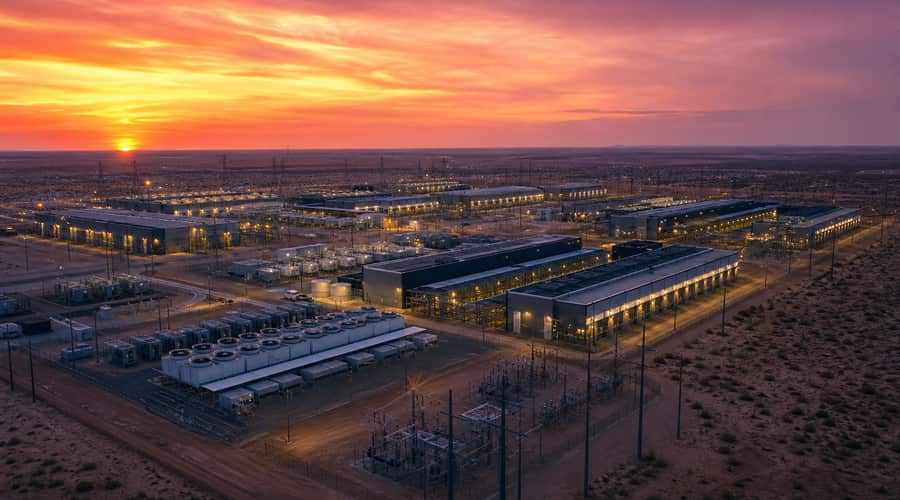
The backstory matters here. When Celsius collapsed in 2022, it left behind creditors, chaos, and a 234-megawatt data center campus in Ward County, Texas, sitting in the West Texas high desert. Ionic took those stranded mining assets, signed a 126-month triple-net lease with Nscale, a global hyperscaler now converting the facility into an AI and high-performance computing data center, and recast the entire operation as digital infrastructure. That pivot took roughly two years. The $400 million private placement, priced at $53.00 per share of Series A convertible preferred stock and anchored by Attestor, Oaktree Capital Management, Sachem Head Capital Management, Citadel, and Weiss Asset Management, closed June 26, three days before the S-1 hit the SEC's EDGAR system.
The numbers are blunt about what this company now is. Bitcoin mining contributed to $152 million in revenue for the twelve months ended March 31, 2026. But that revenue base is not really the story anymore: the Nscale lease, which commits the full 234 MW of the Ward County campus at contracted rates, represents $1.95 billion in total future revenues locked in across a decade-plus agreement. Nscale is converting the site. Ionic is, in practice, a landlord with a very sophisticated tenant and a very long lease.
The choice to go direct rather than through an underwritten IPO is worth examining. In a conventional IPO, bankers price shares, underwrite the offering, and typically impose a lockup on insiders. A direct listing skips all of that: no new shares are issued, existing stockholders sell what they have, and the market sets the price in real time. Ionic registered up to 10.8 million shares for sale by existing holders. J.P. Morgan, Jefferies, and BTIG are advising, but as financial advisors, not underwriters in the traditional sense.
Companies choose direct listings when they don't need the capital an IPO raises and when they're confident the market already understands the story well enough to find a fair price on its own. Spotify went direct in 2018. Palantir and Coinbase followed in 2020 and 2021. Ionic's institutional roster from the $400 million raise suggests those investors already priced the equity at a $2 billion pre-money valuation with eyes open. The direct listing, then, is a statement: we don't need an underwriter to tell the market what we're worth, and we're not going to dilute existing shareholders to find out.
That confidence is notable given Ionic's lineage. Celsius creditors explored liquidating the company as recently as 2025 while it faced delays in its public listing timeline. Getting from "creditors weighing a liquidation" to "Nasdaq direct listing at $2 billion" in under two years, with Oaktree and Citadel on the cap table, is a meaningful signal about how the market has revalued crypto-native power infrastructure in the context of AI's voracious appetite for electricity and data center capacity.
Frankly, that revaluation is the real story here. West Texas power assets that were stranded inside a bankrupt Bitcoin miner are now the foundation of a hyperscaler's AI build-out. The underlying commodity, cheap dispatchable electricity in a low-cost grid region, didn't change. The demand signal did. Every major hyperscaler is racing to lock in power capacity for AI training and inference workloads, and Nscale's 126-month commitment to the Ward County campus reflects exactly that pressure. Ionic didn't reinvent its assets so much as stay put while the world reclassified what those assets were worth.
Whether the $2 billion valuation holds up once IOND actually trades is a different question. The company still generates meaningful Bitcoin mining revenue, which carries volatility and regulatory exposure that pure infrastructure plays don't. Nscale, while described as a global hyperscaler, is a newer entrant compared to the cloud giants, and the lease's value depends entirely on Nscale completing its conversion and operating at scale for a decade-plus. Investors buying in on the secondary market won't have the benefit of the Series A pricing anchor or the institutional conviction that came with it.
What they will have is a company with contracted revenues of nearly $2 billion, a campus already under conversion by a committed tenant, and a redemption arc that runs from Celsius's implosion straight to the Nasdaq Global Select Market. That's a story institutional investors in 2026 appear willing to pay for.
Also read: A 20-year-old high school dropout just raised $31 million to stop AI data centers from poisoning themselves • Google makes personalized AI image generation free and the pressure on image startups just got real • Hugging Face's CEO says being labeled too dangerous is the best enterprise marketing an AI lab can get