
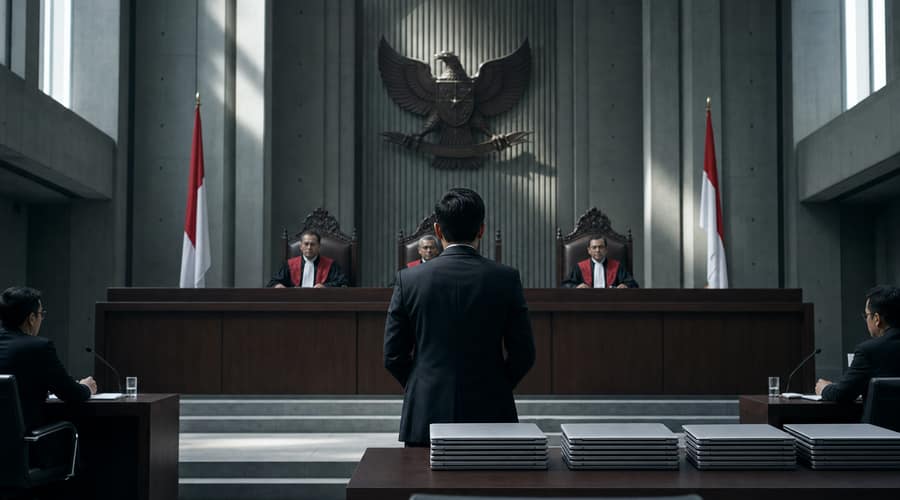
A Jakarta court found former education minister and Gojek co-founder Nadiem Makarim guilty of corruption on June 30, 2026, sentencing him to a decade in prison over a pandemic-era school laptop program that prosecutors say cost the state at least 2.1 trillion rupiah.
The verdict landed on the last day of June, and it hit hard. Nadiem Makarim, the Harvard-educated tech entrepreneur who built Gojek into one of Southeast Asia's most valuable startups before Joko Widodo tapped him as education minister in 2019, was found guilty of abuse of power and corruption in connection with a government program to supply Chromebooks to Indonesian schoolchildren. The sentence: 10 years in prison, plus fines totaling IDR 810 billion. Visibly emotional in court, he said he plans to appeal.
The procurement program itself ran from 2019 to 2023, eventually covering IDR 9.9 trillion worth of Google Chromebook laptops purchased for the Ministry of Education. Prosecutors had pushed for 18 years, arguing that Makarim caused state losses of 2.1 trillion rupiah by steering the program in ways that inflated costs and excluded viable alternatives. The numbers cited at trial were striking: according to prosecutors, lower-specification Chromebooks that should have cost around 3 million rupiah per unit were procured at approximately 6 million rupiah each, effectively doubling the price the government paid.
The Google dimension of this case is what makes it unusual. Prosecutors argued that Google's investment in Gojek's parent company GoTo was relevant context for why Chromebooks, and not competing Windows or other devices, were chosen at scale for Indonesian classrooms. Makarim's defense countered that he had already divested from Gojek before taking office and was only present for five of the Chromebook-related meetings during his tenure. He called the prosecution's theory an "illusion" of legal reasoning. The court was not persuaded.
Earlier in the case, tech consultant Ibrahim Arief was sentenced to four years in prison and fined IDR 500 million after being convicted on related abuse-of-authority charges, as reported by The Jakarta Post in May 2026. That conviction made the outcome for Makarim, who held direct ministerial authority, harder to escape.
Makarim's trajectory before this verdict was the kind of story that gets told at business schools. He co-founded Gojek in 2010 as a motorcycle taxi booking service, and the company eventually merged with Tokopedia to form GoTo Group, which listed on the Indonesia Stock Exchange in 2022. When Jokowi picked him for the cabinet at age 35, it was framed as a bet on a new generation of technocratic leadership. He was one of the youngest ministers in Indonesian history.
That biography now sits at the center of a corruption trial where the prosecution's central argument is that the line between his public role and his private corporate interests never fully disappeared. Don't mistake the defense's framing for an implausible one: the question of whether a founder who divests retains meaningful influence over a company's commercial relationships is genuinely complicated, and it will be tested again on appeal. But the judges today found the evidence sufficient to convict.
For Indonesia's anti-corruption establishment, the case is a signal. Prabowo Subianto's administration has positioned itself as serious about graft, and convicting a cabinet minister from the previous government's tech-optimist wing sends a message that visibility does not confer immunity. Whether the appeal changes the outcome is another matter.
What the case makes undeniable is that procurement at the scale of nearly 10 trillion rupiah, conducted inside a ministry under emergency conditions during COVID-19, created the kind of opacity that corruption requires. Remote schooling was a genuine policy emergency in 2020 and 2021, and Indonesia's archipelago geography made the laptop distribution program a genuine logistical challenge. But speed and scale also meant fewer checks, and fewer checks meant room for the price per unit to quietly double.
Google, whose Chromebooks were at the center of the procurement, has not been named as a defendant in the case. The company's investment in GoTo is a matter of public record, but the Indonesian proceedings have so far focused on the ministry side of the ledger, not the tech company's conduct. That asymmetry will likely draw scrutiny as the appeal proceeds, especially given the specificity with which prosecutors traced the corporate relationship.
Makarim's legal team now has the appeal window. Given the gap between the prosecution's demand of 18 years and the court's 10-year sentence, there is at least an argument that the judges drew their own distinctions within the guilty finding. Whether an appeals court narrows the conviction further or upholds it will define the final chapter of a case that has already reshaped how Indonesia thinks about the boundary between Silicon Valley-style entrepreneurship and public office.
Also read: Ferrari and BMW are ditching copper wiring, and the implications run well beyond the factory floor • Meta secretly sent fake teen accounts to flood rivals' chatbots with thousands of crisis prompts • South Korea is treating nuclear construction speed as an AI infrastructure problem and it's right