
"They get better at email writing generally; they never get better at sounding like you specifically." That distinction - the gap between a tool that writes well and one that writes like you - is what Curtis Boortz built ForthWrite around.
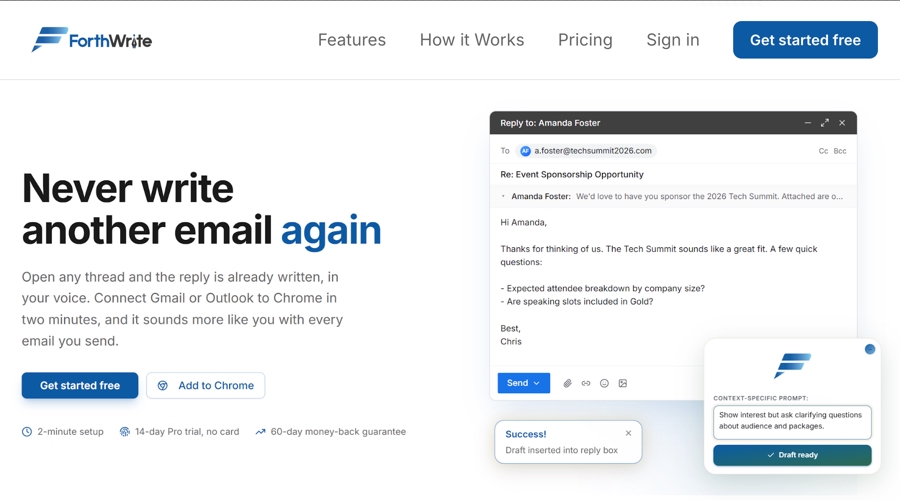
ForthWrite is a Chrome extension that lives inside Gmail. When you set it up, it reads your sent mail history and builds a personal voice model from your actual writing patterns - not a style questionnaire, not a one-time prompt, but the emails you have already sent. From that point forward, every new incoming email has a draft waiting before you open the thread. Boortz sat down with StartupFortune to talk through the product decision behind training on real edits, where ForthWrite sits in a crowded market, and what the extension does differently at the workflow level.
On the idea behind training on sent mail
StartupFortune: ForthWrite trains on your sent mail history rather than a style preset or a prompt. Walk us through why that decision matters.
Curtis Boortz: Most tools ask you to describe how you write, or they give you a one-time style configuration. The problem is that a description of how you write is never as accurate as the emails you have actually sent. Your sent folder already contains hundreds or thousands of examples - how you phrase things, how you open and close messages, your natural sentence length, your level of formality with different kinds of people. ForthWrite reads all of that on setup and builds the model from real data instead of self-reported preferences. The result is a voice model that reflects how you actually communicate, not how you think you communicate.
SF: And that fit improves over time without re-teaching the model?
CB: That is one of the key differences from tools like ChatGPT, which require you to leave your inbox and re-establish context every session. The voice model ForthWrite builds does not need to be re-taught. Within a few weeks, most users find they are editing very little because the model has matched how they write. The distinction matters: it is getting better at sounding like you specifically - not better at writing email in general, which is what the general-purpose tools optimize for.
How ForthWrite fits against native inbox assistants
SF: Native assistants like Copilot and Gemini are now built into a lot of inboxes. How does ForthWrite sit alongside those?
CB: Native assistants compose from scratch, and they do it well. But they do not build a personal voice model over time. They are designed and priced around general email writing capability - they improve at the task of writing email, not at the task of writing your email. ForthWrite is built around a different goal entirely, which is why the training approach has to be different too. An AI email writer that learns your voice has to be trained on your voice - there is no shortcut through a prompt or a preset that gets you there.
SF: The distinction between "better at email" and "better at sounding like you" - can you give that a little more texture?
CB: General-purpose tools get better at email writing as a skill. They learn what a well-structured professional message looks like in the abstract. ForthWrite trains on your specific output, so the model is learning your habits, your rhythm, your particular way of handling a request or a follow-up. Those are two different things, and neither ChatGPT nor the native assistants are built or priced to solve the second one.
On the day-to-day workflow
SF: What does using ForthWrite actually look like inside Gmail?
CB: The extension installs in Gmail, and from setup onward every new incoming email has a draft ready before you open the thread. You are not composing from scratch - you are reviewing and editing something that already sounds like you. If you want to clear a full inbox at once, one click drafts every open thread simultaneously. A full inbox can be cleared in under a minute. The goal is to close the gap between receiving an email and sending a reply without flattening your voice into something generic in the process.
ForthWrite's Show HN launch drew attention precisely because the training approach is a genuine product decision, not a marketing angle. Most AI writing tools sidestep the voice problem by asking users to describe themselves or configure a tone setting. Boortz chose the harder path: read what the user has actually written, build from that, and let the model prove itself through reduced editing over time. The bet is that the people who care most about how their email sounds are also the people who will notice, and appreciate, when a tool finally gets it right.