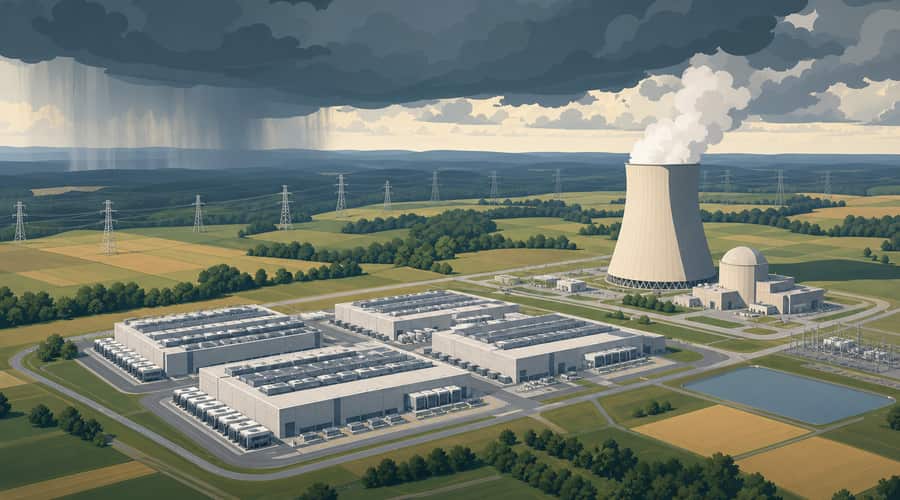
PJM's data center problem has moved from planning decks into power bills, and the operators with firm generation now have the advantage everyone else wants.
PJM Interconnection is no longer treating AI data centers as just another big customer waiting at the end of the wire. The grid operator, which serves about 65 million people across parts of 13 states and Washington, D.C., is under pressure to decide who gets power when demand rises faster than supply. If you're building AI infrastructure in Virginia, Pennsylvania, Ohio, or Maryland, that question now sits right beside land, fiber, tax credits, and water.
The numbers explain why the fight has hardened. Barron's reported that PJM's 2026/2027 capacity auction cleared at $329.17 per megawatt-day, up from $269.92 for the prior auction and $28.92 the year before that. A later auction for 2027/2028 reached $333.44 per megawatt-day, the highest allowable price. Capacity payments are not a theory. They are the cost of keeping power plants available for days when the grid is under stress, and those costs eventually move through the system toward consumers.
Monitoring Analytics, PJM's independent market monitor, has been blunt about the cause. In a May report highlighted by Tom's Hardware, the watchdog said wholesale electricity prices in the region rose from $77.78 per megawatt-hour in the first quarter of 2025 to $136.53 in the first quarter of 2026, a 75.5% increase. It tied much of that pressure to data center load and warned that the price impact on customers was already large. That's the part tech companies can't smooth over with clean-energy language. Somebody pays for power when the grid is tight.
Power now comes with conditions
The curtailment question is the real change. In a complaint filed with FERC in November 2025, Monitoring Analytics said PJM was proposing to add large data center loads that could not be served reliably at all times, which would require curtailments of data centers or other customers during stressed periods. Business Insider reported that the monitor wanted FERC to clarify that PJM can require large loads to prove they can be served reliably before they are added to the system.
That is a hard message, and it should be. A data center is not a normal office building with a bigger electric bill. Some AI campuses want hundreds of megawatts, and a single large project can look less like a customer than a new industrial town. You don't get to plug that into a strained grid and pretend the consequences stop at the property line.
The political pressure is just as real. The Washington Post reported in January that the White House and several governors pushed a plan that would make tech companies fund their own power generation or agree to go offline when the grid is under stress. Pennsylvania Gov. Josh Shapiro said the arrangement could save consumers $27 billion over several years. The exact rules still have to move through regulators and PJM's stakeholder machinery, but the direction is plain: data centers that bring no new supply will face a harder road.
Frankly, the strongest operators saw this coming before the policy caught up. Talen Energy's deal with Amazon Web Services is built around the Susquehanna nuclear plant in Pennsylvania, a 2.5-gigawatt facility near Berwick. Talen sold its adjacent data center campus to AWS in 2024, and Utility Dive reported in 2025 that the power agreement could scale as high as 1,920 megawatts from Susquehanna by the early 2030s, with an expected value around $18 billion.
Constellation Energy and Microsoft took a different route at Three Mile Island. Politico reported in September 2024 that Constellation signed a 20-year power deal with Microsoft tied to restarting Unit 1, the undamaged reactor that shut in 2019. The restart is not complete, and the earlier draft was wrong to say it came back online in late 2024. Constellation has said the plant, renamed the Crane Clean Energy Center, is expected to return later this decade if regulators approve the work. That distinction matters. A promised nuclear restart is valuable, but it isn't the same as power flowing today.
The bill is leaving the server farm
This is where the AI boom runs into an old utility problem. The benefits of a new training cluster sit with the technology company that owns the compute. The costs of transmission upgrades, capacity shortfalls, and emergency planning can spread across households and small businesses that didn't ask for a 500-megawatt neighbor. You can support AI and still reject that accounting.
PJM's service territory includes Northern Virginia, the densest data center market in the country, so this fight won't stay local. If PJM forces large loads to bring generation, accept curtailment, or pay more directly for upgrades, other grid operators will study the result. Texas is already tightening its own large-load process through ERCOT. The pattern is not subtle.
For startups, cloud buyers, and infrastructure investors, the useful lesson is simple: power certainty is now part of the product. A cheap site without firm electricity is not cheap. A cloud region that can be curtailed during a heat emergency is not just an engineering risk, it's a business risk for every customer depending on it. The AI stack used to begin with chips. In PJM territory, it now begins at the power plant.
Also read: Tesla rolls its controlless Cybercab onto Austin streets and the robotaxi race just got real • Etched bets $800 million that transformer silicon will outlast the GPU era • Bending Spoons prices its Nasdaq IPO above range as Wall Street bets on AI-powered software roll-ups