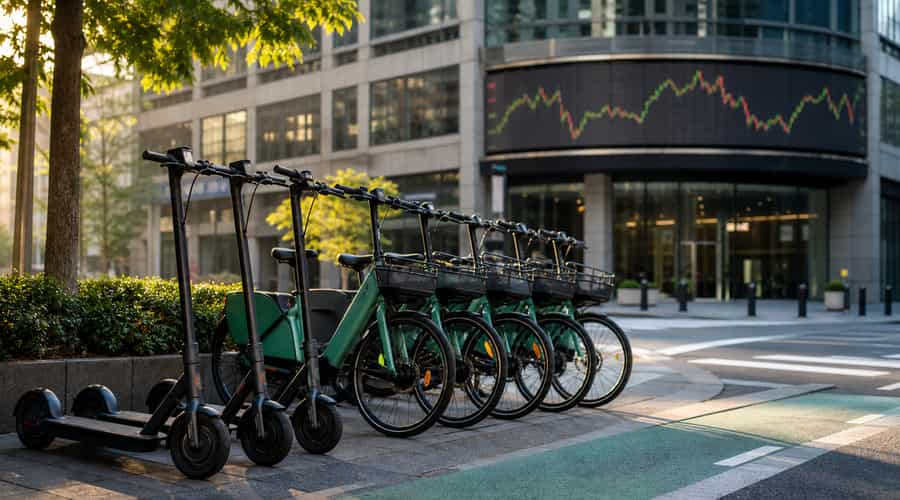
Lime hit the top of its $24 to $26 pricing range on Tuesday night, raising $182 million and valuing the e-scooter and e-bike company at roughly $1.8 billion as it prepares to trade on Nasdaq under ticker LIME on July 1, 2026.
The deal got done. That's not nothing. Micromobility has spent the better part of three years trading on its reputation as a category that ate investor capital and delivered embarrassing headlines, most memorably Bird's December 2023 Chapter 11 filing and its eventual reorganization as Third Lane Mobility. For Lime to price at the top of range in that environment, with Goldman Sachs and JPMorgan on the cover and Uber anchoring with up to $20 million in stock purchases, is a statement of sorts. Whether it's a statement about Lime specifically or about a reopened IPO window is a harder question.
Here's the thing: the financial profile underneath this offering is not what a growth-story IPO typically looks like. Lime reported $886.7 million in 2025 revenue, up 29% from $686.6 million in 2024, which traces back to $522 million in 2023. That's a real revenue trajectory. But the company has posted a net loss every year since it was founded in January 2017, including a $59.3 million loss in 2025. More pressingly, the company disclosed in its S-1 a $584.8 million liquidity shortfall and roughly $845 million in debt coming due this year. Without the IPO proceeds, the filing stated plainly, the company could go out of business. That's not a standard risk factor. That's the whole story.
So what you're looking at is a company that needed this window to open, and it did. Whether that's a vindication of Lime as a durable business or simply the result of timing a receptive market is the question serious investors should be asking themselves before the first trade prints.
Uber's anchor investment deserves more scrutiny than the favorable framing it's received. The ride-hailing giant already owns more than 10% of Lime, a stake that traces to a $170 million funding round in 2020. It also integrates Lime rentals directly into its app, a distribution relationship that accounts for roughly 14.3% of Lime's total revenue. Uber committing up to $20 million at the IPO price isn't a vote of confidence in the category from an arm's-length investor. It's a strategic check from a company that benefits directly from Lime staying solvent and maintaining that in-app integration.
That's not cynicism, it's just the structure of the relationship. Uber needs last-mile options to keep its super-app ambitions intact. A Lime bankruptcy or distressed sale to a less cooperative buyer would be genuinely disruptive to Uber's product. Buying $20 million worth of IPO shares at a moment when Lime urgently needs the capital is a cheap way to protect a partnership that drives hundreds of millions in bookings. You'd do the same thing. That doesn't mean the investment is wrong, it means you shouldn't read it as independent validation.
What Lime actually is, stripped of the narrative, is the last large operator standing in a category that destroyed billions in capital during its first cycle. Bird went bankrupt. Spin got absorbed into Third Lane Mobility. Lyft sold its scooter and bike business. The consolidation was brutal and it was probably necessary: too many operators chasing the same city contracts with nearly identical hardware and no unit economics to speak of. Lime survived because it had Uber's balance sheet behind it and because it was disciplined enough to pull out of markets where the numbers didn't work. Operating across 230 cities in 29 countries, having crossed one billion total rides, it can credibly claim to be the category's dominant survivor.
Survival isn't the same as a business model, though. Micromobility's structural problem has never been demand. People will rent a scooter. The problem is that the cost of maintaining hardware in public urban environments, absorbing vandalism and weather and regulatory friction across dozens of city contracts simultaneously, compresses margins in ways that are genuinely difficult to escape. Lime's revenue growth is real, but the path from here to consistent profitability requires either meaningfully higher pricing, a dramatic reduction in operating costs, or both. The S-1 doesn't make that case clearly, and at a $1.8 billion valuation on a company with $845 million in near-term debt, the market is being asked to price in a lot of optimism.
What changes the math, potentially, is the regulatory environment. Many of the cities that initially welcomed scooters and then spent years tightening permit restrictions are now treating shared micromobility as infrastructure rather than novelty. That shift matters for Lime's contract stability. If city governments increasingly treat a Lime permit the way they treat a bus franchise rather than a tech pilot program, the revenue base becomes considerably more predictable. That's the actual bull case, and it's more credible in 2026 than it would have been in 2021.
For now, Lime has the capital it needed and a public currency it can use for future deals. Trading begins today. The category gets another chance to prove the math works at scale.
Also read: SaaS Customer Segmentation Is the Lever Most Founders Pull Too Late • Former DeepMind researchers who beat professional poker players raise a $500 million Series A to trade stocks and crypto • Etched bets $800 million that transformer silicon will outlast the GPU era