
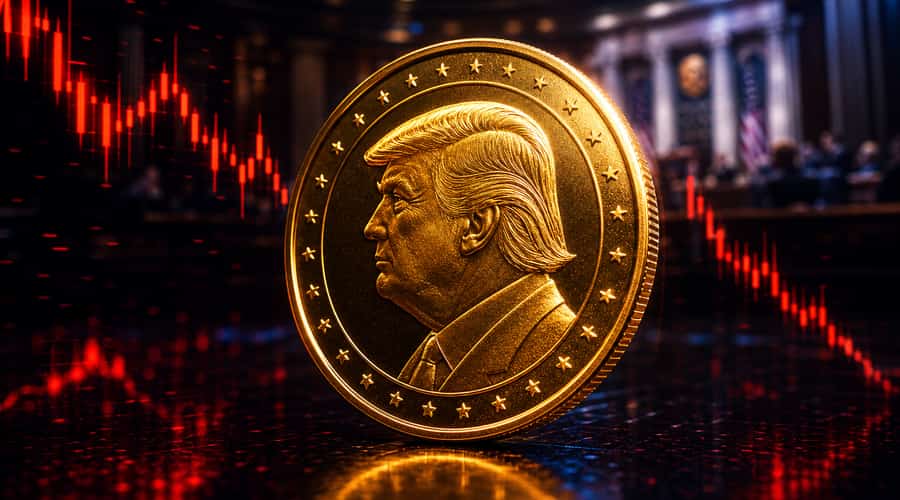
Trump's 927-page financial disclosure did not create the crypto ethics problem. It put a number on it: roughly $1.2 billion in crypto income while public buyers of Trump-linked tokens were left holding the risk.
The numbers are out, and they're worth sitting with. Donald Trump's annual financial disclosure, released by the U.S. Office of Government Ethics on June 30, 2026, shows more than $635 million from a Trump-branded meme coin licensing deal and more than $500 million from World Liberty Financial, the crypto venture tied to Trump and his family. The Associated Press put the total crypto take at about $1.2 billion for 2025. The Wall Street Journal reported the same broad shape: Trump made more than $1 billion from crypto while many buyers of his branded tokens lost money.
That is the part you should not glide past. This was not a president holding Bitcoin in a brokerage account while regulators argued over market structure. It was a sitting president earning hundreds of millions from crypto businesses while his administration pushed a friendlier regulatory line for the same industry.
The $TRUMP coin shows why the outrage has stuck. The token launched on January 17, 2025, three days before Trump's inauguration, on the Solana blockchain. CIC Digital LLC, a Trump-linked company, and Fight Fight Fight LLC, associated with longtime Trump business partner Bill Zanker, controlled about 80% of the one billion tokens created at launch, according to the coin's own distribution structure. Public buyers were entering a market where insider-linked entities held four tokens for every one released to the public.
That is not a normal political souvenir. It is a financial product wrapped in campaign imagery, complete with a supply schedule and trading fees. The coin's logo used the photograph-like image of Trump raising his fist after the July 2024 assassination attempt. The website called it the official Trump meme, while also saying the token was not an investment opportunity or a security. Frankly, that disclaimer does a lot of work.
Earlier reporting had already shown how the trade worked for small buyers. A New York Times forensic analysis found that 813,294 wallets lost $2 billion trading the coin, while Trump's company and partners made about $100 million in trading fees. Reuters reported in February 2025 that the project had generated nearly $100 million in fees as small traders lost money. The new disclosure adds the presidential income line that was missing from those earlier blockchain snapshots.
The World Liberty Financial numbers are just as important, because they move this from meme coin speculation into foreign influence and policy. The New York Post reported that Trump's 2025 disclosure included $236 million from WLFI token sales, $205 million from stablecoin-related investments and $65.6 million from a World Liberty equity sale. The Wall Street Journal has reported that a group led by Emirati royal Sheikh Tahnoon bin Zayed al Nahyan made a covert $500 million investment in World Liberty, with at least $187 million going to Trump family entities.
You do not need to invent a conspiracy to see the problem. Five Senate Democrats, including Elizabeth Warren and Ron Wyden, called for hearings in late June over that UAE-linked investment. Their concern was not abstract. Months after the deal, the Trump administration approved expanded access to advanced AI chips for the UAE, according to the Journal's reporting on the senators' demand. The White House has denied any conflict and says Trump is not involved in decisions tied to his financial interests. That answer may satisfy allies. It should not satisfy anyone reading the filing.
The legislative timing makes the disclosure sharper. The GENIUS Act, signed by Trump on July 18, 2025, created the first major U.S. framework for payment stablecoins. It did not solve the memecoin problem. Now the CLARITY Act, the broader crypto market structure bill, is still moving through Congress, and Democrats have a very simple number to bring into the room: more than $635 million from a Trump-branded meme coin while the president's administration chooses how aggressively crypto gets regulated.
Presidents are exempt from some federal conflict-of-interest laws, but that exemption was never meant to make every arrangement politically acceptable. A family-managed trust does not change who benefits when a token sale, stablecoin venture or licensing deal throws off income. It only changes the paperwork around the benefit.
There is a useful lesson here for anyone who still talks about meme coins as if they are harmless internet culture. When insiders hold most of the supply, public buyers provide the liquidity, and the most powerful elected official in the country is attached to the brand, the joke is over. The June 30 filing gave Congress 927 pages of material. The hard question now is whether lawmakers use it, or whether crypto ethics gets treated as just another partisan fight until the next disclosure lands.
Also read: The CLARITY Act's ethics fight is the only thing standing between crypto and a legal foundation • Nearly 1,700 UK investors are suing Binance and CZ for £150 million over unauthorized derivatives sold to retail customers • Stripe, Visa, and 140 partners launch Open USD to take reserve profits away from Circle and Tether