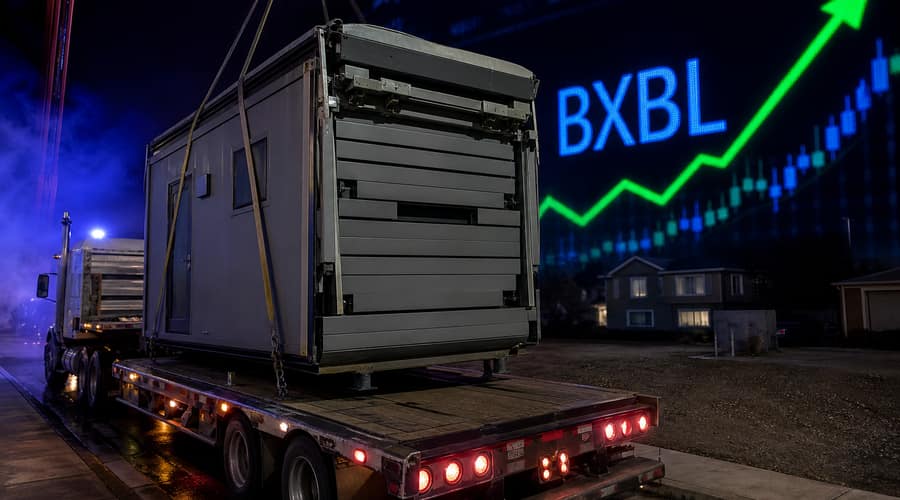
Boxabl's Nasdaq debut gave its crowdfunding investors a public price at last. The harder question is whether a company valued near $3.5 billion can turn a clever folded studio into a business that actually ships homes.
Boxabl started trading on Nasdaq under the ticker BXBL on Monday, July 20, after completing its merger with FG Merger II Corp. The stock jumped 20 percent in its first session, Investing.com reported. If you were one of the more than 50,000 people who bought into Boxabl through crowdfunding rounds, this was the first clean public price you'd seen after years of waiting.
That price matters. It's not a factory tour, a reservation list, or a pitch deck. It's a market number attached to a company that has spent years selling investors on a simple idea: build small homes in a factory, fold them for ordinary truck transport, and unfold them on site fast enough to make the old housing process look absurd.
The listing came through a business combination with FG Merger II Corp., a blank-check company that renamed itself BOXABL Inc. when the deal closed, according to the company's July 17 PRNewswire release. FGMC shareholders approved the merger at a special meeting on June 9. Under the deal terms, FGMC issued 350 million shares to Boxabl stockholders at a deemed value of $10 a share, putting the transaction valuation at about $3.5 billion.
That's the number you have to sit with. Boxabl says it has raised more than $230 million from over 50,000 investors. Much of that money came through Regulation A crowdfunding campaigns on Republic and StartEngine, where small investors could buy into the company long before Nasdaq gave it a ticker. Some put in modest checks. Some put in more. Either way, Monday changed the bet from private optimism to public pricing.
The Casita Still Has to Prove It Can Scale
The company's core product is the Casita, a 361-square-foot factory-built studio with a kitchen, bathroom, electrical, plumbing and HVAC. Boxabl says the unit is designed to unfold on site in under an hour. It's a clean pitch, and you can see why it traveled. The United States has a housing shortage, construction is slow, and a room that folds flat enough for standard transport sounds like the kind of manufacturing answer housing has been waiting for.
It's still only a pitch until the units move.
Boxabl's own filings show why the Nasdaq pop doesn't settle the story. In its 2025 annual report, the company said it had manufactured 795 Casitas and completed deliveries of 312 Casitas in 10 states as of March 27, 2026. It produced 73 Casitas in 2025, down from 140 in 2024. It also wrote down inventory, including 68 units management determined were obsolete. That's not a footnote. It's the tension inside the whole company.
The financials are just as blunt. Boxabl reported $1.5 million in revenue for 2025, down from $3.4 million in 2024, and a net loss of $57.5 million. Its annual report said substantial doubt about the company's ability to continue as a going concern was probable, citing slower sales tied to delays in statewide modular approvals and customer readiness. Those are dry accounting words, but they're doing real work here. They tell you the company's public valuation is running far ahead of its operating record.
Paolo Tiramani and Galiano Tiramani, the father-and-son founders, are real operators with real technical history behind the product. Boxabl's SEC filings identify Paolo as an industrial designer and mechanical engineer with more than 150 patent filings, and Galiano as an entrepreneur who previously founded a cryptocurrency exchange and ATM network. That background helps explain why the company has attracted attention. It doesn't answer the delivery problem.
A Regulatory Win Helps, but It Doesn't Build the House
There is one practical development Boxabl can point to. In a February SEC-filed announcement, the company said California's Department of Housing and Community Development reduced inspections for its Casita Studio product line to 25 percent of units, down from full inspection under the prior arrangement. For a company trying to sell factory-built homes into a state with severe housing pressure, that matters more than another viral video.
Still, don't confuse approval friction with the whole problem. Boxabl's filings describe state-by-state modular approvals, customer readiness issues, installer networks, deposits, deferred revenue, and production adjustments. This is what housing startups run into when the product leaves the showroom and meets permitting, land, utilities, transport, installers and actual customers. The Casita can unfold quickly. The business around it can't.
For Boxabl's crowdfunding investors, Nasdaq is a milestone, not a rescue. A public listing gives them liquidity, price discovery and quarterly filings that everyone can read at the same time. It also removes some of the fog that private crowdfunding can create when a company's story is easier to market than to measure.
Frankly, that's healthy. If Boxabl can turn a 400,000-square-foot factory footprint in North Las Vegas into repeatable deliveries, the market will have something real to value. If it can't, the first-day pop will look like what first-day pops often are: demand for the story before proof of the machine.
For now, BXBL gives investors a ticker. The next test is duller and much more important. How many Casitas ship, how much cash leaves the business, and whether public-company scrutiny makes Boxabl sharper or simply more exposed.
Also read: How to Price a SaaS Product With No Competitors to Copy, How to Value a Pre-Revenue Startup When There Is No Revenue, and Jeff Bezos and the UK Government Just Bet $450 Million on CuspAI