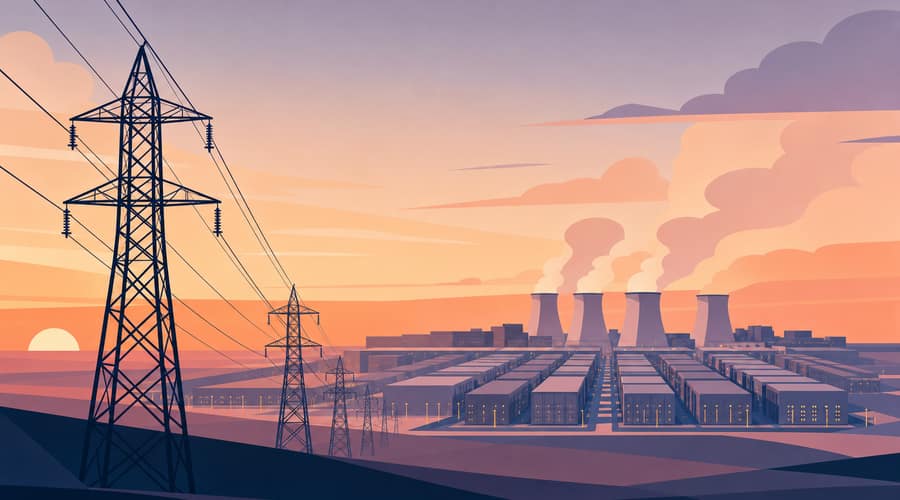
Google just admitted its own AI buildout is now outrunning the clean power meant to run it.
Google's newest environmental report, published June 30, 2026, shows the company's electricity demand climbed 37% in 2025, the steepest single-year jump in its history. That's up from a 27% increase in 2024, and it means Google's total electricity draw has grown roughly 3.5 times over since 2019, according to the company's own figures. You don't have to run a data center to feel the downstream effect of that curve. It shows up in your electricity bill if you live near one of the grids Google draws from.
The report doesn't dress this up. Google wrote plainly that its AI infrastructure buildout is "currently accelerating faster than the grid is decarbonizing," a line first flagged by Data Center Knowledge. That's not a hedge. It's an admission that the company building some of the world's largest data centers can't keep its own power supply as clean as its growth is fast.
The emissions numbers back that up. Google's total greenhouse gas emissions rose 18% in 2025, the largest annual increase the company has ever reported, driven largely by the manufacturing of AI chips and servers rather than by running the data centers themselves, Axios reported on June 30. That's a supply chain problem as much as an operations one. Google can control what powers its data halls far more easily than it can control the carbon footprint of the factories fabricating its TPUs.
To its credit, Google isn't standing still on power procurement. The company signed agreements for more than 12 gigawatts of new clean energy in 2025, more than its previous two years of procurement combined, and the largest annual total in its history. But the climate math didn't move much. Electricity related emissions fell just 3% from 2024, compared with a 12% decline the year before. Google is buying clean power faster than ever and still losing ground on the pace of improvement. That's the decoupling claim under real strain.
Google also leaned on a genuinely striking efficiency number: the median Gemini Apps text prompt now uses 33 times less energy and produces a 44 fold smaller carbon footprint than it did twelve months earlier, the result of hardware, software, and model improvements working together. That's real engineering progress, and it's the kind of specific, checkable claim worth taking seriously. But it measures cost per query, not total consumption. When the number of queries, models, and data centers is scaling as fast as Google's own report shows, a leaner engine bolted onto a much bigger fleet still burns more fuel overall.
The grid is where this actually lands
Google isn't building in a vacuum. The PJM grid serving the Mid Atlantic recorded its highest energy demand in 14 years during 2025 and issued a growing run of Level 1 emergency alerts, the kind of warning that precedes talk of rolling blackouts, a dynamic StartupFortune has covered as PJM began curtailing data center load during peak demand. PJM answered with 51 new generation projects announced in May, adding 9,300 megawatts, split roughly between natural gas and nuclear. Talen Energy's restructured deal with Amazon Web Services, finalized in June 2025 and worth $18 billion over 17 years, will route up to 1,920 megawatts directly from the Susquehanna nuclear plant to a single company's servers. That's the AI boom's actual price tag, paid in gigawatts and reactor capacity rather than dollars.
Frankly, the pattern here isn't unique to Google. It's the shape of the entire industry's growth curve, and Google is simply the company transparent enough to publish the numbers that prove it. Microsoft and Amazon are running the same race with less public disclosure. The next environmental report is due in 2026's successor cycle, right as this new wave of gas and nuclear capacity is supposed to start coming online. Whether that supply actually arrives on schedule, not whether the marketing language around it holds up, will decide if decoupling AI growth from emissions is real or just deferred.
Also read: A Former Goldman Analyst's New AI Startup Just Raised $22 Million • Bhavin Turakhia is spending $30 million of his own money to rebuild Office from scratch • Switch chases a $19 billion valuation as private money floods into AI data centers