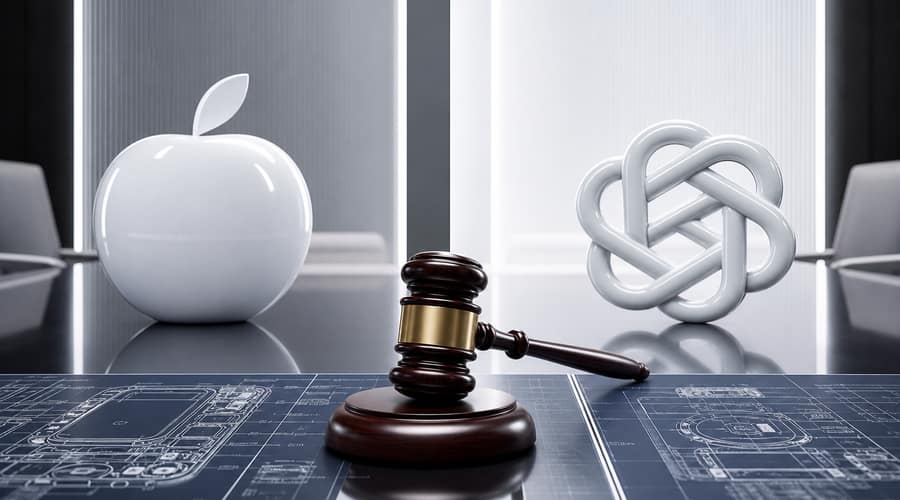
Apple is accusing OpenAI of raiding its hardware playbook, alleging a scheme that reached all the way to OpenAI's chief hardware officer.
Apple filed suit against OpenAI on Friday in the U.S. District Court for the Northern District of California, and the complaint reads less like a corporate dispute and more like an inside job. According to CNBC, Apple accuses OpenAI of stealing trade secrets "at every level, from members of its Technical Staff to its Chief Hardware Officer." That officer is Tang Yew Tan, an Apple veteran who spent years as vice president of product design for the iPhone and Apple Watch before joining OpenAI to help build its consumer hardware.
The lawsuit names OpenAI Foundation, OpenAI Group PBC, and io Products, the hardware venture OpenAI built around its $6.4 billion acquisition of Jony Ive's startup. Ive himself is not named as a defendant, and Apple does not accuse him of wrongdoing. The people it does blame are Tan and Chang Liu, a former senior systems electrical engineer who spent eight years at Apple.
The specifics are the part that sting. Apple alleges Tan directed job candidates who were still working at Apple to bring "actual parts" to their OpenAI interviews for what the filing calls "show and tell" sessions, according to CNBC's reporting on the complaint. In one instance, Apple claims OpenAI showed a business partner a trade secret metal finishing technique, leading the partner to believe Apple had signed off on the disclosure. It hadn't.
Liu's alleged conduct is more straightforward, and more damning if proven. Apple says he kept an Apple issued laptop after leaving the company in 2026, found a way to access Apple's cloud storage, and downloaded dozens of confidential technical documents, many stamped confidential, according to NBC News. You don't need a law degree to see why that detail matters more than the others. Interview small talk is one thing. A former employee quietly pulling files off a company's servers after he's gone is another.
This isn't a total surprise. TechCrunch reported back in May that OpenAI was itself preparing legal action against Apple, part of a running dispute over how Apple's App Store treats ChatGPT relative to Apple's own AI features. Friday's filing flips the script, with Apple striking first and on different ground entirely, not antitrust, but trade secrets.
Apple is asking the court for an injunction barring OpenAI from possessing, using, or disclosing its technology, plus damages to be determined at trial. "Recently, significant evidence has emerged suggesting individuals employed by OpenAI wrongfully took Apple's secret and confidential information regarding our unreleased technologies, processes, and products," an Apple spokesperson told CNBC.
OpenAI hasn't filed a public response to the specific allegations as of this writing.
For founders watching from outside, the lawsuit is a pointed reminder of what happens when a company hires aggressively from a rival with a reputation for secrecy. Apple has spent decades building a culture around confidentiality: compartmentalized teams, need to know access, laptops that get wiped the day someone leaves. OpenAI hired Apple's own former hardware chief to help it compete in the exact category Apple has guarded longest. That's not an accident of talent acquisition. It's a direct challenge, and Apple is treating it as one.
The bigger story here is what it says about where the AI race is actually headed. OpenAI isn't just building models anymore. It's building a physical device meant to sit in your pocket or on your desk, the kind of product Apple has defined its entire business around. When two companies start fighting over metal finishing techniques and unreleased component specs, you know the AI hardware category has stopped being speculative and started being real money.
Whatever the court decides, the case will likely surface more about OpenAI's device roadmap than either company wanted public. Discovery has a way of doing that.
Also read: Mike Novogratz Turned a Distressed Bitcoin Mine Into an AI Power Giant • US grants the UAE license free access to advanced AI chips after reclassifying its export status • Morgan Stanley Warns Chip Stocks Look Overbought Just as SK Hynix Debuts