Proxima Fusion just raised 411 million euros and became a unicorn, and Google's name on the term sheet tells you exactly why fusion suddenly matters to Silicon Valley.
The Munich company announced on July 7 that it closed a 411 million euro, or 468 million dollar, financing round at a 2.4 billion euro valuation, according to Proxima Fusion. That makes it the largest fusion specific funding round in European history and one of the biggest European tech raises of the year. XTX Ventures and East X Ventures led the round. Google and the German utility RWE came in as strategic investors, alongside KfW Capital and the government backed deep tech fund SPRIND. Returning backers Plural, Balderton, Lightspeed and DST Global all wrote checks again, joined by newer names including Cherry Ventures and Burda Principal Investments.
Proxima has now raised more than 650 million euros in under three years. That's a lot of money for a company still trying to prove the machine works.
The backers matter here. Google doesn't take strategic stakes in speculative energy science projects out of goodwill. It takes them because its data centers are running short on power, and fusion, however distant, is one of the few technologies that could eventually supply carbon free electricity at the scale an AI company actually needs. Microsoft signed a power purchase agreement with Helion Energy in 2023. Google's move into Proxima is the same instinct, aimed at a different reactor design entirely.
The bet is on a stellarator
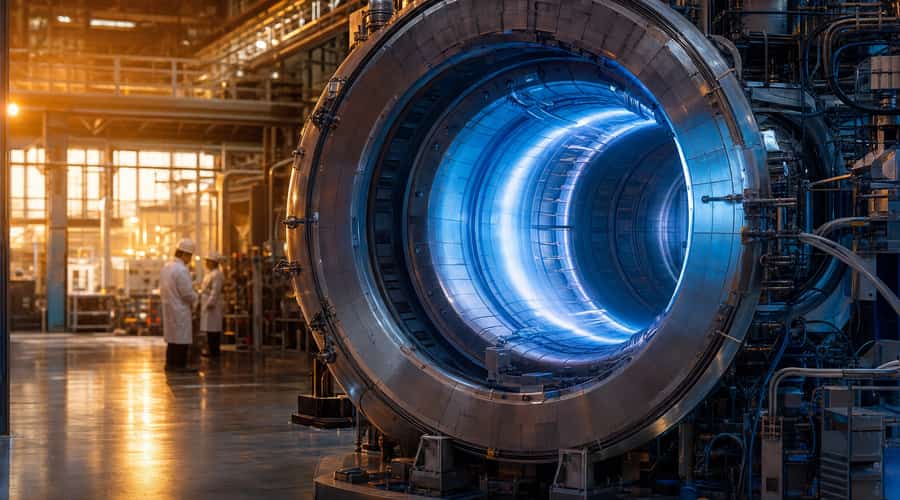
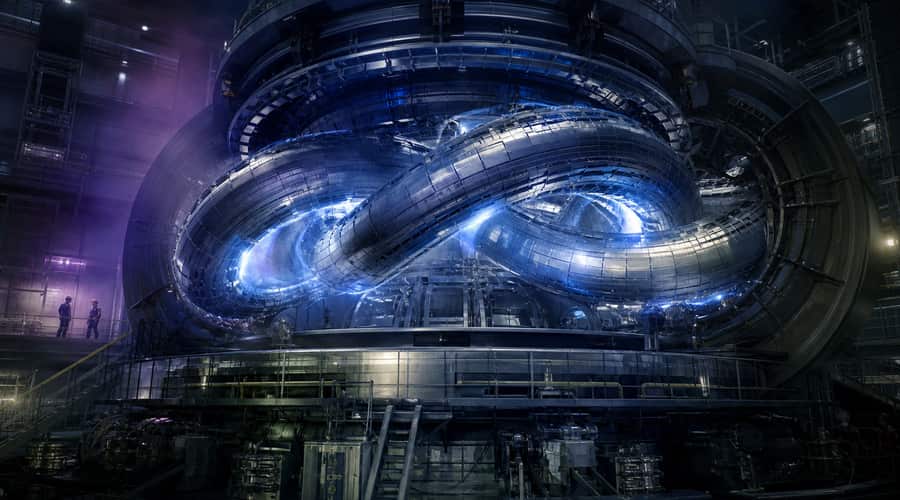
Proxima is building Alpha, a stellarator style fusion reactor near Munich, with support from the Max Planck Institute for Plasma Physics, the state of Bavaria and RWE. This isn't the donut shaped tokamak that dominates most fusion headlines. A stellarator twists its magnetic coils into a more complex geometry, keeping plasma stable without needing a large internal current running through it. Proxima is the first spinout from Max Planck's Wendelstein 7-X program, which has spent two decades proving the approach can hold plasma steady for longer stretches than a typical tokamak.
Alpha is targeting net energy in the early 2030s. That means the reaction would produce more energy than the machine takes to run, which is the line every fusion company has to cross before the talk about power plants becomes serious. If Alpha works, the data feeds into Stellaris, the commercial power plant concept Proxima unveiled with its partners as a design for continuous fusion power generation. RWE has already agreed to work with Proxima on a first commercial plant at the former nuclear site in Gundremmingen, Bavaria, where grid connections and industrial land are still valuable even after fission has gone.
None of this produces a single watt yet. Fusion has a long history of ten year promises that quietly become twenty year promises. But the money moving into it has changed character. This isn't only government lab funding anymore. It is venture capital and corporate capital, the kind that expects a return, betting the physics finally works on a schedule investors can underwrite.
The capital now looks industrial
American fusion startups have still raised more total capital than European ones, led by Commonwealth Fusion Systems and its roughly 2 billion dollar war chest. But Proxima's raise says Europe isn't sitting this race out. Frankly, a 2.4 billion euro valuation for a company that hasn't built a working reactor yet says more about capital appetite than proven technology. That's fine. Deep tech bets are supposed to carry that kind of risk.
The mix of backers is the real story. SPRIND and KfW Capital are German state vehicles, meaning Berlin is putting public money next to Google's. RWE is a utility protecting its own grid, not a passive financial investor. The Wall Street Journal recently reported that Germany has pledged more than 2 billion dollars in fusion funding by 2029, with Bavaria also committing up to 400 million euros to Proxima if federal money comes through. You don't see that structure in an ordinary software round. You see it when a country wants factories, suppliers, magnets, engineers and a power plant at the end of the chain.
That is why Proxima matters beyond the valuation. AI companies need electricity. Germany needs an industrial story that isn't just about losing cheap Russian gas and watching factories get nervous. RWE needs future generation assets that can use sites and grid links it already knows. Proxima sits in the middle of all three problems, which is exactly why the round attracted Google, a German utility and state backed capital at the same table.
The test isn't the funding round. It's 2031, when Alpha is supposed to demonstrate net energy. Every fusion company eventually meets that test. Most of the ones that came before Proxima are still waiting on it.
Also read: Klarna Wants Its Own Bank, and Regulators Now Have to Decide • Valarian raises $50 million to help Europe escape America's cloud grip • Helsing is closing in on an $18 billion valuation as Europe's defense tech boom accelerates